
Extract from Marriage and Modernity, Family Values in Colonial Bengal (Rochona Majumdar) indicating that the anchal was eventually draped on the left for the Brahmika saree.
Extract from Marriage and Modernity, Family Values in Colonial Bengal (Rochona Majumdar) indicating that the anchal was eventually draped on the left for the Brahmika saree.

This gallery contains 4 photos.
The blouses in the 40s – apart from the ubiquitous choli – reflect wartime fashions in the West and have touches like scalloped neck lines, trims, collars and the like. Though most omit the strong shoulders. Nargis – whose … Continue reading

Tamara Karsavina, one of Diaghilev’s ballerinas, in the part of Nirilya/Nerilya in The Talisman.
The sari doesn’t appear to have pleats and Karsavina has a body stocking underneath. And although the blouse is loose and prettily edged, its the lovely print of the saree that I really liked here. There are a few vintage photographs of ballet dancers in sarees (Anna Pavlova et al) but this appealed to me the most – you can see why Karsavina was often posed in costume.
You can see a coloured version here.
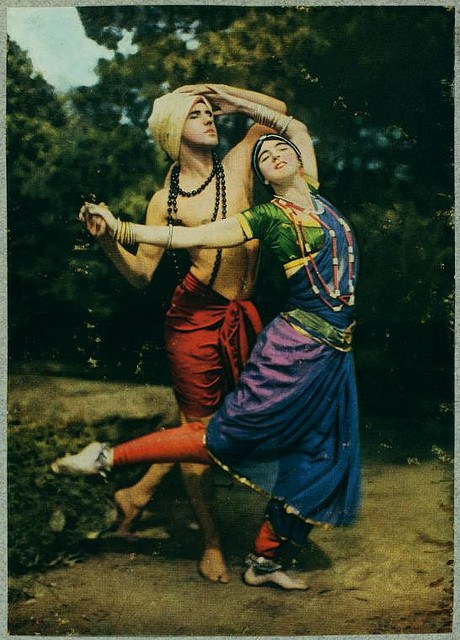

Dance forms in the early 20th century in the west often incorporated oriental elements, be it a tawdry interpretation or a more serious minded approach. There are probably many ways to look at Ruth St. Denis’ body of work that includes “exotic elements”, but its obvious from the stills that a lot of effort and care has gone into the presentation, including one that evokes a Chola bronze. Plus of course she seems to have been responsible for the revitalisation of modern dance.
To the blouse. Its a simple one for the year it is taken in (1915) but quite clearly a choli as opposed to a Western style blouse. I am not sure that is a sari, probably an approximation of the garment.
Re the second pic – she seems to have favoured the choli, common in dance forms in India. And there is the brooch at the centre and a single armband. And the very neat figure.
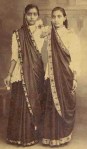

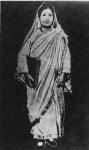

The Parsi Style (First Pic)
The Brahmika Sari (2nd pic, Suniti Devi of Cooch Behar with an additional stole/veil over the sari pinned with a brooch) and 3rd picture Rokeya Begum in a simpler version)
The Nivi/Madrasi style (Last Pic)
Jnanadanandini Debi was deeply influenced by the newly-introduced Parsi gara, the kind worn by Lady Bachoobai Nowroji Vakil. By the latter part of the 19th century, Parsi garas or garos—saris with Chinese embroidery in white or variegated silk threads—were introduced in India. These were either originals or based on the all-over hand-embroidered garas brought back by Parsi traders from China in the 1850s. Either embroidered all over—the peony, cock, and butterfly being favourite motifs—or only with heavily worked borders that were attached, they soon became eponymous with a style that spread throughout India. Not long after its introduction, crafts-people in Surat started copying the gara as well as the fine borders and supplying rapidly expanding markets in the urban areas of Bombay and Bengal Presidencies, and in time, some parts of Madras Presidency as well as north India and the more Westernized among the princely states.
The style of wearing the sari with a blouse often modelled on the Western dress, with a fine muslin sudreh (undershirt), was soon adapted by those from families involved in the social reform movement in Bengal as well as by emancipated families in other parts of the country. The introduction of the sari blouse (jama) and petticoat (shaya) was essential before upper- and middle-class Bengali women could come out in public; in an article said to have been written by Jnanadanandini (using a pseudonym) in Bamabodhini Patrika, a women’s magazine popular in reformist circles, the author commented on a new mode of dress that took from English, Muslim, and Bengali traditions and yet retained a Bengali essence. For instance, the author wrote, she now wore shoes, stockings, bodice (angiya cachali in place of the sudreh), blouse, and a short skirt-like petticoat with a sari draped over it; when she went out she wore a chador (shawl) that could be used to cover her head if necessary. Blouses were elaborate, modelled on current styles prevalent in the West: thus high collars with ribbons, frills, jabots, and brooches were popular from the 1870s till the turn of the century and a few women also wore mutton-chop sleeves, peaked at the shoulder. Shawls draped elegantly over one shoulder, closed shoes, brooches, and hair ornaments completed the ritual of Westernized elite female dress (figure 3). Later, while those from the Brahmo Samaj referred to the new style of wearing the sari with blouse and chador as the “Thakurbarir sari” (sari worn in the style of the Tagores, a leading Brahmo family), as more and more Brahmos started wearing the sari in this manner, it came to be popularly known as the “Brahmika sari” throughout India.
From Malavika Karlekar’s comprehensive essay on the evolution of dress in Bengal (Reform and Sartorial Styles in 19th century Bengal). Eventually the Brahmika Saree gave way to the Madrasi/Nivi style akin to what we wear today.

Continuing the cycle theme, this was probably a college student on her daily commute. On a “ladies” cycle with a very low central bar. Her attire suggests pre-Independence Bengal – probably the teens/20s.
They did have a lot of blouse at the time.

A Bombay Scorcher. Is that the bicycle or the bicycle?!
This was of course a saucy postcard as opposed to being taken on the streets of Bombay while this barefoot lass was going about her day’s business.
Her smile is sweet, her sari is tied Maharashtrian style (maybe just tuck away that falling pleat?!) and her blouse is cute and snug with a glimpse of decolletage. And she has blouse armband jewellery. Win.
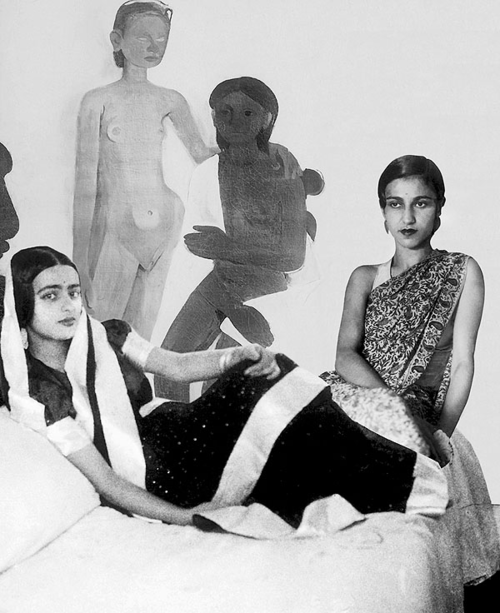

Vivan Sundaram, Retake of Amrita – Sisters, 2001
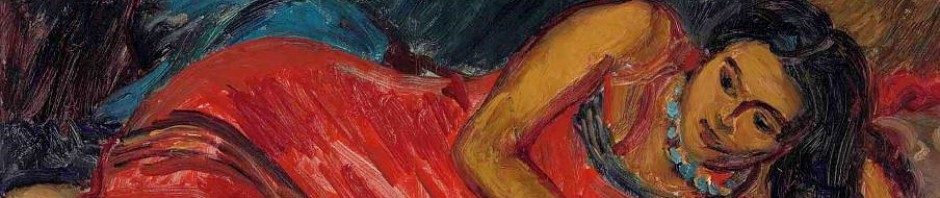
Amrita Sher-gil’s parallels with Frida Kahlo are oft commented on – self portraits, the incorporation of indigenous elements, the bisexuality, the early death, even the odd photograph with a lady moustache.
And there’s the keen sense of fashion. In Sher-gil’s case, a frequent adoption of Indian dress and the sleek style of the 20s with the simple, sleeveless blouses and the emphasised mouth. The second picture here foregrounds her sister whose blouse in it is a simpler, conservative version.
The photographs are by Vivan Sundaram, her nephew, whose re-imaginings of Amrita’s old photographs play around with the concept of twinning and also incorporate his mother (Amrita’s sister, Indira).

Rehana Mogul’s very demure blouse with the puff sleeves common for young women and girlish plaits contrasted with a hitched up sari (was it a sari or just draped cloth?).
The pic source site has interesting bits on the modern girl in India and some vintage Homai pics of JJ School students of the 1930s that capture the mood of the time and everyday fashion.
 Vintage Indian Clothing