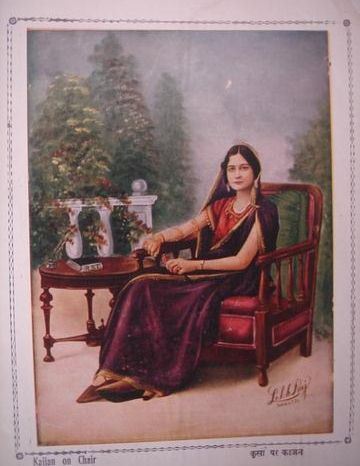
Miss Kajjan. On chair as helpfully indicated.
Also elegant shoes!
Miss Kajjan. On chair as helpfully indicated.
Also elegant shoes!

I love Miss Kajjan’s dress here from that little cutwork/embroidered blouse to the casual pinning of the saree with those long pins that seem to have been around at the time.
The waved hair is so common in the 20s/30s in Indian cinema.
And you have to love it when an actress is described as having “roaring love affairs”.


Not many period dramas in India get their period details right. I am not sure a leg of mutton sleeve blouse was the way to go in 1942 but its the evoked emotion rather than authenticity that matters in film. And this is a fair bit of effort for Bollywood.
This film did not eventually feature Ms Dixit but she looks quite radiant in this photoshoot.
Via the MD tumblr.
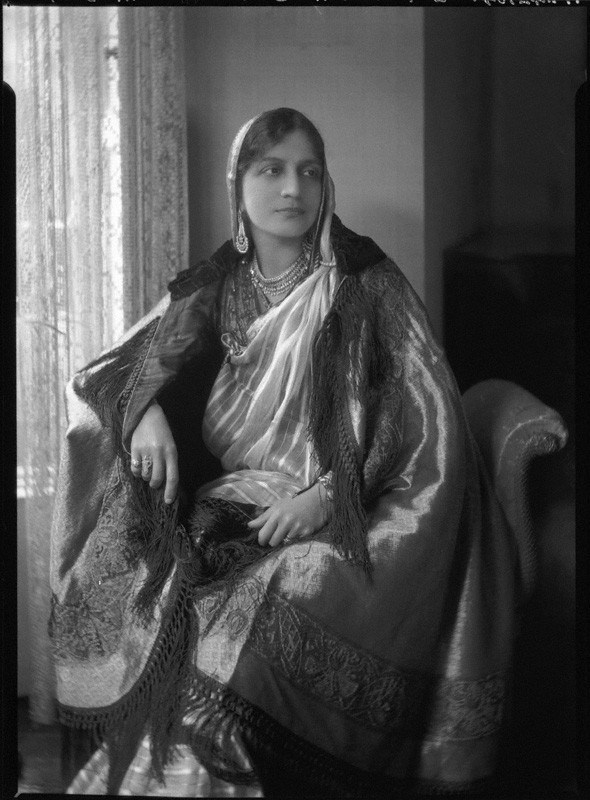
Lady Abbas Ali Baig by Lafayette (Lafayette Ltd), half-plate film negative, 14 May 1929. Love all the elements here – the cacophonous sari and a rather magnificent cape-shawl.
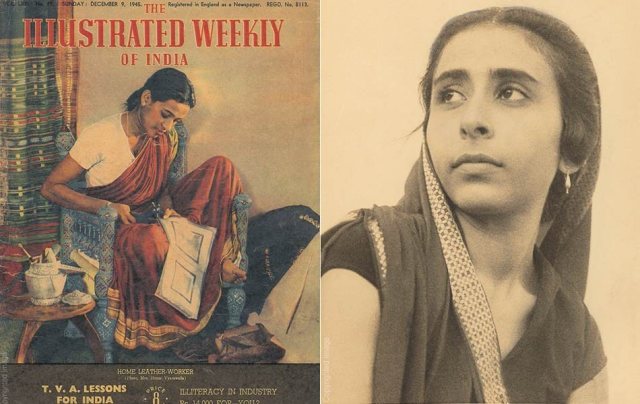
Homai Vyarawalla is a favourite so I am featuring her again.
She looks totally professional and totally at ease in cute, simple blouses teamed with a saree and lugging around her ever present camera.
The Illustrated Weekly cover of 9/12/1945 is from a time when white blouses were teamed with every kind of saree.

The sari influenced western attire in the early part of the 20th century to some extent – though there was no separation of the bodice and skirt as in India. Elsa Schiaparelli for e.g. was known for her “sari dresses”.
I am assuming this is a gown with a shawl. It has all the elements of a saree in it – the folds of the skirt, the draped cloth over the bosom, the pallu (the loose end of the saree) and the head covering (though the last of this is optional in a saree). I think Ms Baker also has a bindi in keeping with the attire. All in all – as always – she looks quite fabulous.
He would choose saris from Benares and Indore – centres of fashion – and wear embroidered georgettes and silks from Bombay, fabrics and designs which became fashionable with middle class Maharashtrian women in the period between the two world wars. He began to wear exotic accessories such as embroidered jackets over the saree blouse, perhaps to cover his male contours which also became fashionable with women at the time…….when necessary, however, he played women shorn of all adornment.
Bal Gandharva is probably the best known of Indian actors who took on female roles in the early part of the 20th century and appears to have been highly successful as a female impersonator and as a fashion trendsetter. His personal life appears to have been fairly scandalous, particularly his association with the actress Gohar.
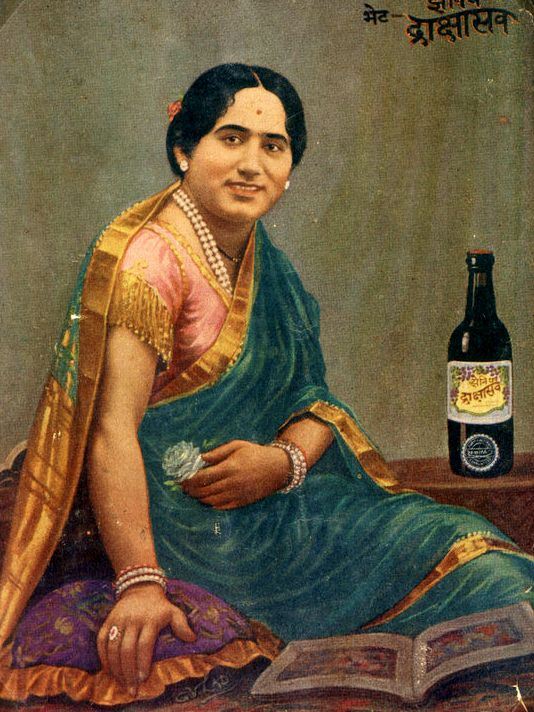
This picture appears to be an ad of some sort for a restorative drink. And I do believe this is one of few occasions I have seen a tasselled blouse. All in all its a tasteful picture of middle class elegance and manners.
I am curious about that jacket over the blouse but can’t lay my hands on a photograph.

Now and then a post where it is just the blouse without the upper drape.
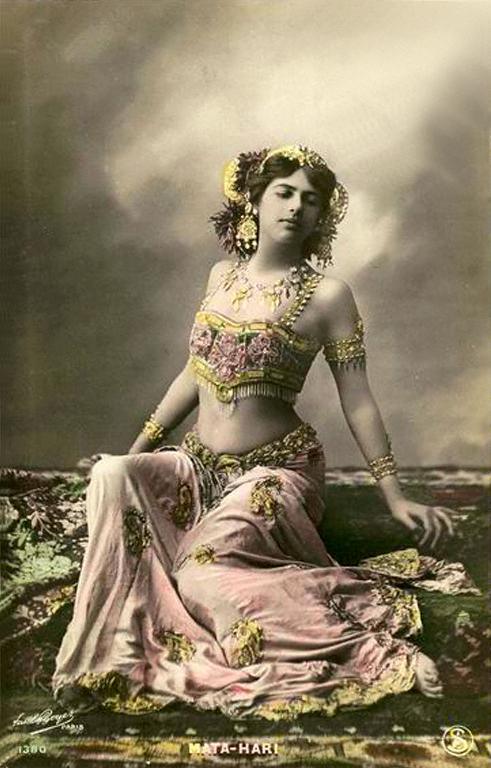
“Javanese Hindu Princesses” seemed to have been all the go at some point and Mata Hari it appears lost little time in adopting the persona during her dancing days.
And no doubt every Javanese princess had a bejewelled strap bodice.

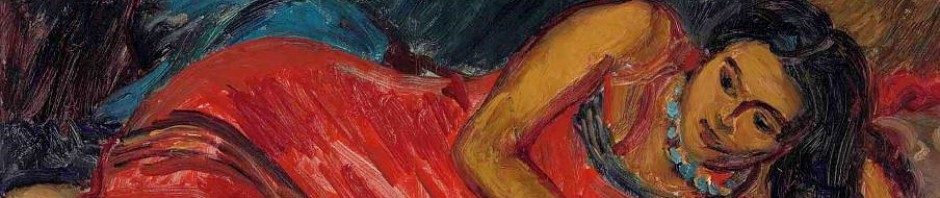
Though I have posted a lot on blouse “borrowings” from the West, one thing that differentiates the Indian version is that the midriff is normally exposed. There is a long history to the choli/kanchuki and modern representations of historical attire often depict a choli, a lower garment that is tied like a dhoti and an upper scarf. This picture for example is an Amar Chitra Katha representation of the heroine of Kacha-Devayani with her friends.
This often appears to travel back to the West mainly as something vaguely Eastern and erotic, of course the lower garment is almost always a skirt. I shall separately post on this.
 Vintage Indian Clothing