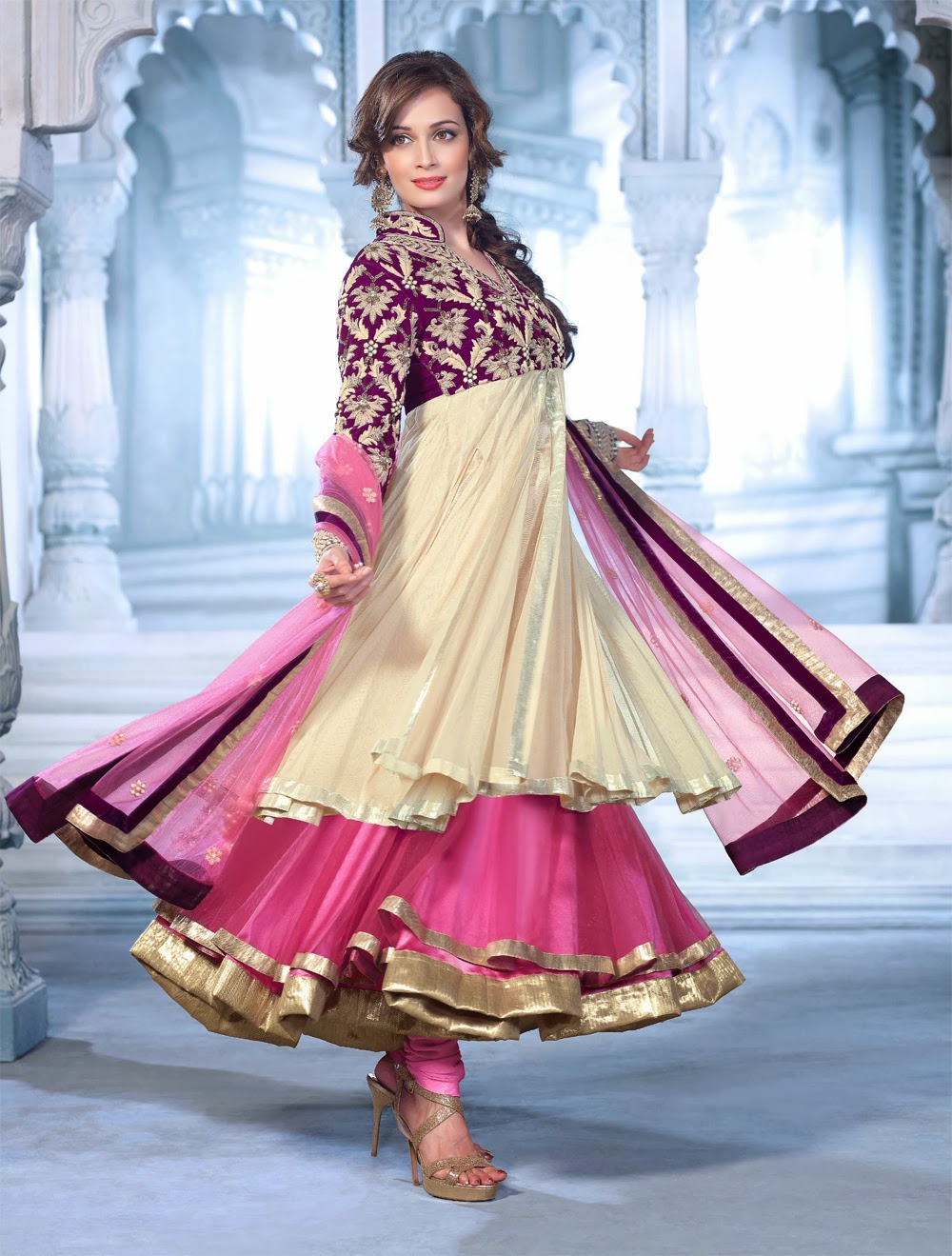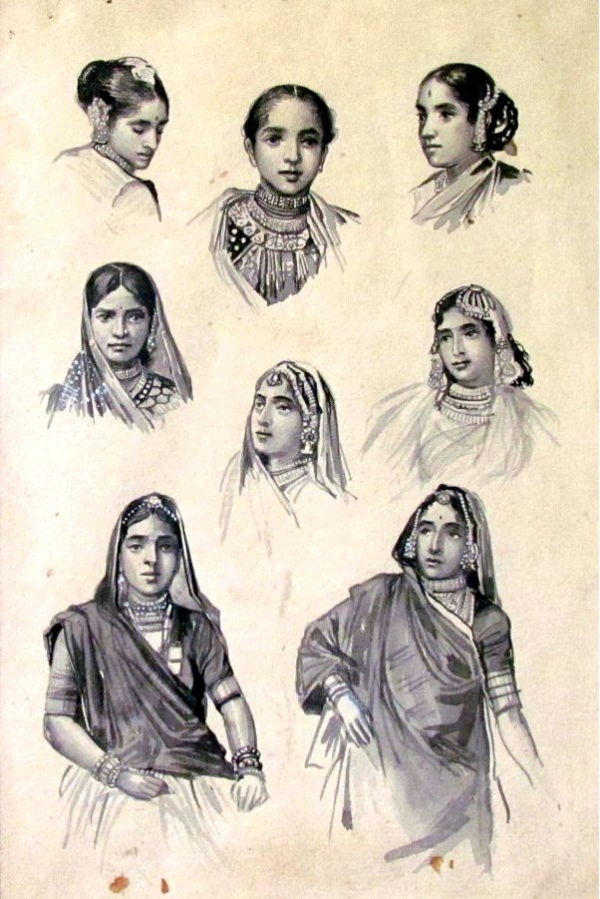
–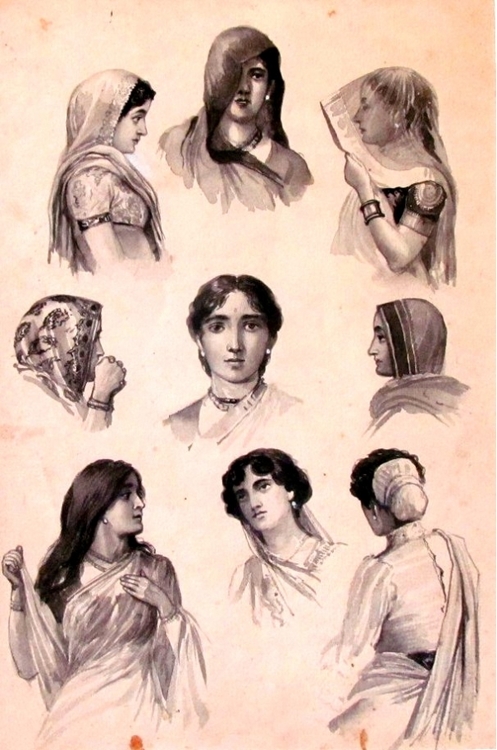 Women of India – MV Dhurandhar via Santanus.
Khazanchi (Cashier) is a 1941 movie which is significant for several reasons (for the full movie X). First, it was amongst a clutch of popular movies made in Lahore that brought in new modes of movie making, until then the Maharashtrian and Bengali ethos had dominated Hindi cinema. Its principal contribution was to music, the Punjabi themes and beats that pervade present day Hindi movies owe a small debt to the popularity of Khazanchi. It also popularised the salwar-kameez and dupatta ensemble amongst Indian women. Plus it’s introductory song of bicycling women was trend setting both in its portrayal of carefree young women and the “meet cute by bicycle collision” of Hindi cinema.
I won’t go into the plot here and will restrict myself to the costumes of the female lead, Ramola Devi (aka Rachel Cohen – based on this movie a charming and subtle actress), Manorama who plays the teenage sister of the male lead (SD Narang), Ramola’s stepmother and a Mumbai seductress who plays a key part in the murder mystery plot of the movie.
But first the bicycle song. Almost all the girls, except Ramola, are in salwar-kameez. And there are a few “frocks” and skirts too (presumably Anglo-Indian girls, there are snatches of dialogue in English).


Ramola plays the daughter of a rich merchant, a girl with a good degree of freedom, albeit answerable to her father and stepmother. She is a collegian and travels unaccompanied, whether by bicycle or by bus. Through much of the movie she wears a sari. Her blouse is usually of the puff-sleeve kind with bow ties being added now and then. And of course there are the two plaits – perennial indicator of youth in Indian cinema.


 Often the blouses match the border of the sari. From what I can see of this, it is possible that the borders are separate and added on to the sari, especially where the fabric seems to be some kind of satin. Note also the brooch (which I have helpfully marked!). In the 30s and 40s the brooches appear at different positions, here they seem kind of meant to pin the sari to the lower end of the blouse. That is a lot of pictures – clearly I really liked Ramola:)
SD Narang, who is the male lead, is training to be a lawyer. The wardrobe department puts him in a lot of suits with an occasional foray into a sherwani.


Ramola does wear the salwar-kameez for one particular scene. Almost all the kameezes (tunic) in this movie have large floral prints with elaborate neck detail (the sleeves are also often detailed).


Manorama plays the teenaged sister of SD Narang’s character and the daughter of the eponymous khazanchi of the title. The family is therefore middle class. The actress appears in a salwar kameez throughout the movie. Like Ramola’s, the kameez is often full sleeved and has a floral print. The dupattas – possibly some kind of nylon or synthetic of the 40s – often have a bit of glitter on them. See also this still from a 1940 Lahore movie for a clearer picture.


 Ramola’s stepmother appears to be a younger trophy wife. Maybe I am reading too much into this but some of the older women in the movie, who appear to be in their late 20s/30s, wear a lot more elaborate costumes. This may partially be due to their wealth but it also harks back a bit to the styles of the previous decade. Or maybe it was just the wardrobe department recycling outfits 🙂 The saris are almost uniformly synthetic fabrics or chiffons, at one point mention is made of saris being ordered from England.


The eponymous Khazanchi (the father of SD Narang and Manorama’s characters) makes a visit to Bombay where he meets an actress/conwoman. Her saree and blouse is 1940s provocative and again there are a few 1930s elements like the ruffle and the headband. Not to speak of the cigarette and gun, essential accessories for bad girls everywhere:)
And a second appearance of the saree brooch on this lady.


A glimpse of costumes for secondary male characters. The entire world of the movie is the modern city, first Lahore, then Mumbai. The action therefore moves between offices, courts, boarding houses and the houses of the protagonists. Dress is therefore western or more often the hybrid Indian-Western wear of the time which involved the addition of a jacket and the retention of specific headgear like a cap or Punjabi safa.


There are a few item numbers in the movie. One has an exceptionally saucy lady in a club (ruffle ruffle ruffle and a nice pair of legs is the key to 1940s seduction). There are also a couple of Indian nautch songs where a ghaghra is worn.
A screengrab of the end wedding scene. The head is covered by a pallu and a bindi worn only on specific occasions in the movie.
 And last but not the least, the 1940s undergarment:)
 The wardrobe of the two main protagonists of Khazanchi, Ramola and Manorama, reveals a simplicity of dress as opposed to the high glamour of the 1930s (these were also the war years and the fight for Indian independence was at its peak). Khazanchi’s success was possibly what made the new kind of salwar kameez, intended for modern young women at work and play, something that would eventually have pan-Indian appeal. It seems to me that, like with the sari, dress reform was at work here. The modifications to the outfit which incorporated new fabrics and were influenced by Western styles changed the dress so that it was no longer intended merely for a) the cloistered life of North Indian women and b) its use as rural working garment in Punjab. Pity that the details are so hazy and it is not better documented.

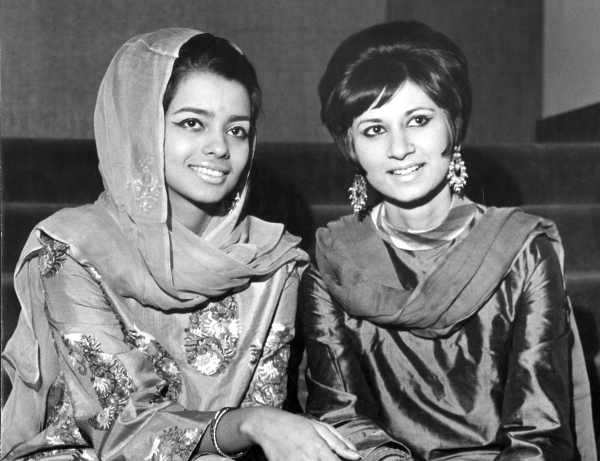
In the 60s, churidars and short tunics [X]. This is likely silk.
And a close up of the kameez. And you can see the footwear in the first pic.
The women: Persis Khambatta and Meher Mistry.
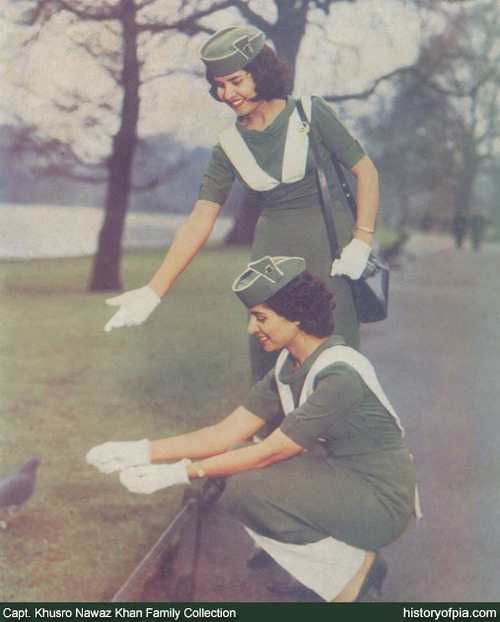
The salwar-kameez as uniform-PIA’s uniform for airhostesses in the 1960s. The changing uniforms with each decade are provided at the link.


The adaptation of the salwar kameez with modernity is perhaps less documented than the sari. In the 1920s and 1930s, the new kind of sari drape was the on trend garment. By the 1940s, the salwar-kameez (or on occasion the churidar-kameez) was in vogue, especially for young college going women. While maintaining the traditional silhouette and embellishments like zari, gota and sequins, it was also possible to incorporate new fabrics and prints as well as collars, laces, trims and the like. Especially for the kameez.
The most common ensemble in the 40s is as in pics 3 and 4, a kameez that ended above the knee, loose salwars and a dupatta. Pics 1 and 2 are of churidar ensembles which you see now and then in the decade.Pic 1: Amrita Shergil with her cousins
Pic 2: Still from a 1940s film
Pic 3: Drama group, Delhi, 1947
Pic 4: Still from Midnight’s Children.


Unlike the chudidar where the cloth is constricted at the knee and the salwar which is constricted at the ankle, flared trousers were also worn with the kameez. The kameez initially was a tunic with skirt but later you can see shorter, simplified versions. Given the pictures here, the fashion appears to date back to the early 19th century (strictly more Lucknowi than Mughal). The sharara is also an example of this, though it may sometimes be constricted at the knee and then flare.
The paintings are all of nautch girls so it’s a little difficult to say whether the same fashion was followed by other women. However at least one of the links is to the costume of the Queen of Oudh so it seems like it was the prevailing style.
For comparison two films set in 1857. Shatranj Ke Khilari uses an accurate costume but Mangal Pandey uses a later mujra costume common in Hindi cinema.


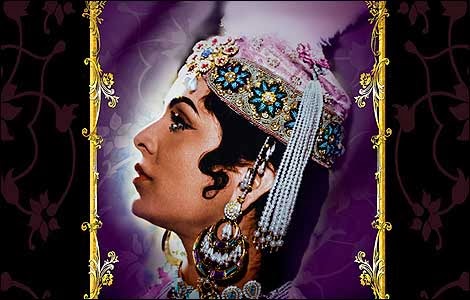
Though the Mughal-e-Azam characters have become a part of Indian cinema folklore, the film was anything but historically accurate in the matter of textual details, costumes, sets and music. For instance, thumri, a 19th century musical form, is used along with kathak costumes in a court supposedly in late 16th century India. Even the Sheesh Mahal (the royal bath of the actual queen) is enlarged into the dancing hall of the Mughal emperor, Akbar. Anarkali could have been one of the numerous dancing girls of the Mughal harem; whether the Mughal prince Salim fought his father over his beloved is not documented in history. [X]
Mughal governance, customs and norms is perhaps one of the more extensively documented periods in Indian history [X, X, X, X]. A number of books refer to clothing with reference to paintings e.g. this encyclopaedia. The Mughals brought with them existing central Asian styles but the full flowering of the style included a number of local elements (by the 1700s some of this was making it’s way back to West Asia).
Ritu Singh’s book and various articles also provide a quick reckoner and a glossary of terms [X, X, X].
As always the cinema has played a role. Mughal historical romances have always been popular right up to Jodha Akbar but the big daddy of them all remains Mughal-e-Azam. The influence is not restricted to clothing but also includes interiors and sets. While not entirely authentic, they remain reference points for modern fashions that trade on Mughal style. Now where’s my Nigar cap🙂


A SHORT AND INCOMPLETE HISTORY OF THE CHUDIDAR, SALWAR, KAMEEZ ETC.
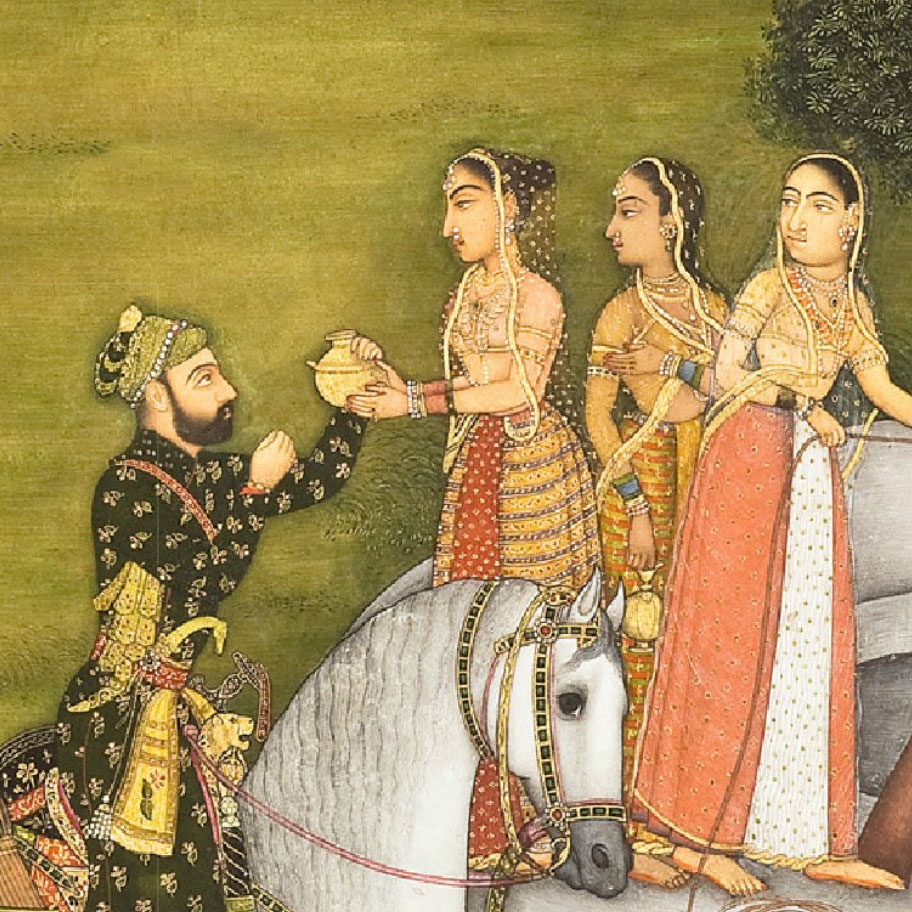
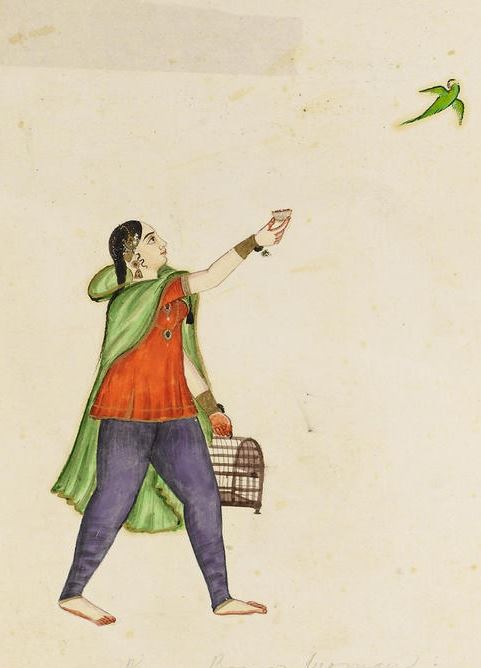
India’s links with West Asia date back to antiquity. It’s significant influence on attire, particularly in North West India, is probably best documented during Mughal rule, especially from the 17th century onwards. The paintings of this period depict patterned churidars, diaphonous overskirts or jamas (like an overcoat), bodices and dupattas, both for men and women. Also seen in pic 1. Full length ghaghras or skirts, however, also appear in these paintings. While influenced by West Asia, the dress is very much Indianised.
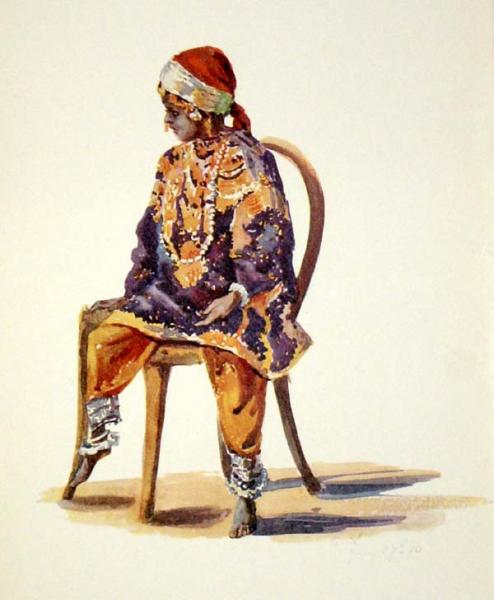
In early European paintings of India in the first half of the 19th century, voluminous tunics are common as in pic 2. They are often paired with churidars or more commonly wide trousers.
Later paintings and photographs show a variety of styles. Essentially a three piece dress, endless variations were possible by changing the size and shape of the trousers or the tunic. Or even as the case may be the dupatta, which can be a simple stole or an enveloping shawl. The cloth used also varies, from very fine muslin to sturdier cottons and silks.
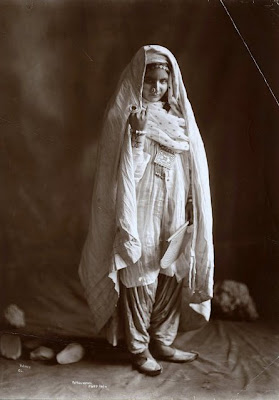
Pic 3 shows the “dancing girl” outfit we are used to which consisted of the chudidar and a tunic that was fitted at the top and flared at the bottom. The flared, skirt like nature of the tunic meant that muslin or chiffon would be used. Pic 4 is of the salwar in the early part of the 20th century, some of the more voluminous ones were influenced by Afghan clothing. As in this pic, the footwear of choice with the garment was the mojari.
The garment was also strongly identified with the Punjab (in many parts of India it is still known as the Punjabi suit). Allah Bux painted a number of traditional scenes incorporating women wearing the garment as in Pic 5. The side slit of the kameez (aka tunic), which eases movement, is optional.
By the 40s, the salwar kameez was beginning to be seen across India, partly due to the freedom movement, partly due to the movies. Pic 6 shows a style prevalent in the 40s: loose salwars and knee length flared kameez, its embellishments often mirroring western fashions. And possibly these are the early examples of synthetic dupattas.


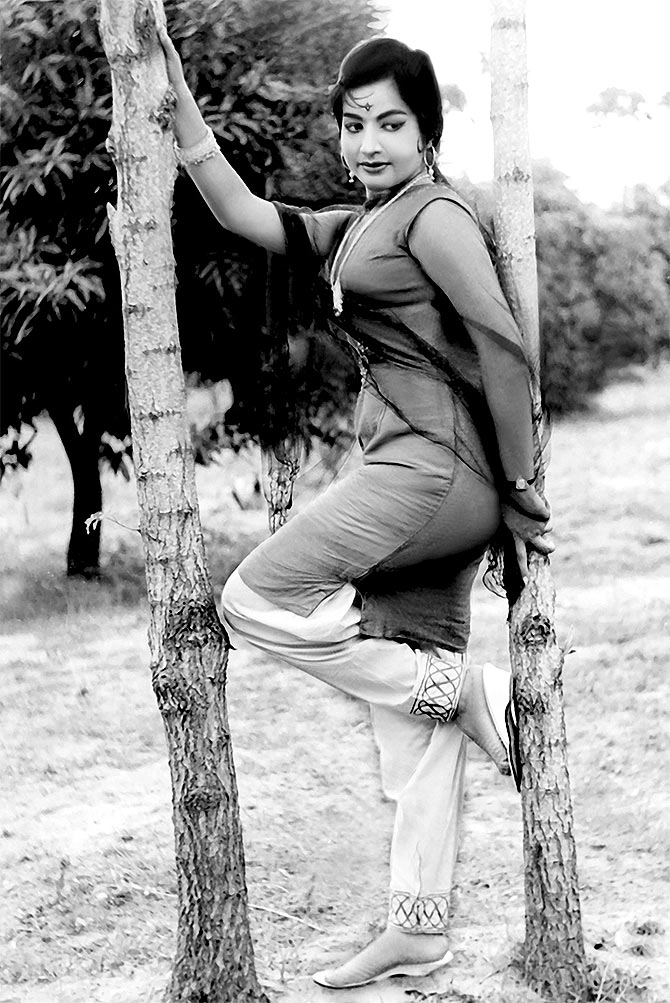
The chudidar of course came into its own in the 60s when it was worn with an extremely fitted kameez and a diaphanous dupatta (pic 7), a style popularised by Sadhana in Arzoo. By this decade it was also increasingly pan Indian, at least in the movies. A southern star like Jayalalitha (pic 8) would probably wear it in a movie to suggest a modern, educated girl.
The “matched set” became popular in the 80s. The set often came with printed dupattas as in pic 9. The adaptation of handlooms for the garment also dates back to the 80s, with the revival of the sector woven cotton and silk sets became common. The chudidar was more popular but the salwar was also worn.
Post the 80s, there have been many variants of the garment and it is increasingly commonly worn all over the country. There are plenty of examples between the early 80s to 2014 but we can all agree that the past few years have the anarkali (pic 10) as the mainstay. In a way linking us back to the 18th and 19th century:)
This post on ruffled blouses refers to Mukti (1937)* [X] [X]. The movie was a bit of a fashion influencer with Kanan’s crown braid and Barua’s beret worn backwards apparently all the rage. It turns out the movie is on youtube. Not the best print but hey given how difficult it is to source 30s movies I will take any print! So without further ado bad screencaps deconstructing the fashions of 1937 as worn in Mukti. Post which you can host your own 1930s themed party:)
In the movie, Prasanta (PC Barua) is a 1930s artist and bohemian in back to nature mode and his wife Chitra (Kanan Devi) belongs to the smart set of Kolkata aka the rich and Westernised elite.


First up ruffles were really on trend so if you want to do anything set in the latter half of the 1930s you can pretty much add a ruffle, either on the blouse or as a saree trim. And here are all the features of Kanan’s ruffle blouse.
In the film clip (about 00.03.00+), you can see that the sari is a chiffon/synthetic sort with a zari border (it is in fact quite rare to see “ethnic” coarse handlooms in many of the early movies-anyone with a bit of money was probably buying up chiffons and getting borders stitched or wearing translucent silks and cottons unless they were swadeshi sorts). Perhaps given that she is upper class, Kanan wears the “modern” sari and not the traditional Bengali drape.
Kanan also has an armband (00.06.26), quite popular in the 1930s given that sleeveless or barely there sleeves were common.
Throughout the movie you will also note the lack of a bindi on Kanan. Though sindoor is strongly associated with Bengali culture post marriage, the bindi is in fact not always seen in movies or even in vintage photographs on young women.
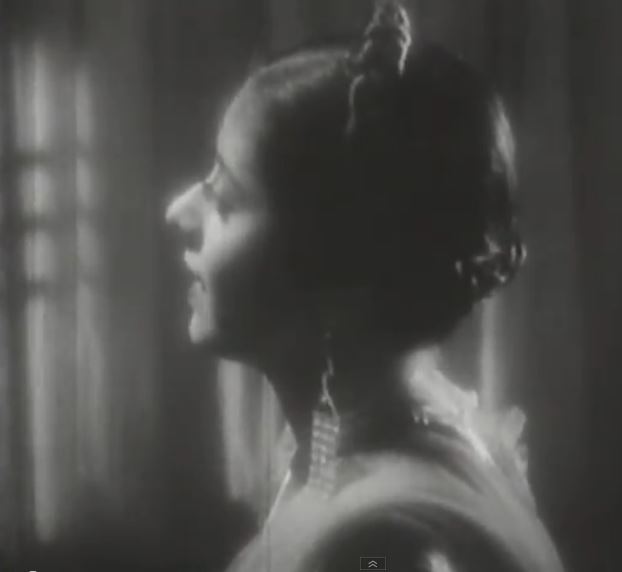 Here is a side view of Kanan’s crown braid. Add to that chandelier earrings (a common feature throughout the movie) and a purse and some white heels and you were ready to party. Or at the very least shoot pool like Kanan (00.11.20+).


Barua’s persona, at least in this movie, is a little fey and eccentric. He is sort of a 1930s hipster, different for the sake of being different:). At one point Chitra refers to his clothes as not being fit for a decent person. In his Misunderstood Artist in the City part he wears a tunic that looks like a silken poet shirt that morphs into a kurta and is worn with loose trousers. Also in the beginning some kind of long, silken jacket. Quite deshabille. I am curious, did he devise the costumes himself?


Just when you think you know EVERYTHING about the fashions of 1930s and are like 100% certain that no one ever wore long sleeved blouses with laces and all, along it comes! (see about the 00.29.00 and 00.35.00 mark). I am going to put it down to Chitra raiding her mother’s closet. The sari seems consistent with the 1930s. Some kind of scalloped embroidery or applique on the border but no distinct pallu (the loose end of the sari).
Jokes apart, a quick look at 1930s movies shows that the full sleeved blouse does turn up now and then even though the decade is fairly liberated and sleeveless blouses were very common.


Barua really really liked scarves. At some point in the movie his character Prasanta runs off to Assam to live in a village. His attire gets more peasant like but the scarf never leaves his neck.
Next up Kanan has a butterfly sleeve blouse with a bit of a contrast trim (around the 0:56.40 mark). The sari is still light and translucent but looks more like a muslin Indian weave (you can also spot the pallu around the 0:59:09 mark). To contrast with Prasanta’s “Indianness” and artistic temperament, the smart set, including Chitra’s father, are in suits.
 This sleeve was pretty common in the 1930s too, here worn by Shanta Hublikar in the 1939 Manoos.


Around the 1.22.10 mark Kanan has something like a satin jacket worn over a sari, hard to get a decent capture of it. This is probably the only sari that Kanan wears that is a bordered Bengal cotton sari (see also 1.22.42).


A little later Kanan in another blouse that seems to have been fairly common in the late 30s and early 40s (I have seen it in old family photographs). Kanan’s blouse is sleeveless with a kind of – I don’t know what to call it – a cape or capelet collar? giving the illusion of a sleeve. The sari looks like a printed chiffon (1.23.41).
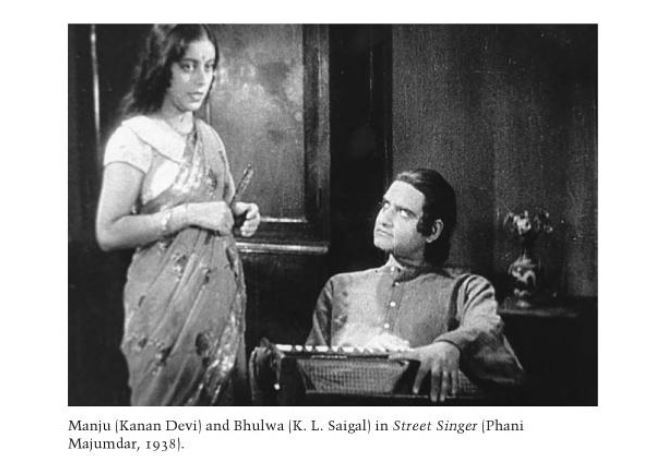 Kanan has a similar blouse in the 1938 movie, Street Singer.


A look at Barua’s famous cap! Every hipster in Calcutta was probably walking around with the cap worn backwards (thus anticipating the trucker cap:)). I can’t say whether it is a cap or a beret or even if its worn backwards with this damn print but I am going with beret worn backwards. (1.33.38). These scenes also have villagers in Indian clothing, both for the men and women.
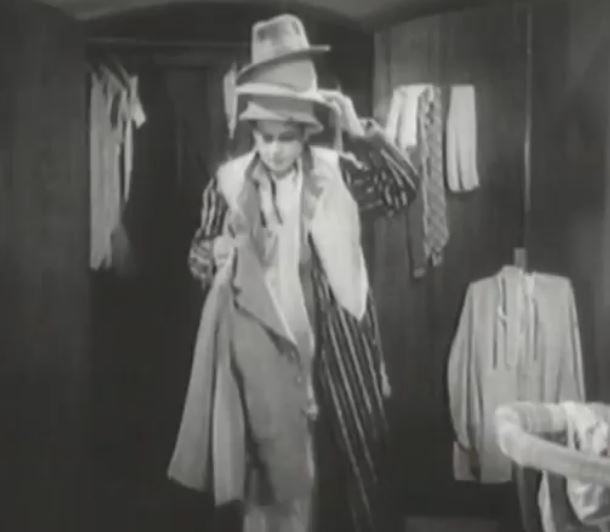 And idk, I kind of prefer Prasanta amusing Chitra by piling on all his hats (~00.07.00) 🙂


Last up at the climax (around 1.51.00), Kanan again opts for a long sleeved blouse but it doesn’t give off a Victorian vibe. It is more like a kurta or even a Chinese tunic with a side closure. Kanan’s sari is again a chiffon/synthetic with a zari/gold border.
And with that you know everything about upper class fashions in Kolkata in 1937:)
*Subtitled version in 12 parts.
_*_
The movies of the 1920s and 30s are either no longer available or the prints are appalling. In fact a number of plots and tropes of Indian cinema are from these decades. And the fashion is also more fun, not so much in thrall to notions of respectability as at the turn of the century and not as formally beautiful as in the 1950s. And there are so many interesting women in these decades too, and from what I can see fairly unapologetic about their lives to boot.
 Vintage Indian Clothing