Two Women

tumblr_nabyh66djW1ry4cywo1_1280 1962rockwellartstudentThe Colours of India:
Abanindranath Tagore, Jamuna,1926. [X]
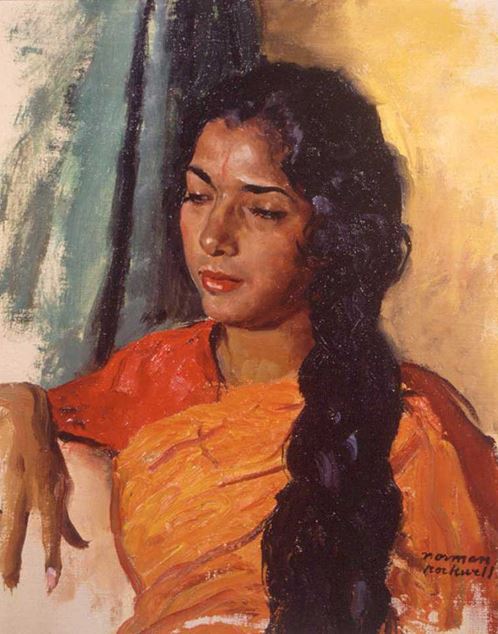
Norman Rockwell, Portrait of an Indian art student (1962). [X]

Posted in 1920s, 1960s, 20th century, Art, Bengal, Culture, Early 20th Century, fashion, Indian Dress, Indian fashion, Paintings, Sari, Sari Blouse, sari history, vintage art, vintage fashion, vintage sari | Tagged , , , , , , , | Leave a comment

The 1960s in India.

In no specific order:

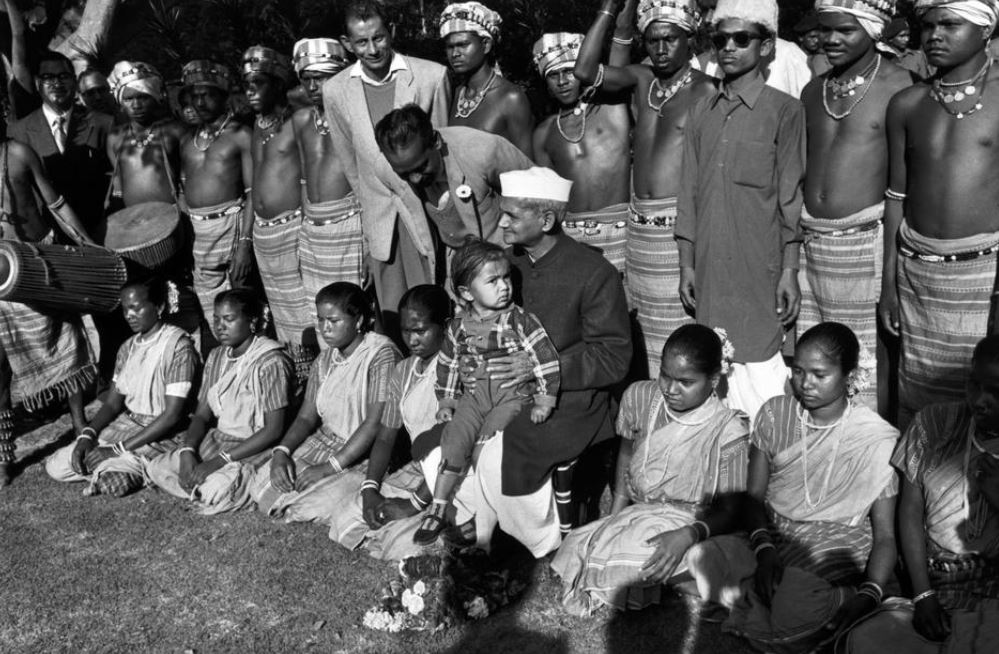
The decade started with Jawaharlal Nehru as Prime Minister and ended with Indira Gandhi as the PM.  From 1964-1966, we had Lal Bahadur Shastri (pictured here in 1964) as the Prime Minister.

In 1961 Goa was annexed becoming India’s 21st state. Portuguese enclaves like Daman & Diu also became a part of India as Union Territories.

The country was at war twice in the decade: The Sino-Indian war of 1962  and the Indo-Pakistan war of 1965.

Shastri was responsible for the Jai Jawan, Jai Kisan slogan of the 1960s.  Shastri’s visit to Amul was the first step in Operation Flood aka White Revolution that began in the 1960s and was intended to make India milk-sufficient. Per this link the Amul Girl was born in 1966.

Around 1961-1963 also saw the introduction of high yielding rice and wheat in India (see Green Revolution).  Part of agricultural policy post this decade was also a result of the Bihar famine of 1966-67.

The banks were nationalised in 1969.

The Naxalbari uprising took place in 1967.

The Dhori colliery disaster took place in 1965. It is listed amongst the world’s worst mine accidents.

Hindi was declared the official language of the nation in 1965 for all government transactions. Following anti-Hindi riots, English was adopted as an associate language in the same year.

The Vishwa Hindu Parishad qas founded in 1964, the Shiv Sena in 1967.

The National Institute of Design was set up in 1961 subsequent to The India Report (by Charles and Ray Eames) in 1958.

The State of Art in 1960s India.

Reita Faria becomes the first Indian woman to win an international beauty pageant.

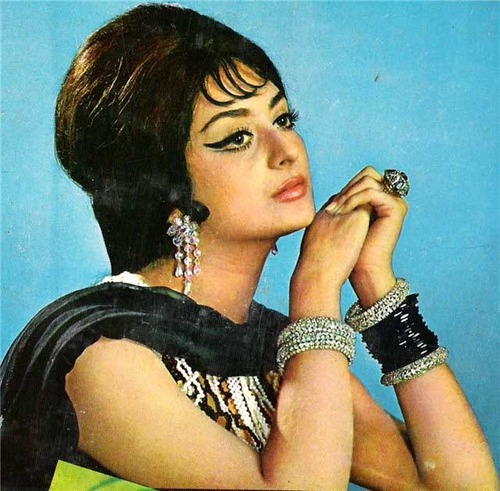
The fashions you have already seen.  The big stars of the decade – Sadhana, Asha Parekh, Sharmila Tagore, Saira Banu et al – sported tightly draped saris, tightly draped churidar-kameez, big hair, pale lips and dramatic eye make-up. The Sadhana fringe was a bonafide craze. Sharmila Tagore rocked a bikini. And there was Helen, the cabaret queen of the country.

Ray, Ghatak and Mrinal Sen worked through the 60s but by the end of the decade you see the beginnings of the parallel cinema movement of the 70s and 80s in films like Gejje Pooje, Sara Akash etc with Bhuvan Shome being a commercial success. [X]

Ads from the 60s in India and Pakistan – X, X, X

Rock in the 60s. The Sri Lankans visit. And the Beatles in India.

A general sum up of the decade through foreign eyes.

1960s. Sari History.

Posted in 1960s, 20th century, History, India, Indian History, Politicians, Politics, Vintage, vintage photography | Tagged , , , , , , , , , , | Leave a comment

The 1960s in Film – Love in Tokyo (1966)

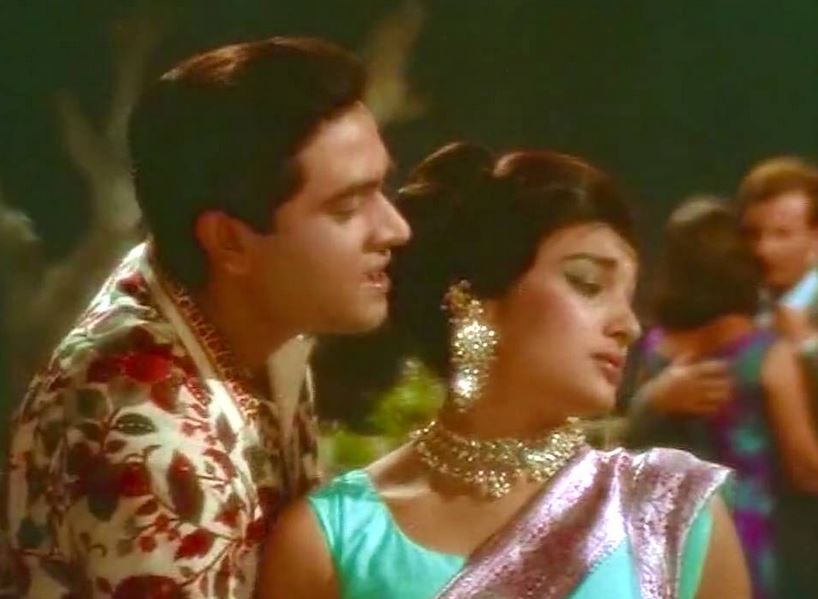
Love in Tokyo (1966) hardly needs any introduction. It’s the kind of frothy romance set in an exotic foreign locale (or at the very least Kashmir) that the 1960s specialised in. Naturally the leads are in their 60s best. With some curious Tokyo induced diversions.

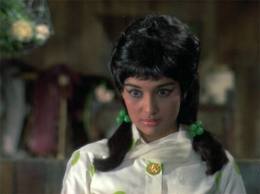
Asha (Asha Parekh) wears a number of pastel coloured saris with elaborate embroidered borders. All very 60s.  These are teamed with fitted long sleeved blouses which are also common in the 1960s.  A similar combo, albeit with all over pattern, for Lata Bose (last panel).

It’s past the mid point of the 1960s, there is no way Asha wasn’t wearing a tight-fitted churidar-kameez.

Some other details: the eye make-up, the danglers(pic 1), the red sari and sleeveless blouse accessorised with an arm bracelet (pic 2), the back buttons on the blouse (pic 3) and the sari cape (pic 4 and 5). Neat hair ornament (pic 6). And pic 7, I don’t know what that is except that Asha seems to lounge around in while reading letters.   And of course there was the love in tokyo hair bands though they seem to have passed me by.

Asha wore a pillbox hat.

I wasn’t sure whether she was Chinese or Japanese,  we got both the cheongsam and kimono.  Further the cheongsam was worn with a kimono cape which is like way ahead of its times given its 2014 avatar (I kid).  To show us they are in Japan, Mehmood dressed as a geisha but we will NEVER SPEAK OF THAT AGAIN.

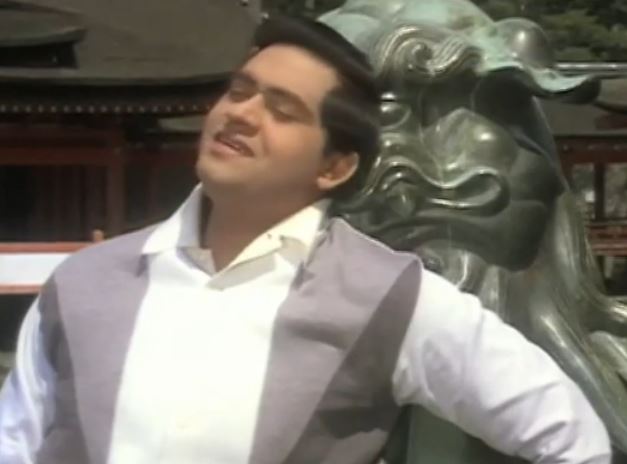
lt9 lt13Ashok (Joy Mukherjee) was the perfect chocolate hero in a suit and a 60s tee.

lt34

The piece de resistance? Surely Asha’s sari-wrap which predates the Mumtaz version by two years. It seems to be pretty much a stitched version of the sari. Also we see yet again sleeveless blouse=arm bracelet.

I don’t think Love in Tokyo resulted in a sari-kimono (still waiting for that day) but it’s clothing certainly captures the slightly frivolous, cheerful nature of 1960s fashions.


Posted in 1960s, Actor, Asia, Bollywood, churidar kameez, Cinema, East Asia, Film Costuming, India, Indian Cinema, Indian Dress, Indian fashion, Indian History, Indian men, Indian Women, Japan, Movies, Old Bollywood, Romance, Sari, Sari Blouse, sari history, Vintage, Vintage Blouse, vintage sari, Women | Tagged , , , , , , , , , , , , | 4 Comments

The 1960s in Film – Kadhalikka Neramillai (1964)

Kadhalikka Neramillai (is a 1964 Tamil film. Given that it’s heroines are a pair of wealthy young girls you get plenty of 1960s fashions with a dash of the 1950s. Saris, salwars, slacks and half-saris all make an appearance.

The older girl is Kanchana (played by Kanchana who was a stylish, glamorous star of 1960s Tamil cinema). Some of her saris evoke the changing nature of traditional saris with each decade – an emphasis on the border, a longer blouse sleeve and the like.  E.g. the pale blue sari. While the plain, translucent sari has echoes of the 1950s. She also wears a few salwar-kameez outifts teamed with some extremely diaphanous dupattas – for some reason this movie is a little light on the churidars of the 1960s. I like the neck detail of her purple and mustard kameez in the last but one panel below.  And the odd trouser ensemble with an on trend scarf for the hair. Due to the nature of the role, her love interest Vasu (played by Muthuraman) has a fair bit of Indian clothes on, including a dhoti-kurta (last panel).

The younger girl, Nirmala (played by Rajasree) is more fashion forward and she has a lot of lovely outfits.  Lots of salwar-kameez, slacks, the half-sari and the odd sari. What looks like a white sari is also a half-sari, albeit in a kind familiar from the 1960s, pale coloured saris with an embroidered border.  The purple horizontal stripe kurta is also very 60s. Though the plait and ribbons, the blouse with a neck border (pic 7) -still channelling the 50s! Her love interest, Ashok (played by Ravichandran), is no slouch in the fashion department himself. Check out the red tee and the shoes!

A bit more of the sisters together.

A smaller role includes an aspiring actress in modest circumstances (played by Sachu). Bar a dress for an audition, it’s all quite traditional South India.

This movie is like a catalogue of 1960s half-sarees.

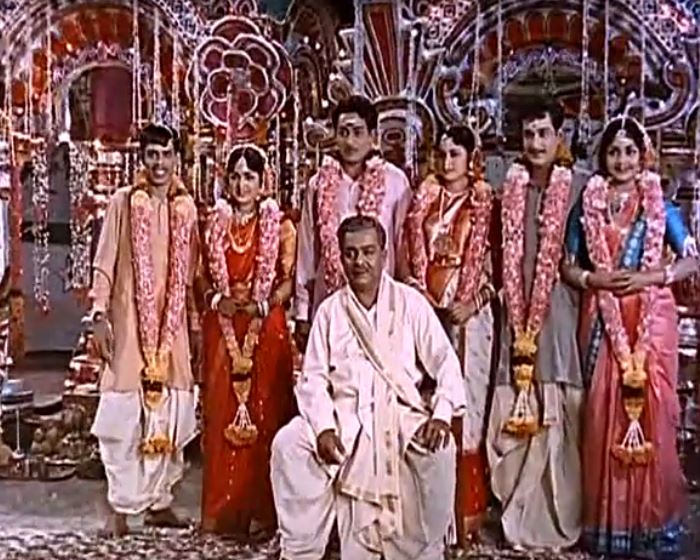
And the 1960s wedding picture.

kn64So if you want to do a 1960s Tamil cinema fashion homage or just recreate a whole bunch of 1960s half-sarees look further than Kadhalikka Neramillai. And if you want a later film, there is always Adhey Kangal.


Posted in 1960s, 20th century, Actor, Cinema, India, Indian Cinema, Indian Dress, Indian fashion, Indian men, Indian Women, Movies, salwar, Salwar Kameez, Sari, Sari Blouse, sari history, Sets, South India, South Indian Cinema, Tamil, Tamil Cinema, Vintage, Vintage Blouse, vintage fashion, vintage sari, Women | Tagged , , , , , , , , , , , , , , | Leave a comment

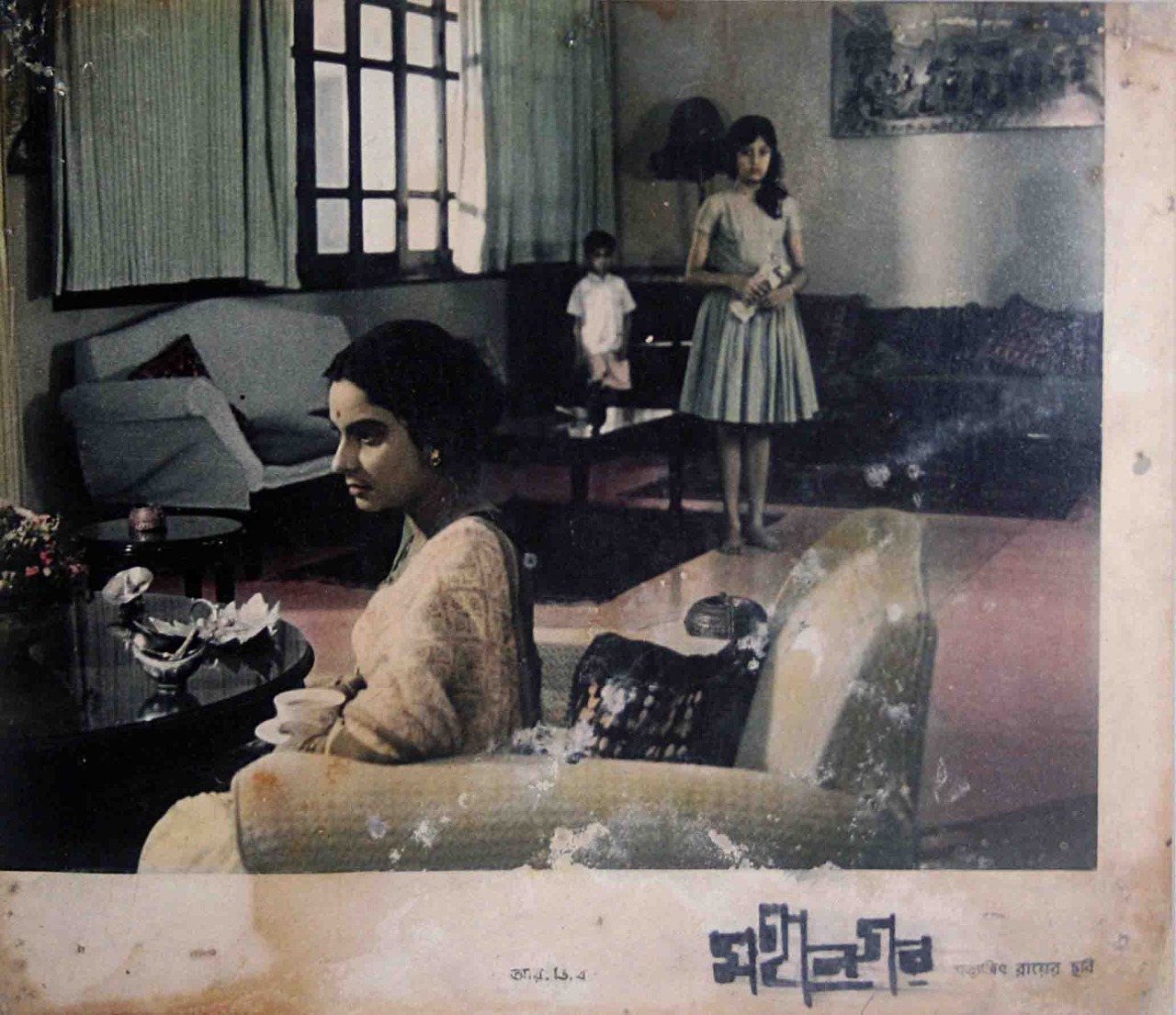
The 1960s in Film: Mahanagar (1963)

Mahanagar is Satyajit Ray’s 1963 film on a housewife who becomes a working-woman due to circumstances and is a critique of traditional Bengali society as well as a changing middle class India.  I meant this to be a 1960s fashions in film post but was puzzled by parts of the film and then found that the film is set in 1955.  Nevertheless I will blog on it to show how a movie made in 1963 might look at a decade earlier. To be frank the clothing looks like a mixture of the 50s and 60s – something you would expect in the early 60s – but Ray is usually particular about details. So I will take it that even if the shifts in a decade, especially in middle class homes, are minor these are incorporated in the film. It is also a good example of what ordinary women actually wore as opposed to what constituted “fashion” for a decade.

Arati (Madhabi Mukherjee) is first introduced as a housewife.  In the first part of the film, she is in a sari styled Bengali style. This is worn with a blouse with little ruffles on the sleeve which is a little old fashioned.  The sari is draped over the head in the presence of elders and this is true even for the later parts of the film where Arati is in a sari worn in the modern pan-Indian style.

Arati’s working wardrobe is expectedly saris. She wears the modern sari drape, the saris are by and large printed cottons or Bengal handlooms and in one scene what looks like a printed silk. These are not always “matched”, there are dotted blouses, bordered blouses and the like. Given her age and marital status, Arati has a low coiled bun (from at least one scene it appears that it is the actress’ own hair casually piled up). Given her lower middle class background, her jewellery is very simple. The same earrings and chain feature throughout the movie.

In a number of scenes, Arati’s bra is clearly visible under the blouse. This is a bit puzzling – it is rarely seen in other characters in the film and generally 50s blouses are not the kind that make the undergarment visible.  Maybe it was common amongst working women in Kolkata or maybe it was a conscious choice, it is difficult for me to say.  Likewise with the broad neck for her blouses, which I see very rarely in the 50s.

Or the sleeveless blouse on various minor characters who play well off upscale housewives in the film.  This always seems very 60s to me – I can’t recall it in the few Bengali films of the 1950s that I have seen – but perhaps it was common in Calcutta.  Some ribbon spotting – as can be seen in pic 3, its a ribbon for presumably a ponytail. I like details like that, differing hairstyles on characters:)

Arati’s colleagues also wear saris with the modern drape.  Though far more worldly than Arati, their wardrobes are not very far from what she adopts as a working woman. Some of these blouses looked a bit 50s to me.  The coiled hair at the nape I think is also fairly 1950s. This was what caused me some confusion- I wasn’t sure whether the setting was the 50s or that change was slow in many middle class families so essentially you would not be seeing the dramatic changes in each decade that you see in some of my posts.

One of Arati’s colleagues is Anglo-Indian. Edith first shows up in a full skirt which I at least think of as very 1950s (she teams it with a shirt which is monogrammed E). Thereafter she wears a few shift dresses, apparently not that uncommon in the 1950s. As well as an at-home housecoat. Her clothing is impeccable, not in the least bit like versions you see in some 60s movies (like they were run up by a local darzi (tailor) not trained in making western clothes). Edith is also responsible for a few contemporray fashions Arati adopts – e.g. the lipstick and sunglasses she presents her.

Arati’s sister-in-law, Bani (Jaya Bhanduri),  is a teenager. In most scenes she is in a frock. This was quite common – and perhaps even more so amongst the Bengalis if we go by Qurratulain Hyder’s book set in the 1930s. The frock is also seen on a young girl in a house Arati visits.  Arati’s first pay goes towards buying Bani a sari – I think it is tied in a style common for young Bengali women – if a Bengali reader can confirm this it would be helpful.

More than a few of the men in the film are in the sort of pan-Indian attire that was around in the early part of the 20th century.  Arati’s husband for e.g. wears a jacket with a dhoti. A few characters – e.g. Arati’s boss – appear in Western suits.

In sum I am still a bit confused about the exact time period of the film. It seems very early 60s to me  but I have to go with the many synopses that provide a mid 1950s date!

Posted in 1950s, 1960s, 20th century, Actor, Bengal, Cinema, Film Costuming, Indian Cinema, Indian Dress, Indian fashion, Indian men, Indian Women, Movies, Sari, Sari Blouse, sari history, Vintage Blouse, vintage fashion, vintage sari, Working Women | Tagged , , , , , , , , , , , | 5 Comments

The 1960s Post


1960sblouse260sSaira-BanuSleeveless blouses and kameez, the just got up and squeezed into my sari/kameez look, mile high hair and dramatic eyes.  A bit of a 50s hangover until the decade is it’s own self. Documenting the 60s on tumblr!

Don’t forget to check out Air india snippets. Clearly the 60s loved the Maharajah, the Maharajah loved the 60s.

Image 2 via ebay.

Posted in 1960s, 20th century, Actor, Bollywood, churidar kameez, fashion, Girls, Indian Cinema, Indian Dress, Indian fashion, Indian Women, Old Bollywood, Sari, Sari Blouse, South India, South Indian Cinema, Tamil Cinema, Vintage, Vintage Blouse, vintage fashion, vintage sari | Tagged , , , , , , , , | 5 Comments

On Clothes

imageedit_7_2197255942imageedit_9_9257966257imageedit_11_5206617768Now and then i think of the underlying philosophy of clothes and how markedly this differs from country to country but haven’t sat down to pen a deeper piece.  So I have kind of relied on extracts as preliminary thoughts. It’s not a new thought, everywhere the evolution of clothes is always about how to integrate the new without compromising a fundamental essence particular to the land. Which in turn is so often shaped by geography and culture. The East vs West debate re clothing is also not new e.g. drape vs structure, timeless vs transitory, group vs individualistic with one preferred over the other depending upon the writer.

1. Fanny Parkes lived in India for a long time and her travel book (1850) is quite lively in it’s description of the country.  Parkes was a bit of an Indophile, not uncommon in pre colonial India.  She starts off a bit of a skeptic at the beginning of her stay in India but by the end is fairly rapturous. She was also a prodigious traveller, it wouldn’t be surprising if she ditched English clothing for Indian given the climate of North India. Re the extract while India certainly changed Parkes’ perception on style and taste, the debate between classical Western drapery (seen as more natural etc.) and the excesses of 19th century fashion I think was also much debated in her time.

2. Wu Tingfang wrote a book on his American experiences (1914) which contrasts Chinese and American mores, sometimes in a humorous vein. The extract is from a chapter on American costumes, in it the author discusses both aesthetics and comfort and contrasts it with the Chinese ideal. Wu Tingfang playfully ends his chapter by suggesting that everyone adopt Chinese clothing but of course thus far the modern age has more often than not gone the other way.  Though as this blog shows, not always:)

3. Anne Hollander wrote extensively on art and dress. The extract is from Sex and Suits which posits that innovations in men’s clothing post Beau Brummell became the template for 20th century fashions for women. It also discusses the fashioning of fashion (so to speak!) and visual representation in the West making it compelling to the rest of the world (the clothing norms of the rest of the world she sees as more fixed and pre modern I think).  The book roams far and wide and can be rambling but it does have interesting insights into how the “Great Renunciation” i.e. the departure from finery and into clean modern lines by Western men was to become the norm for both men and women in our times.

Personal Experience: I had barely ever worn Western clothing until I went to Australia.  My first encounter with wearing it on a daily basis was not dissimilar to Wu Tingfang’s. I found it clumsy,  restrictive, often weather inappropriate and requiring far more time and effort to co-ordinate than Indian clothing. It took me awhile to “get it” so to speak.

Posted in 1850s, 18th century, 1900s, 1990s, 19th century, 20th century, Costume, Culture, fashion, historical costume, History, Philosophy, Vintage, Women | Tagged , , , , , | 3 Comments

The SE Asia/East Asia Post

South-East Asia/East Asia

1. Thailand (1905) 2. Cambodia (1928) 3. Laos (1930) 4. Bali (1935) 5. Malaysia (Peranakan) 1930s 6. Indonesia (1940) 7. Vietnam (1930) 8. China (1930s) 9. Korea 10. Japan (1930s).

I have spent a fair bit of time in South-East Asia over the past year and got a little curious about the region’s (and East Asia’s) clothing history.  As in India, almost all the countries of the region went though a process of evolving a national dress (also X).  As in India there are regional variations.

While by no means definitive, a look at some of the clothing for women in the region in the period 1920s-1940s (bar pic 1 which is 1900s in order to show what I think is the chang kben – it seems to have a kachcham aka the tying of the cloth between the legs as in the dhoti).

Roughly a sheath like or tubular lower garment is common in SE Asia. In Laos and Thailand this is the sinh.  Additionally in Thailand, Laos and Cambodia a dhoti like garment (sampot or chang kben) was in use.The upper cloth which can cover the breasts and also the shoulders is common and generally an elaborate weave or ikat.

In Malaysia and Indonesia the lower garment is the sarung, The addition of a blouse is common and widespread aka the kebaya (X). In Malaysia it is more commonly known as the baju-kurung (X). While woven cloth and of course ikat is common you see a lot of batik. 1885 picture here. The kebaya encim of the Nyonya are also derived from this (X).

I didn’t have space (tumblr!) to put in the Philippines which had a number of Spanish and American influences on the native costume but there are some examples here of the baro’t saya (the saya being similar to the sarung) -the butterfly sleeves are very characteristic of the costume (X, X).

The hanfu is generally claimed as the origin of clothing styles in East Asia. While many of the clothing styles in the region are said to derive from the crossed collar style of the hanfu, personally I think that even with borrowings clothing tends to be quite distinct and specific and influenced by geography and culture.

In Vietnam the ao dai was common. There is actually an excellent chart on Vietnam’s historical clothing available. Like in Korea and Japan, there are Chinese influences on the clothing.

The qipao/cheongsam is seen as distinctly Chinese in origin. It is in fact a Manchu garment. Early versions were closer to the changshan (per Eileen Chang the changhsan was adapted by educated women) before becoming the very fitted version we are more familiar with. In fact the loose version was more commonly used in daily life. There are plenty of resources on  traditional Chinese clothing, largely on the qipao in the 20th century (X, X, X).

I think the costumes of Mongolia at this time also had distinct Manchu influences.

The hanbok has a jacket (jeogori) and a skirt (chima). The way colours are combined is quite specific for the hanbok while the jeogori underwent a number of variations with the short bodice more common in the early 20th century. Because of the length variations possible with the chima, the reformed shortened hanbok was quite popular in early 20th century Korea (X).

The kimono (and yukata) is again well known and extensively documented. In the 30s the drape of the garment seems to have remained unchanged with modifications in fabric and print. In the pic here (No 10) it is worn with a haori.  In fact western outerwear like jackets and coats could be easily worn with most SE/East Asian clothing.

As far as I can see it is only the sarung-kebaya and the baju-kurung (and perhaps the summer yukata, X) that remain in everyday use, the rest appear to be worn more for special occasions.

My favourite of the costumes is the hanbok but truth is each has its special history and charm and there has always been a good bit of thought behind the evolution of each, especially in the early 20th century. Its been great to be able to see them on the streets and in the museums.

Additional Links: X, X, X, X, X, X, X
Posted in 1920s, 1930s, 1940s, Asia, China, Colonial, Costume, Culture, Dress Reform, Early 19th century, East Asia, fashion, Girls, historical costume, History, Photography, Postcards, South East Asia, Studio Portraits, Vintage Blouse, Vintage Dress, vintage fashion, Women | Tagged , , , , , , , , , , , , , , , , , , , , , | 2 Comments

Personal Notes

Just a note. I don’t make any money from my tumblr/wordpress site – or leverage it in any way – and that’s fine by me. I enjoy doing it and if people learn something from it and go off and do their own projects I am cool with it.  Long time readers will also be aware that I am meticulous about crediting all source material (unless I have lost it though I do my best not to).  However please do credit any material that you use from here that relies on more than the credited image! Some of the images and 100% of the written material is mine.  Plus some of the posts are extremely difficult to do and require a lot of research.  The ongoing one on each decade for e.g. I write from scratch because there is literally very little mapping fashions in each decade. I use about 30-40% of my material for posts (because else it would get too boring and obsessive) so well it requires a lot sifting, pruning aka loads of work! And as a scientist, I can say that all the pleasure is in writing a paper and being cited 🙂 So please do cite the blog if you use any material!
Posted in Citations, Credit, Indian Dress, Personal, Sari, Sari Blouse, Vintage, Vintage Dress, vintage fashion | Tagged , , | Leave a comment

Modern Times

fb1

I love all those illustrations back in the day (largely the 20s) that have men terrified of the forthcoming emancipation of women.  More often than not, the women in the illustrations look so nonchalant and cool. Pic 1 from Korea possibly 1920s; Pic 2 from India (Woman’s Revolt, 1919) and Pic 3 from China, also possibly 1920s, titled “Future Position of Woman”.
It’s kind of interesting that unlike pic 1 and 3 which boast modern girl fashions, in pic 2 the woman is not in the modern sari. There is no blouse worn (the norm by this time for educated women).  Probably the wear at home outfit-best to be comfortable when the man of the house is serving tea:)
Posted in 1910s, 1920s, Asia, Comics, Early 20th Century, Feminism, Flapper, Illustration, India, Magazine, Vintage, vintage art | Tagged , , , , , , , | 2 Comments