A Birthday

WP

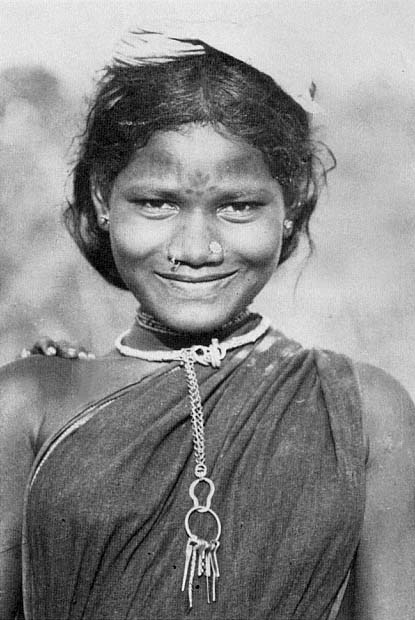
My grandmother died not too long back, she would have been 88 today.  The studio pic is of her as a wee thing in about 1930-she was the eldest child so this must have been a special trip. She looks pretty good all decked up in a pavadai, loose “chattai” and bits and bobs. I like that ribbon touch the best but that’s just me, I love ribbons.

Later in life – and I don’t have a picture handy –  she was a slim 5’6’ who always wore a nine yard sari even as her peers abandoned it. She also  retained her two nose studs. Her abundant hair was always oiled and plaited, her person always neat and elegant. She was a calm and methodical worker, not the kind who cooked up a feast but the kind who would make two faultless dishes. Like many Tamil women of her age she had been instructed in music and was good at it.

Though we had a fractious relationship at times – she was strict and serious, I carefree and unruly – her influence on me in matters aesthetic is very strong. Most of all my fascination with the 30s-50s is thanks to my grandparents accounts of the times.

My grandmother gave me this photo as a keepsake when I was 21, she trusted me to preserve it and take joy in it. It’s a little battered with all my moves but still intact. In a way it was the first piece on my vintage inspiration board.

My personal journal has a lot of entries on my grandmother. When she died I found that she had kept copies of those pieces. To be remembered in a public post, to know that this first photograph of hers is still around, would make her happy. So here it is!

Posted in 1930s, Girls, India, Indian Dress, Indian fashion, Personal, Photography, Tamil Nadu, Vintage | Tagged , , , , , , | 9 Comments

Roop and Baz

At first love seemed easy but after hard. [X]

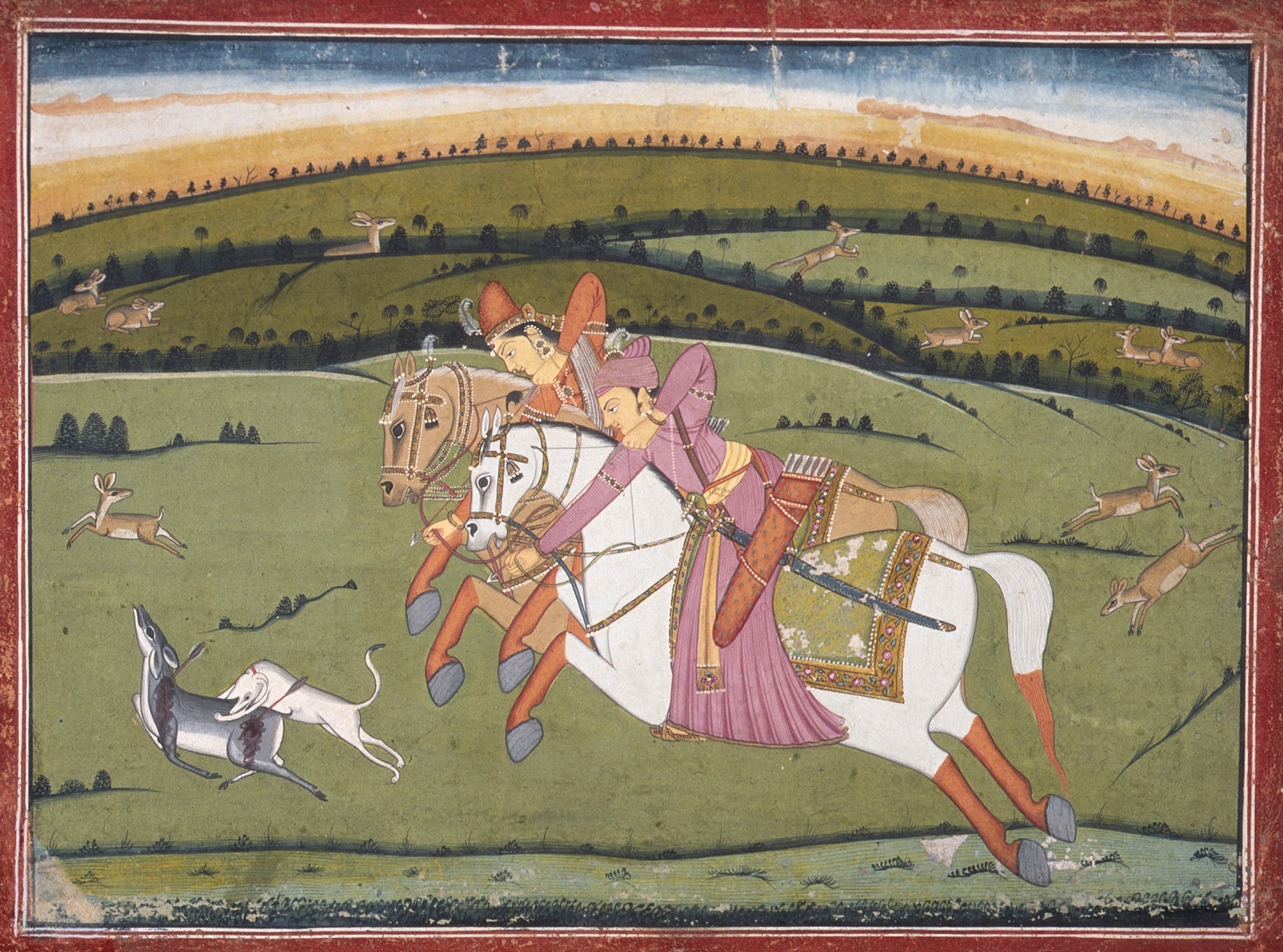
For a couple whose legendary relationship was built on a love of poetry and music, Baz Bahadur and Rani Roopmati appear an awful lot in hunting scenes in miniature paintings. Their poems are celebrated + there are enough subsequent songs on the romance, unfortunately hard to track down good translations. A few snippets here.

There seems to be a single English translation dating to 1926 of the original Persian language romance of 1599 on Baz Bahadur and Roopmati authored by Ahmad-ul-Umri.

Pic source: X, X and X.

PostScript: Baz Bahadur was defeated by Rani Durgavati, the Gond Queen, around 1556. That decisive defeat left him averse to war. In 1561 however Baz Bahadur was forced to defend Malwa, lost to Akbar and fled.  Roopmati poisoned herself rather than surrender. The Mughals then turned to Gond.  Despite resistance the Gond army eventually lost, largely due to the lack of artillery. Rani Durgavati died in 1564 on the battlefield by her own hands resulting in the Gonds of Garha Mandla becoming a vassal state of the Mughals.

Adham Khan aka Baz Bahadur’s nemesis was more than taken up with the famed musicians and dancers of Baz Bahadur’s court retaining more than a few of them for his own pleasure and sending on only captured elephants to Delhi. Eventually Adham Khan was killed in 1562 by royal order. Those dancing girls? Akbar did get them, you can see them in the Akbarnama. And Baz Bahadur? He too ended up – probably as a musician – in Akbar’s court.

Posted in 16th Century, Art, Asia, churidar kameez, Costume, Culture, Deccan, fashion, historical art, historical costume, historical dress, History, hunt, indian art, Indian Dress, Indian History, Indian men, Indian Singers, Indian Women, Mughal, Music, Paintings, Poetry, Romance, Royalty, Women | Tagged , , , , , , , , , , , | Leave a comment

Recreating Vintage/Historical Art

This slideshow requires JavaScript.

Like him or hate him, Raja Ravi Varma remains influential more than a 100 years after his death. Recreating his work seems to be a bit of a thing ranging from the recent Rang Rasiya to Makaramanju to Pushpamala’s photo performances.

Ananthabhadram recreates several paintings (Hamsa Damayanthi, Lady in her dressing room and a few other paintings of Malabar women, The Milkmaid, Maharani Chimnabai, Lady Holding a Fruit and Contemplation) in the song Pinakkamano.

Pictured here: Kavya Madhavan in Ananthabhadram and Ravi Varma’s In Contemplation (Reproduction) and Hamsa Damayanthi.

This slideshow requires JavaScript.

Recreating Hemen Majumdar‘s Study of Miss Shelly Gupta (1939) for a new documentary on the painter.  See also X.

Though I guess every Hindi movie with clingy wet saris is a homage to Hemen:)

This slideshow requires JavaScript.

Recreating Nainsukh’s Mian Mukund Dev in Amit Dutta’s documentary on Nainsukh. The lady in red is identified as the singer Amal.

Via cineaesthetica.

Posted in 16th Century, 1900s, 1930s, Art, art recreation, Asia, Bengal, Documentary, ghaghra, historical art, historical costume, indian art, Indian Women, Malayalam Cinema, miniature paintings, Paintings, Sari, Vintage, vintage costume | Tagged , , , , , , , , , , , , | Leave a comment

Abhisarika Nayika

She’s taken off her belt (with it’s tingling bells)
also her jingling anklets
her silk sari is soaked through-her body too,
to the bone. Thank God!
for the lighting flashes:
They show her the path
the one her messenger described.
Now she’s arrived. She stands there
tossing her long hair, drenched by rain
bangles ringing as if announcing
“I’m at the door!”.*

The Abhisarika Nayika is generally – but not always – shown in costumes of blue or dark colours. This is especially so if the painter is depicting her in the darker half of the lunar month (krishna paksha, pic 1). If it’s the brighter half of the lunar month (shukla paksha) the painter will usually depict the nayika/heroine in white clothes.

There are further classifications of the abhisarika but in all cases it is a woman who goes out to meet a lover or calls a lover over i.e. they all exert agency.

Also more examples of front open tunics, loving the delicate patterning on the garments.

*translated extract of Srinivasa Diksitar’s Bhavana Purusottama (16th cent.) by David Shulman

Pic Sources – X and X.

Posted in 16th Century, 17th century, Art, churidar kameez, Costume, fashion, historical art, historical costume, historical dress, India, Indian Dress, Indian fashion, Indian History, Indian Women, Islamic Dress, miniature paintings, Mughal, Poetry, Sanskrit, Sanskrit Drama, Sari, Women | Tagged , , , , , , , , | 2 Comments

The Maharashtra Post

Zee Talkies got a bunch of actors to recreate iconic roles in Marathi cinema for its 2013 calendar. The ones in this post are:

Pic 1-Urmila Kanitkar as Shanta Apte in Kunku.

Pic 2-Amruta Khanvilkar as Durga Khote in possibly Rajmukut.

Pic 3-Sonalee Kulkarni as Jayshree Gadkar in Sadhi Mansa.

Pic 4-Mukta Barve as Smita Patil in Jait re Jait.

There are different kinds of handlooms in Maharashtra. I can’t exactly id the sarees but I am guessing Pic 1 is Maheshwari, Pic 2 is Narayanpet (a bit uncertain about this) and Pic 3 and 4 are Ilkal* because of the characteristic pallu. In Pics 1, 3 and 4 the blouse is khan.

In the pics you can see some of the several styles of bindi in Maharashtra. The first of course is the kumkum/sindoor worn by married women and not specific to Maharashtra.  In Pic 2 you can see the chandrabindu – normally a red crescent with a black dot underneath – which is quite particular to Maharashtra (and maybe parts of Goa and Karnataka).  In Pic 3 is a horizontal red line, also quite specific to Maharashtra.  I canvassed a couple of friends but the only information I have that it possibly worn by rural women and is specific to some castes. A few accounts of Deccan paintings refer to it as chiri. Last up the black designs that used to be worn by tribal women (sometimes these were tattoos).

*Ilkal saris made of silk and mixed silks in Ilkal in Karnataka were very popular and fairly expensive in the 1900s or so in Maharashtra. Subsequently cheaper varieties were developed in Maharashtra which is why its probably a rural sari in pics 3 and 4.

More Maharashtra posts on tumblr.

Posted in 1930s, 1950s, 1970s, 20th century, Actor, Cinema, Costume, Culture, Dance, Dancer, Early 20th Century, fashion, Film Costuming, Indian Cinema, Indian Dress, Indian fashion, Indian Women, Maharashtra, Movies, Sari, Sari Blouse, sari history, Vintage, vintage fashion, vintage sari | Tagged , , , , , , , , , , , , | Leave a comment

The 1980s Recap

This slideshow requires JavaScript.

Apologies for my absence!

As always on tumblr the 1980s. Not the best of decades for fashion but damn young Supriya Pathak was a goddess. And my style icon back in time. And a good actress to boot – someone please resurrect Idhar Udhar for us 1980s DD tragics. The other photograph is of Jayalalitha and Sivasankari. True story. I met Sivasankari once on a flight. Lovely lady.  We had a brief chat in which I defended my lack of Tamil reading skills – what can I say, it was the age of Rushdie and Roy – recalling this makes me deeply embarrassed.

And all the work on each decade at this link. This might be the last decade I cover because I can’t make up my mind about the 1990s – retro or not?! Also 1990s fashion – just looking at it makes me faintly depressed….

Posted in 1980s, 20th century, Actor, Bollywood, churidar kameez, Cinema, Indian Cinema, Indian Dress, Indian fashion, Indian Women, Salwar Kameez, Sari, Sari Blouse, Sets, Vintage, Vintage Blouse, vintage fashion, vintage sari | Tagged , , , , , , , , , , | 6 Comments

Bali

This slideshow requires JavaScript.

I spent some time in Ubud, Bali and despite being overrun with tourists it seemed to suffer little from the usual soulless nature of such places. It helped that I wasn’t in Ubud “proper” though I missed out on a few performances.  I can’t believe I never made the trip from Australia! Its been a long time since I felt such utter bliss, I left very reluctantly:)

The photograph of the 4 girls is taken at Tirta Empul, Bali.  The dress for a upacara (ceremony) includes a kamen (sarong) generally ikat or batik, kebaya (lace jacket) and selendang (outer sash for kebaya, also generally the minimum requirement for entering a temple). The sabuk was traditionally a long broad cloth wound from the hips and around the torso over which the kebaya is worn. Also keeps the kamen in place. I think this has been replaced by a tube top these days though there must be some additional means for securing the kamen.

Ritual cloth is everywhere in Bali. Along with Indonesian terms for clothing like kain you also chance upon wastra (Sanskrit) and dastar (Persian) now and then.

Posted in 21st century, Asia, Contemporary, Costume, Culture, Flowers, Girls, Hinduism, South East Asia, Travel, Women | Tagged , , , , , , , | Leave a comment

The Autumn Post

We are kind of heading towards autumn in India. Less marked by weather and more by festivals these days. So a little bit about the kuṟiñci, an autumnal flower, that bloomed in some parts of the South this year.

krThe poems that are set in the autumn months are remarkably consistent in imagery and in resulting mood.  In the Sanskrit and Prakrit poems, the monsoon has ended, the skies have cleared, and the whole world is cool and washed clean, leaving the poets with a fresh emotional canvas. The Tamil poems set in the autumn months are composed in the kuṟiñci (conehead flower) landscape, the one appropriate to love-in-union and more especially to love that is kalavu (stolen, clandestine) and not yet legitimized by formal marriage. These poems are set by convention in the hills, and even though the heavy rains of the monsoon have ended, the poets who composed poems in this context still draw on rainy, misty imagery set against the dense darkness of midnight. The Circle of Six Seasons, A Selection from Old Tamil, Prakrit and Sanskrit Poetry.

The Kuṟiñci (குறிஞ்சி) is a shrub that flowers once in twelve years.  This year is one of them.  It is often associated with autumn (शरद्) by way of the season’s association with the kuṟiñci poetic mode. In general what is referred to is the neelakuṟiñci (blue kuṟiñci).

Kuṟiñci painting by Remya Kumar.

Neelakuṟiñci up close.

Posted in Art, Flora, Flowers, il nadu, oetry, Paintings, rinji, Seasons, South India, Tamil, Tribal | Tagged , , , , , | 3 Comments

The 1970s Recap

Wrapped up the 1970s on tumblr: 1970s, sari history, fashion history.

Jaya-Bhaduri-in-Piya-Ka-GharAnd a very random round up of the decade it was:

Indira Gandhi was elected Prime Minister with a decisive majority in 1971.

The same year the Indo-Pakistan war of 1971 resulted in the creation of Bangladesh.  Subsequently the Simla Agreement took place (the young Benzair Bhutto in Simla).

The Shillong Accord took place in 1975.

Nav Nirman, the Bihar Movement and the Chipko Movement all began in 1974.

Emergency was declared on 25 June 1975. It led to the arrest of many of India’s leaders.  The Emergency is a well documented period in Indian history e.g. the compulsory sterilisation program of the years, the killings at Turkman Gate, the Rajan case and the incarceration and death of Snehlata Reddy.

The lifting of Emergency in 1977 was followed by a general election which led to a new government, the first time Congress lost power after Independence. Parliament was however dissolved in 1979 and Indira Gandhi was back as Prime Minister in 1980. The same year Sanjay Gandhi was killed in an aircrash.

The Marichjhapi incident took place in 1979. The incident is referenced in Amitava Ghosh’s The Hungry Tide.

The Samba Spy Scandal also took place in 1978-1979.

MISA and COFEPOSA were the 1970s best known acronyms.

India conducted its first nuclear weapon explosion in 1974. Aryabhata was India’s first satellite followed by Bhaskara in 1979.

In 1978 the Sarda Act was amended to raise the legal age of marriage to 18 for girls and 21 for boys.

The Mathura rape case in 1972 led to amendments in laws pertaining to rape, albeit only by 1983.

The crash of Air India 855 was the biggest in Indian aviation history until the 90s.  The Morbi dam disaster took place in 1979.

India won the hockey World Cup in 1975.

Amar Chitra Katha’s major titles date back to the 70s.

Though the 1970s started with the “King of Romance”, Rajesh Khanna by the end of the decade Amitabh Bachchan, the Angry Young Man persona and Sholay had all happened.

Apparently Panna Dossa was the big cheese of sari fashion in the 1970s. She started a sari store called Kalindi and designed saris for Indira Gandhi (opinions vary wildly on her as a politician but sartorially she rarely put a foot wrong) but I can’t find much else on her.

70s: The decade of innocence.


Posted in 1970s, 20th century, Actor, Bengal, Bollywood, Culture, Feminism, History, India, Indian Cinema, Indian fashion, Indian men, Indian Women, Politics, Sari, Sari Blouse, sari history, Tumblr, vintage sari, Women | Tagged , , , , , , , , , | 2 Comments

Plucky Girl

Sanskrit poetry is so often full of lovelorn ladies unable to bear separation from the hero (Virahotkanthita Nayika). And this recurs often in those Radha-Krishna paintings. And of course Hindi cinema is full of “viraha” songs.  But none of that for this 7th/8th century lady in the Amaru Shataka (translated as Erotic Love Poems from India) going her own way.

Posted in 7th century, 8th century, Ancient India, Feminism, Girls, Indian Women, Literature, Love, Poetry, Romance, Sanskrit, Women | Tagged , , , , , , , | Leave a comment