
[X]
Indian Christian Girls, circa 1900 with long sleeved blouses.
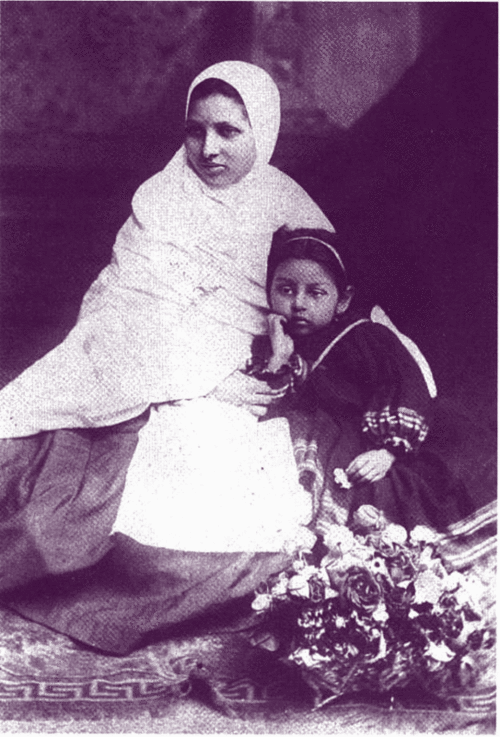
Pandita Ramabai, author of The High Caste Hindu Woman and an early feminist and social reformer, converted to Christianity and went on to found the Mukti Mission.
It isn’t completely clear in this picture, but Helen Dyer records in her biography of Ramabai that she chose to retain Indian dress. Lakshmibai Tilak, also records that Indian Christian women chose to adopt the pleated sari and blouses with wrist length sleeves and kept ornaments to a minimum.
PS: Ramabai also wrote an account of her visit to the US, which is now available in an English translation.
Christianity has a fairly old history in India.
However, the arrival of “Christian soldiers” during the British Raj seems to have given rise to questions of attire for missionary work. For the most part, most women missionaries appear to have adopted the sari and long sleeved blouse. An attire also adopted by Indian Christian women at the time.
As an aside, though Hindu women (and other religious denominations in India), seemed to have no problem in adopting the blouse, skirts, dresses and gowns were rarely adopted because it was far too identified with the Christian West. Instead the sari at times seems to follow the silhouette of the dress/gown depending on the decade, sometimes wound twice to give fullness, sometimes draped tight to follow the lines of the body.
[X]
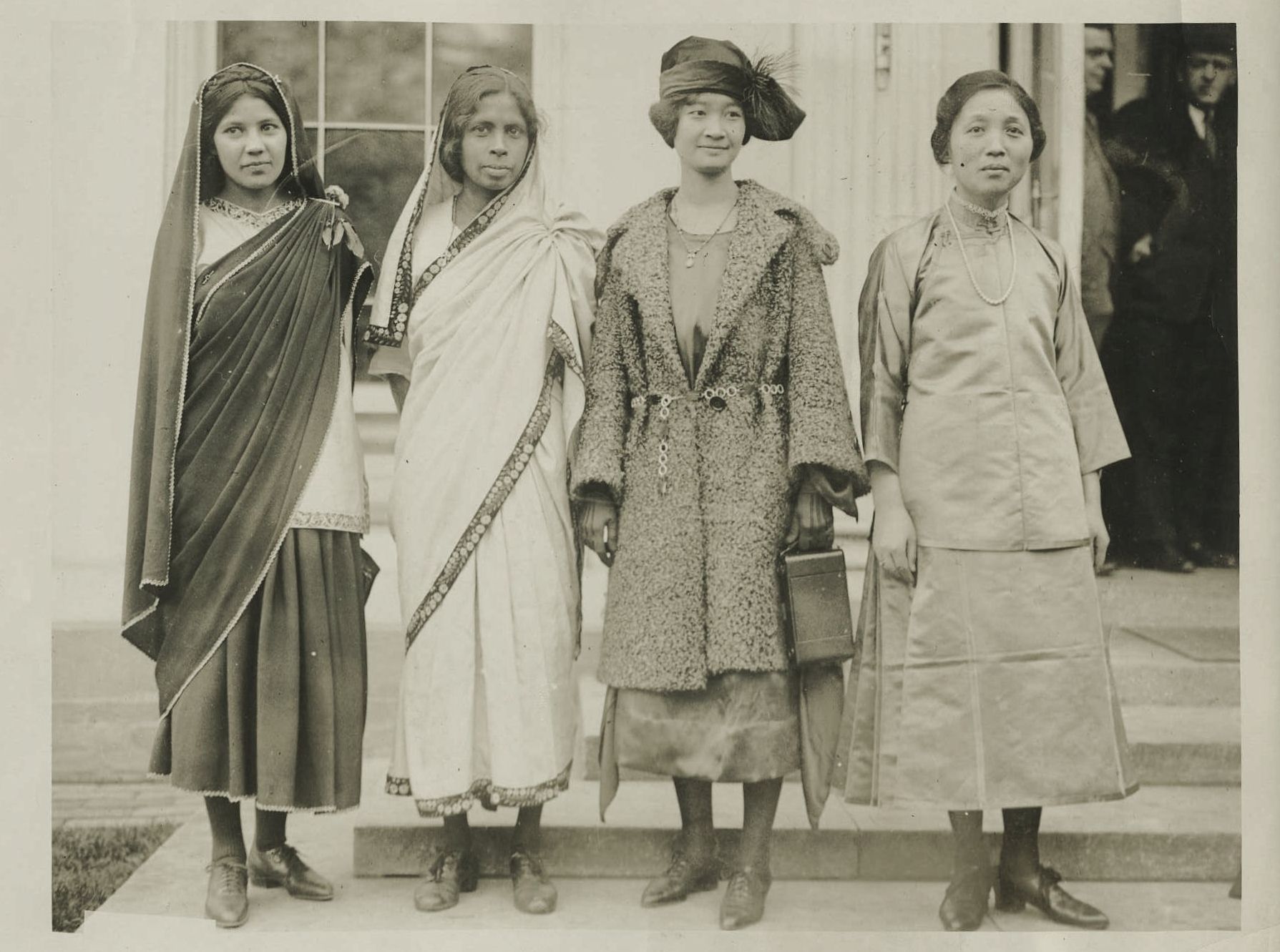
This picture is from a 1922 meeting of foreign missionaries in Washington. The women are Isabelle Dux (India), E.N. Thillayampalam (India), Leoedegaria Sapao (Philippines) and Mei-Lien Chang (China).
For awhile the short sari worn with boots was fairly common. And as with many photographs of this time, the sari is pinned with a brooch and its loose end draped over the head.
[X]
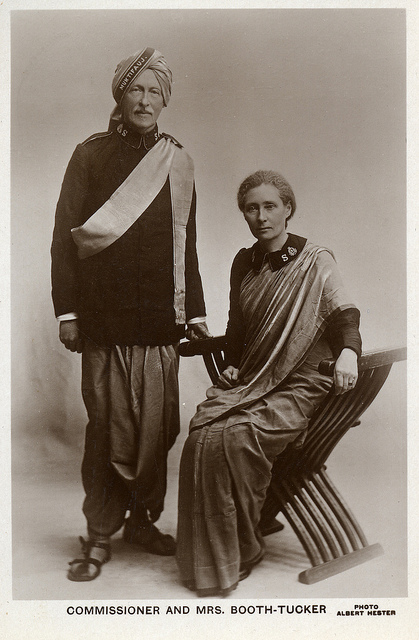
Almost all photographs of Salvation Army volunteers of the time have both men and women in this uniform. In fact there appears to have been a deliberate effort to adapt to Indian culture.
It appears the saris were a sort of sandalwood/saffron colour with a red blouse.
A bit on Booth-Tucker here.

Samuel Stokes came to India as a missionary. His wife appears to have converted to Christianity and in this picture she is in a long sleeved blouse.
Subsequently Stokes converted to Hinduism (as did his wife). His life story is the subject of a biography by his grand daughter. And those apples in Simla –he might have had something to do with them.

In the same tradition, Mother Teresa in a sari tied Bengali style and again with the long sleeved blouse.
Both Maitreyi and Na Hanyate (books I referred to in my post on Mircea Elaide and Maitreyi Devi) refer to Indian flowers and scents. So I thought I would do a post on advertisements for Indian/Ceylonese scents. Though not all of them feature saris and/or blouses.
Grossmith, a perfume house which has been recently revived, was one of the first to introduce oriental scents in 1891.
The advertisement for Phul-Nana doesn’t feature a sari but is vaguely oriental (yet distinct from the advertisement for the perfume, Shem-el-Nessim which draws its name from the Arabic).
Wana Ranee (Forest Queen, advertisements from around 1914) uses Ceylonese women in all its advertisements and appears to be floral in nature. The picture here is suggestive of the half-sarees popular in South India. And I like that the Wana Ranee always has a rose tucked in her hair!
And lastly, by 1923, the advertisement for Ganika (Sanskrit for Courtesan) while still trading on the mysterious East is otherwise modern in nature.

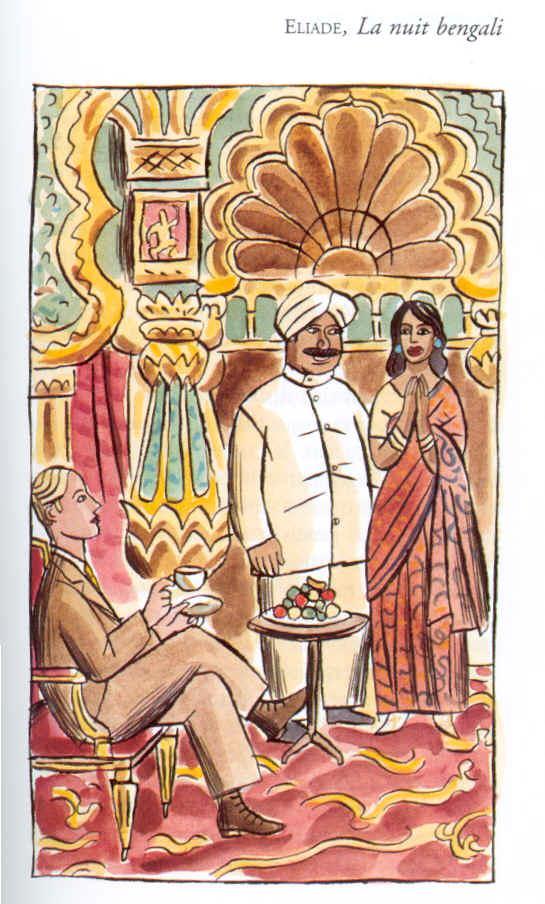
Apart from the movie based on Maitreyi/La Nuit Bengali, the book covers also leave much to be desired featuring as they often do a generic exotic Indian woman barely indicative of the decade in which Maitreyi takes place.
The first cover is the closest to a realistic representation given that it seems to be a painting from around the time (or similar to Tagore’s paintings around the time).
The second cover, while not entirely accurate, is at least an attempt to recreate a scene from the book with attire from the early twentieth century (though not necessarily Bengali).
[X]

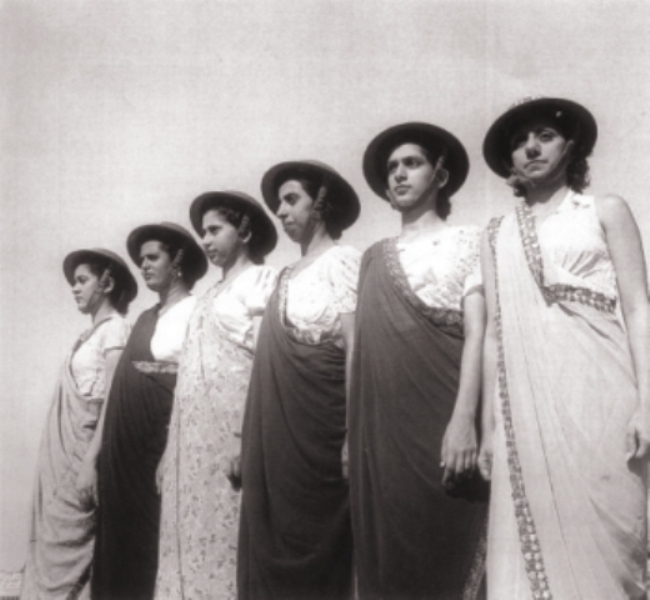
At the 1931 Congress meeting, Manmohini was a minor celebrity, beseeched by young women and men for her autograph and frequently snapped by Brownie cameras. When a young man offered to drive her and her friends to an airstrip where a small plane had landed, he soon had a car full of single women in their late teens and early 20s ready for an adventure. The young women donned helmets and prepared for a flight that never happened. However, the fact there was no flight is of little importance compared to what this photograph represents in terms of female autonomy in the early 1930s. Gandhi’s initiatives legitimated independent political action by young men and women that made possible new friendships and adventures. At the same time, these educated and self-assured young women gave the North Indian movement a youthful, self-confident and glamorous image.
A little intrigued by the attire of the girl without a helmet. The blouse is rather long (probably true for all the girls). Her hair seems to be cut short too and the shoes look quite fashionable.
[X]

All the sarees are worn Parsi style. Its kind of interesting that the blouse as a form of sedreh worn under the sari is relatively unchanged over two decades or so. As are the bordered sarees. And I think I spy a collar on one of the blouses (I love collars).
[X]


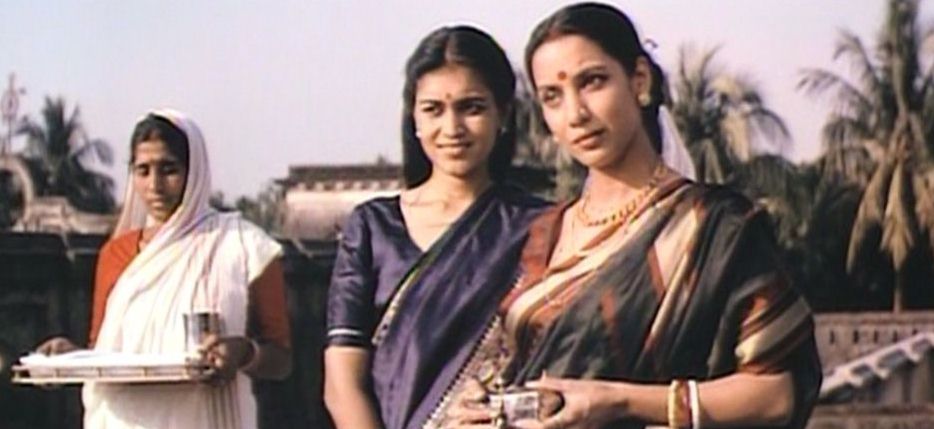
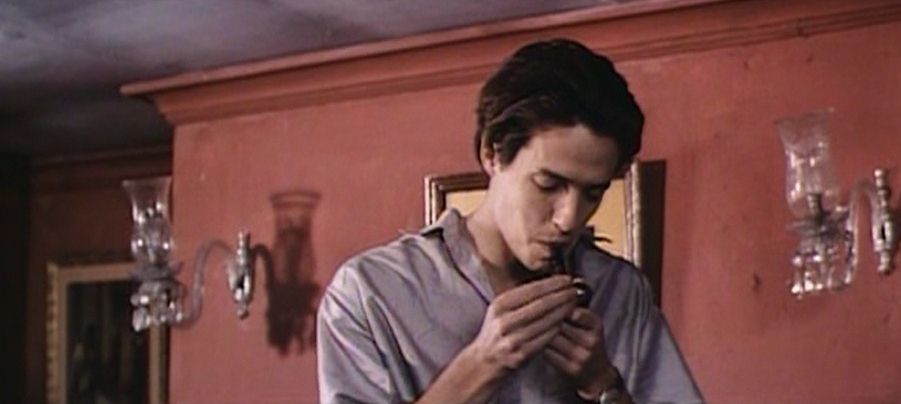

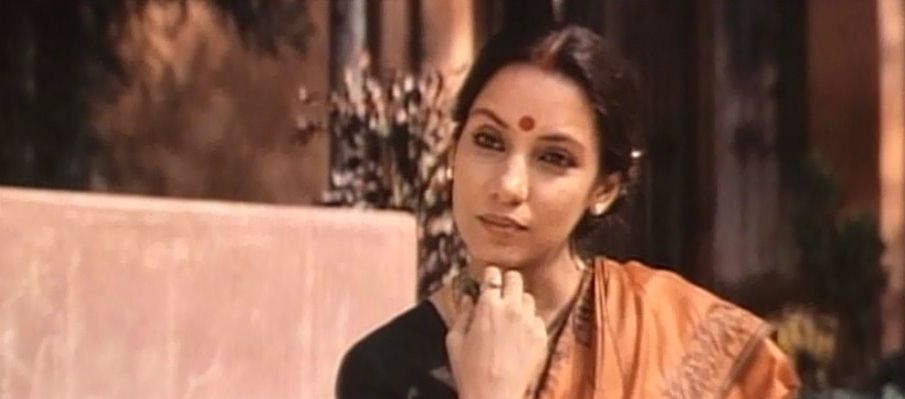
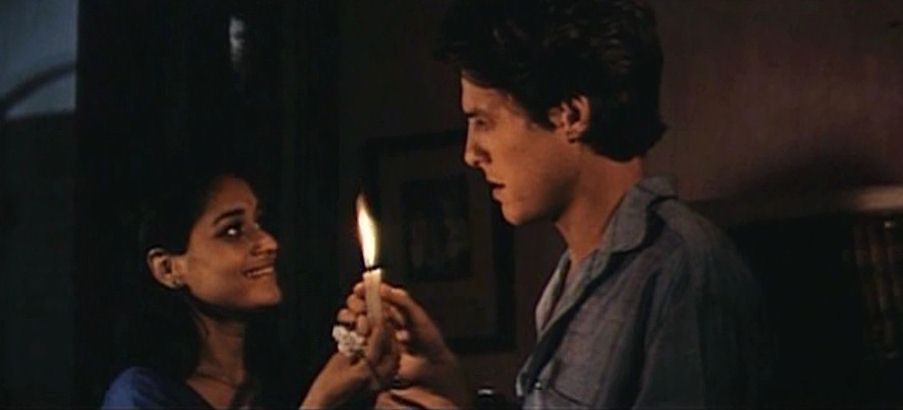

The movie adaptation of Maitreyi starred Hugh Grant and Supriya Pathak and is a listless Jean-Claude Carriere adaptation in which the costuming is the least of its troubles. But it is as uncertain as Hugh Grant’s French accented English in the film, partly because it is never made clear which year the movie is set in. However, the film largely borrows from the novel and leaves intact references to Tagore. For the most part Supriya Pathak wears handloom sarees and blouses common in the 80s. And Alain/Mircea never appears in Indian dress.
Shabana Azmi plays Maitreyi’s mother in the film. While her saris are worn in the Bengali style, the blouses are fairly unremarkable.
Apologies for the pics-my copy has a pretty crap transfer.


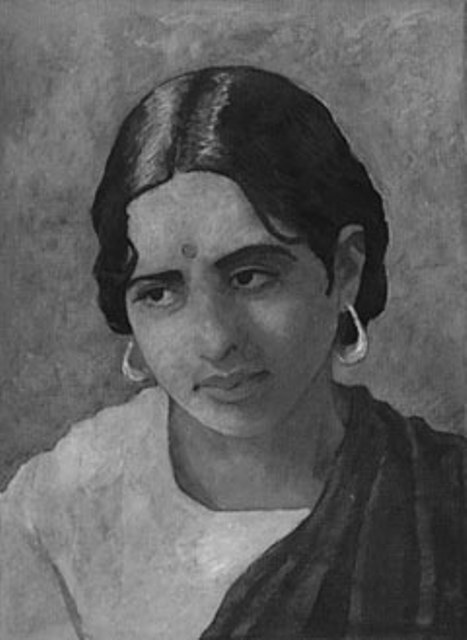
She is without doubt the most gifted and enigmatic of all the girls I have known. But obviously I cannot marry. What will become of my freedom?
Mircea is twenty-three, I am sixteen. But both of us are a bit too serious for our age.
In 1930, while living in Surendranath Dasgupta’s house in Calcutta, Mircea Eliade fell in love with his daughter, Maitreyi Devi. Subsequently he wrote the thinly disguised roman á clef, Maitreyi/La Nuit Bengali. In 1974, Maitreyi Devi wrote her account of his time in her father’s house in Na Hanyate, also a roman á clef. Both books did not appear in English translation until 1994. Subsequent analysis of the book has been largely of the he said/she said, East/West sort but I won’t go into it here, though I might point you to this review.
La Nuit Bengali/Bengali Nights was made into an English movie of the same name, which was promptly banned in India.
Na Hanyate found its way into Hum Dil De Chuke Sanam though it is uncredited.
There aren’t very many photographs of the two from the 30s but in the few Mircea Eliade appears in Indian dress. Maitreyi is usually in a simple sari (she was greatly influenced by Rabindranath Tagore) and in one she seems to be in a sleeveless blouse much like the fashions of the 20s/30s.
 Vintage Indian Clothing