
And of course you need to know about the many drapes possible at The Sari School.
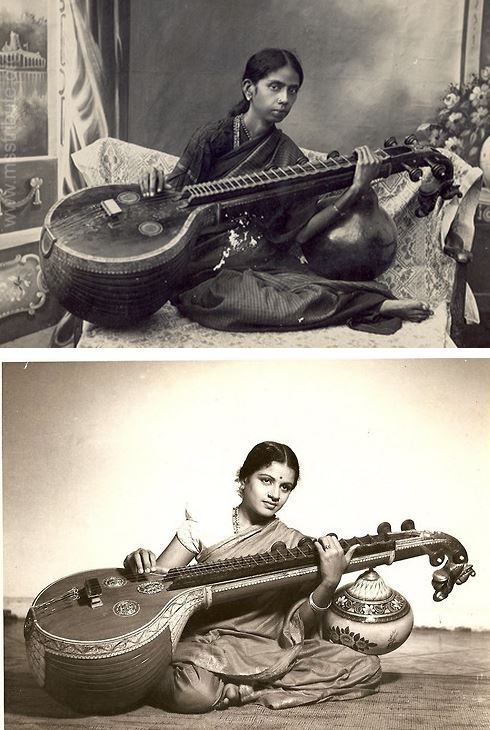
Mothers and Daughters-1
MS Subbulakshmi (MS) was one of India’s most famous and celebrated singers. Her mother, Shanmugavadivu (note that the S in MS is her mother’s name) was a famous veena player. Pic 1 is of her mother, Pic 2 of MS playing her mother’sveena in 1945.
MS really seemed to love puff sleeve blouses, a number of her early photographs have her wearing the style.
Also see here.
I have been tied up a bit with a move but tumblr had some queued posts which got posted over the past few weeks. A few sets as usual which I always find useful to demonstrate the persistence of a motif:

This gallery contains 3 photos.
In the Gallery: 1. “An elegant lady stands facing right holding a white floral garland with both hands. She is finely dressed in an olive green pleated sari edged with gold over a crimson underskirt, the end draped over her head like … Continue reading
 Nargis illustrated by colonelhathi at tumblr. I love the daffodils (aka nargis flower) at the side as a finishing touch. And divine blouse.
Here are the screencaps on which it is based. Which kind of makes the illustration even more perfect.
There are a few more illustrations at the site – they definitely need to go into a Hindi alphabet book for adults:-)

A departure from my usual posts.
I am pretty much apolitical. But I am a woman. And this speech from Ms Gillard, Australia’s first female PM, resonated with me. Via [X]
Also Ms Gillard knits and I think it is wonderful that she had the top job and has a “feminine” hobby given that more than a few professional women feel the need to eschew this.
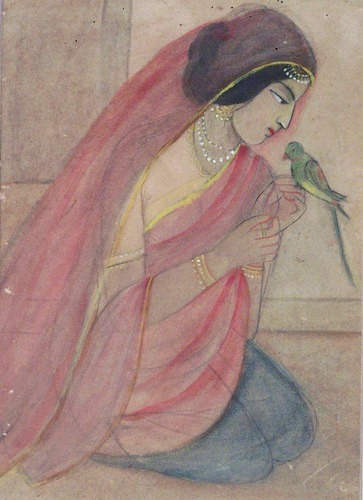
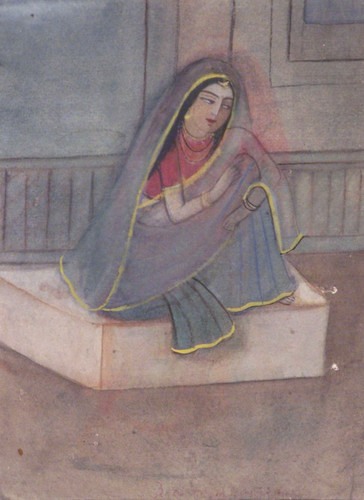
Sunayani Devi stands out not because of her degree of conformity to male peers but because of her distinct pursuit of a personal vision. Although Abanindranath Tagore and the Bengal School would have been influential, her concerns were more mythic than historicist. In addition, she was inspired by the folk pata painting style, familiar to the women in the Tagore household. Her subjects include women at their toilet, dolls, players, actors and themes from the mythic Radha-Krishna cycle. A precursor of folk art in the fine art tradition, she anticipated the more full-blown realisation of Jamini Roy (1887-1972). She also introduced a more margi, or heterodox element in an art practice that was seeking a more exclusive identity. Excerpt from Local/Global: Women Artists in the Nineteenth Century (Chapter on India by Gayatri Sinha).




 Vintage Indian Clothing