The Kappi Kultur Post

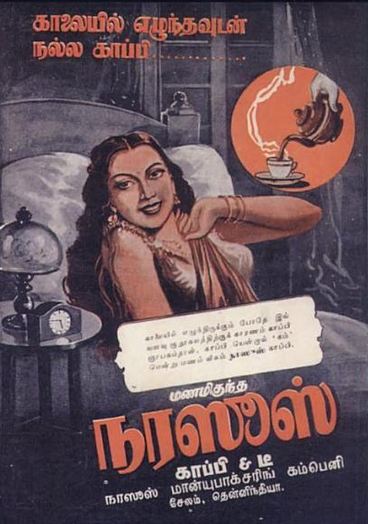
2 3                 good cup of tea or coffee makes all the difference to the start of a busy day— It drives away that sleepy, lazy feeling and peps up your energy. Make sure by buying only NARASUS— it’s always good. The Indian Review, GA Natesan, 1942.

Alas! This damned thing has got hold of women! Two cups of coffee have become the order of the day. Stri Dharma quoted in In Those Days There Was No Coffee-Writings in Cultural History.

Pic 1 is taken from AR Venkatachalapathy’s book In Those Days There Was No Coffee which discusses the rise of coffee houses and coffee culture in South India in the early 20th century (more correctly kaapi which after much discussion became a bonafide Tamil loan word). The sleeveless blouse and strategically draped slinky sari of the woman in this Narasu’s ad suggests the 1930s. The header of the ad loosely translates as “Get Up, Drink Good Coffee”, presumably a glamorous thing to do for single ladies:-)

Pic 2 is from Narasus facebook page.  The company was started in 1926. Its hard to place the decade of the ad, though in my mind this is the 1940s  and not the modern girls of the 1930s:)
Posted in 1930s, 1940s, Advertisements, Colonial, Early 20th Century, Indian Women, Sari, Sari Dress, Vintage | Tagged , , , , , , , , | Leave a comment

1925 – Karachi and Kolkota

1

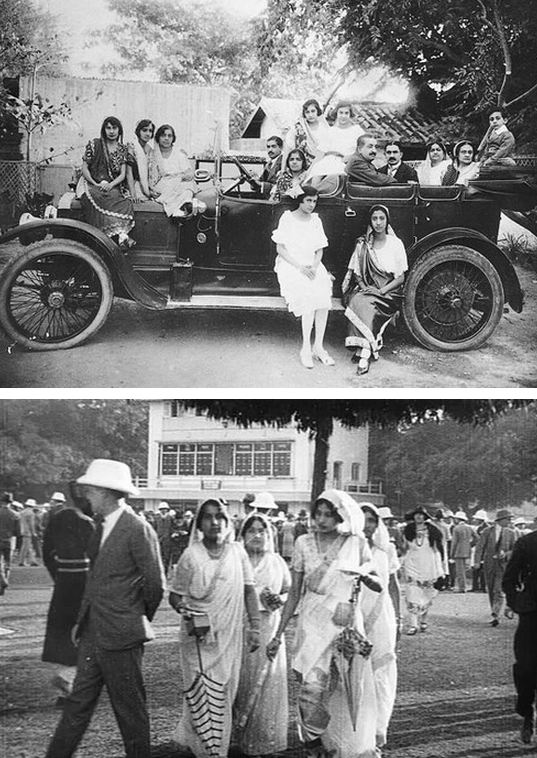
Saris in the 1920s on either side of the subcontinent 1) A Parsi family in 1925 Karachi and 2) A Calcutta Cup Race where “horses take second place to fashion” (from the film Calcutta Topical No 1-1925) . The pallu is worn over the head so often in this decade.  Also still a lot of blouse. The sari drape – pic 1 is Parsi, pic 2 the version adapted in Bengal -varies, otherwise the look is similar.

Do follow link 2 and check out the pic for Delhi Extract -1938 for Delhi fashion of the time.

Posted in 1920s, British Raj, Colonial, cycling, Early 20th Century, fashion, Vintage, Vintage Blouse, Vintage Dress, Women | Tagged , , , , , , , | Leave a comment

The Girls Post

zz


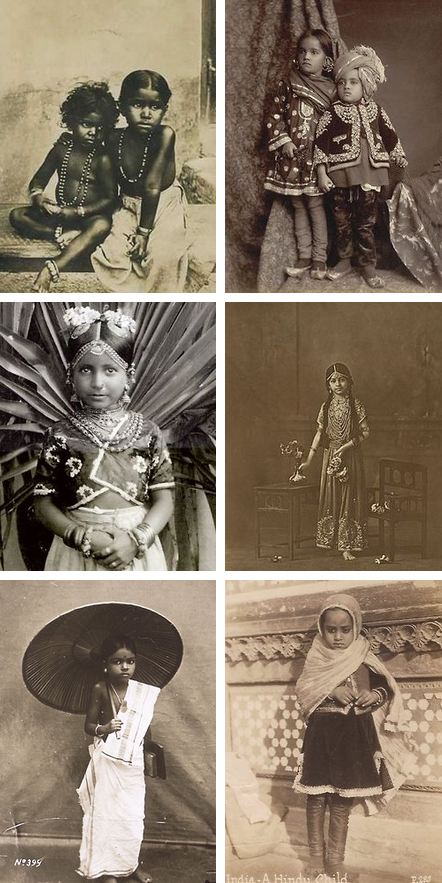
zzFrom this week’s series on costumes for young girls.

Posted in 1920s, 1930s, 1940s, 1950s, Children, Costume, Early 20th Century, Education, Girls, Indian Dress, Tumblr | Tagged , , , , , , , , , , | 2 Comments

The South India Post

zz

1.  A Maratha brahmin girl from Tanjore (Tamil Nadu) holding a marigold garland 2. A Tamil girl wearing jasmine flowers in her hair and a silk sari for a temple visit 3. A Muslim lady with a headdress of jasmine blossom and  pearls sewn into her hair and a silk and gold gauze dupatta worn over a coloured coat for outdoor wear 4. The daughter of a Muslim merchant from Triplicane in a red and gold bordered dupatta and silver anklets.

From Lady Lawley’s illustrations for Southern India (1914).

Posted in 1910s, British Raj, Colonial, Costume, Culture, Early 20th Century, Illustration, Indian Dress, Paintings, Sari, Sari Blouse, South India, Vintage, Women | Tagged , , , , , , , , | Leave a comment

The Dress Reform in Bengal Post

z13

On top of that, the kind of fine [clothing] material they wear is not fit to go out in society, and when the material becomes wet and clings to the body, then there is no difference between being naked and dressed.  Many a time a decent man hesitates to get out of the pond in such clothes, but women, displaying remarkable ease get out of the pond and walk home in their wet clothes……I don’t know when you will learn the real use of shame! (Anon. 1871)

But finally many have begun to realise the bad taste involved in the custom of wearing one transparent/fine piece of cloth (Hemantakumari Choudhury, 1901)

..all we have done at the Vidyalaya* is adopted a dress for the girls that combines the elegance of the national dress with the decency of the European(Brahmo Public Opinion editorial, July 4, 1878)

All the changes that took place in dress and the sometimes fierce discussion over these changes in Bengal.

Posted in 19th century, Bengal, British Raj, Colonial, Dress Reform, Indian Dress, Indian Women, Sari, Sari Blouse, Victorian, Vintage, Vintage Blouse | Tagged , , , , , , | Leave a comment

The Women in Love Post

z12

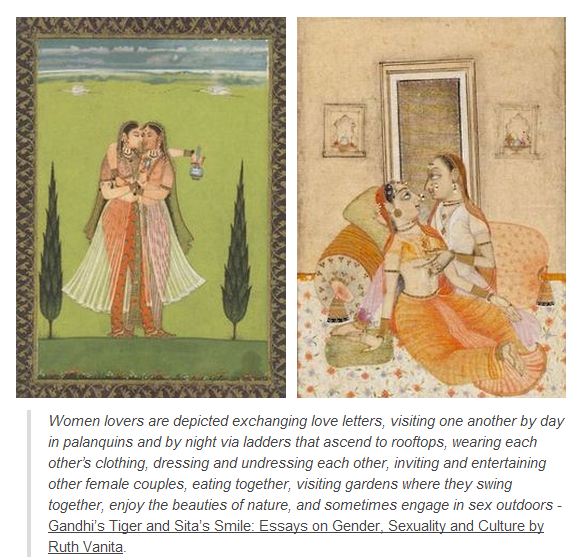
Lesbianism in 18th century art.

And an extract from Ismat Chughtai’s Tedhi Lakir.

Posted in India, Indian Women, Lesbianism, Love, miniature paintings, Vintage Dress, Women | Tagged , , , , , , , | Leave a comment

Links

z17Contemporary Pakistani Art.

A young woman in European male costume (I quite like this).

Pretty Punjabi Women.


Posted in Tumblr, Vintage, Vintage Blouse, Vintage Dress, Women | Tagged , , , , , , , , , , , , | Leave a comment

The Ancient India Post

Rather just a look at 2 early 20th century paintings recreating the era.

v1

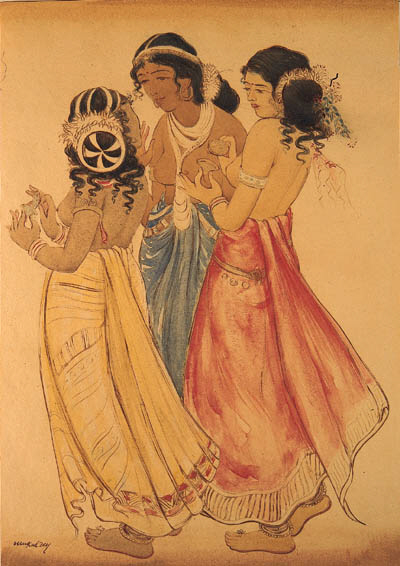
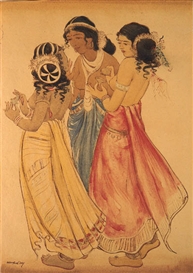
From dawn until late into the night I worked. By day I copied the parts of the wall that were well lit, and by night I shifted on to those corners that always remained dark; thus I economised both in petrol and eyesight. Mukul Chandra Dey, My Pilgrimages to Ajanta and Bagh.

Around 1918-1919, Mukul Dey made a trip to the Ajanta and Bagh caves to recreate the frescoes there.  Dey’s circumstances were modest and the trip wasfunded by commissioned portraits.  The work was eventually published in book form in 1925. “Dancing Girls” is possibly part of this or at least inspired by Dey’s trip given the costumes and hairstyles.  No bodices in this particulars painting.

More on the artist at this dedicated site. And a 1979 article.  Dey’s book seems a rather engaging read and I might order the book given I can only find truncated bits online.

v2

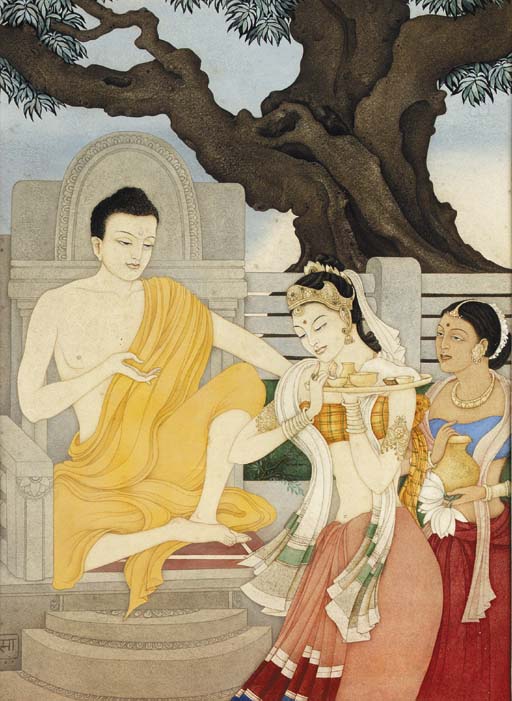
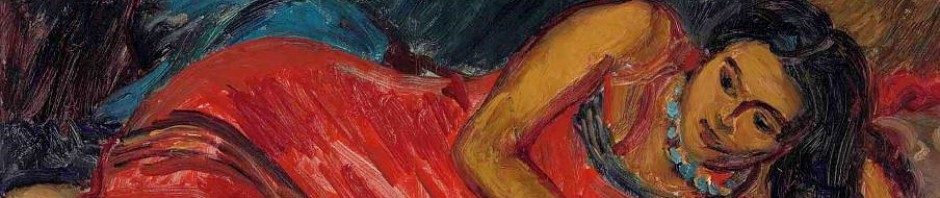
AmrapaliRoma Mukerji.

It is not often that you come across early 20th century Indian women painters but I can’t find much information on the artist.  This seems to be from a 1950s series of paintings on the life of the Buddha and probably has to do with the episode of Amrapali serving food to the Buddha.  Both she and her attendant wear an antariya, uttariya and cholaka (though the attendant has less finery and of course is a bit darker!).

Posted in Ancient India, Art, Bengal, Colonial, Costume, Courtesan, Culture, Dance, Dancer, Early 20th Century, fashion, Indian Dress, Paintings, Vintage, Vintage Dress, Women | Tagged , , , , , , , | Leave a comment

The Chinese Brushwork Post

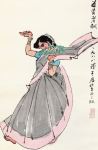
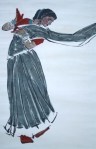
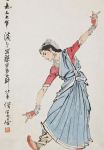
From Ye Qianyu‘s Indian Dancing Gestures – painted in the 1979s (X, X, X)

ZHANG DAQIAN_Indian Actress (1)


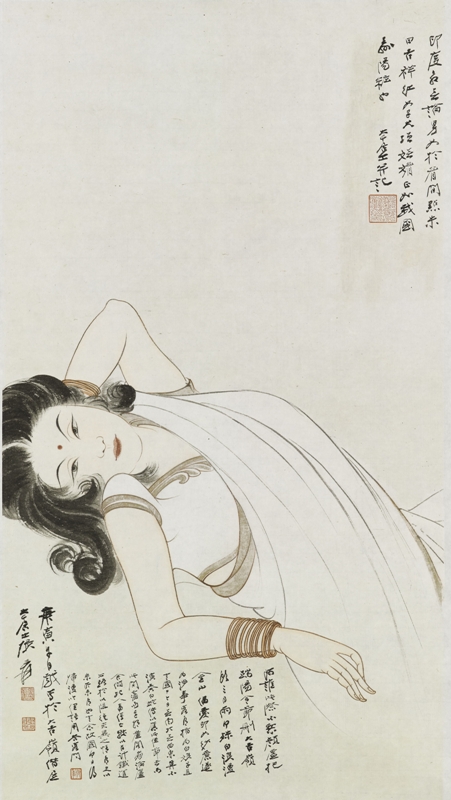
Zhang Daqian‘s Indian Actress (1950).

Posted in 20th century, Actor, Asia, Chhina, China, Dancer, Vintage, Vintage Blouse, Vintage Dress, Women | Tagged , , , , , , , , , , | Leave a comment

Ashapurna Devi

z12

In her trilogy, Pratham Pratisruti, Subarnalata, and Bakul Katha, Ashapurna Devi traces the progression of the feminist movement from colonial to post- colonial India. Anita Ghosh in Feminism In Indian Writings In English,  edited by Amar Nath Prasad.

Covers of Ashapurna Devi’s books (click to see larger version). The books to the right and left are Pratham Pratisruti, (available in English translation,torrent of  the 1971 movie)  the book in the middle is Bakul Katha (Bakul’s Story).  From right to left there is an evolution in the blouse, from the heavily Victorian influenced version with a brooch on a little girl (a look complete with ribbons for the hair) to the retention of the frill in the blouse to the pared down completely Indian version familiar from the 1950s on.

Of the books themselves, chronologically Pratham Pratisruti is the earlier book, a kind of awakening of feminist conciousness whilst Bakul Katha is a critique of a detached kind of feminism in post colonial India (rough summing up).

__*__

They are never the most popular but my favourite posts either are historical or have to do with literature.  I haven’t read much of Ashapurna Devi at all thanks to the few translations but I felt drawn to her when composing this post.  The trilogy made me reflect on my own family, from a grandmother married at 15 and unhappy throughout her life at her curtailed education and us, the moderns who take it for granted.  As it should be.

Posted in Authors, Bengal, Colonial, Early 20th Century, Feminism, Indian Dress, Novels, Sari Blouse | Tagged , , , , , | Leave a comment