All About Hair

I had a bit of a meandering look at the history of hairstyles in India on tumblr and as always this post collates it on wordpress.

curnakuntala (Sanskrit): locks or ringlets hair style.
alaka-avali (Sanskrit): hair arrangement in spiral locks
dhammilla (Sanskrit): hair bun

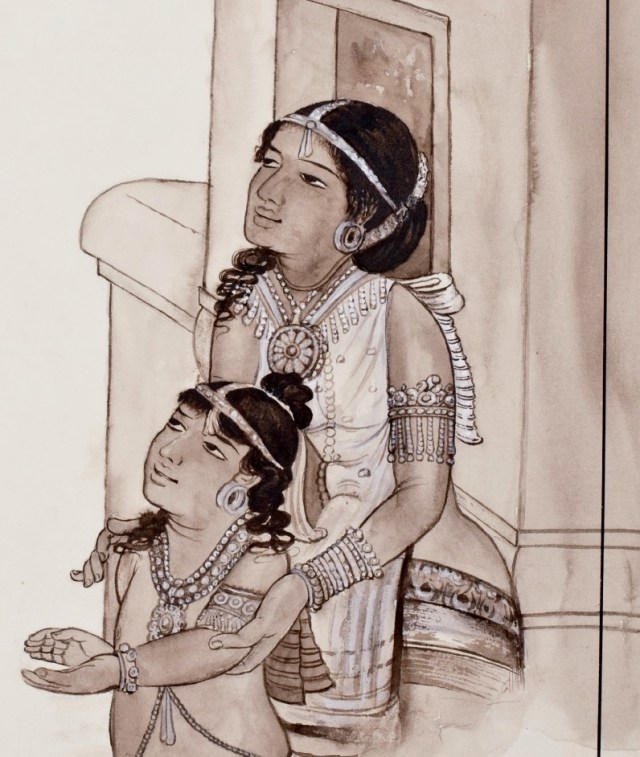
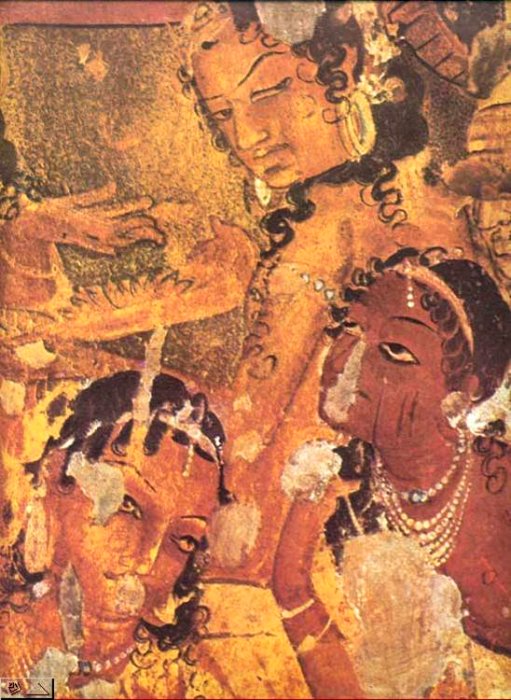
You could blame the Greeks but for a period of time everyone in the subcontinent was seemingly mad for curls. And ringlets and waves and completely improbable spherical somethings (though the last was probably confined to sculpture).  The beginnings seem to be in Gandharan art and representations of the Buddha but curls and elaborate coiffures appear in sculpture, literature and art for at least a few centuries later in different parts of the sub continent. The Gupta Age is probably the most classical style (see also X), the curls gradually disappearing from Indian art over later centuries.

Apart from the curls, the elaborate hair bun (I think the dhammiila is similar to the modern day khopa) was all the go. To this you could – if you wished – pin dupattas, flowers or jewels to give a style that recurs throughout Ancient Indian art.

In the pics: 1- Head of Parvati from Ahichhatra, U.P. 5th century,  2 – detail from 12th century sandstone from Madhya Pradesh, 3 – Ajanta fresco.

1O your hair, he said,
It is like rainclouds
moving between branches of lightning.
It parts five ways
between gold ornaments
braided with a length of flowers
and the fragrant screwpine. From the Kalithokai, translated by AK Ramanujam.

I have probably seen this photograph all over the internet but it also probably best fits the poem (bar the screwpine).

The five different hair styles usually mentioned in Sanskrit and Tamil texts include hair in a knot, hair gathered in a bun, hair curled, hair parted and hair plaited. The last, the veni, as everyone is aware has a long history and is often embellished with flowers and jewels.

The beauty and eroticism of wet hair – loose, yet to be braided, perhaps perfumed a little after a bath – recurs throughout Indian art and literature. Almost always the setting is outdoors, whether natural or landscaped.

Sanskrit literature is much given to conceits – with wet hair it plays on the beauty of water drops wrung from hair. Women drying their hair after their bath are usually depicted with a hamsa – the bird mistakes the water drops for pearls. Not entirely clear but depicted in the 8th-11th century sculpture from Morena, UP  in pic 1 and here.

Wet hair and beauty rituals of the bath are also seen in a number of miniature paintings like in pic 2 (18th century, Bikaner or Deccan).

Then again in colonial paintings as in pic 3 (Bengali woman wringing out her hair after bathing).

The early 20th century boasts a number of paintings titled After the Bath. One amongst several similarly titled works of  Hemen Mazumdar (pic 4).

Pic 5: Contemporary photograph via Getty Images.

12the sight of me combing my long hair
brings you back to your country
where you tell me
girls sit in the open air
combing each other’s hair.  Poem for an Indian Scholar, Crazy Melon and Chinese Apple, The Poems of Frances Chung.
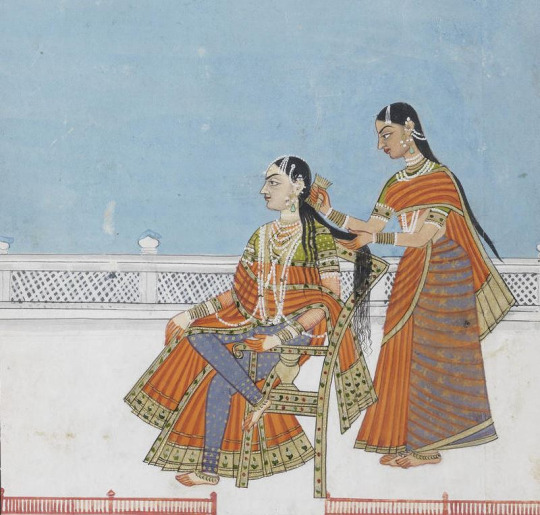
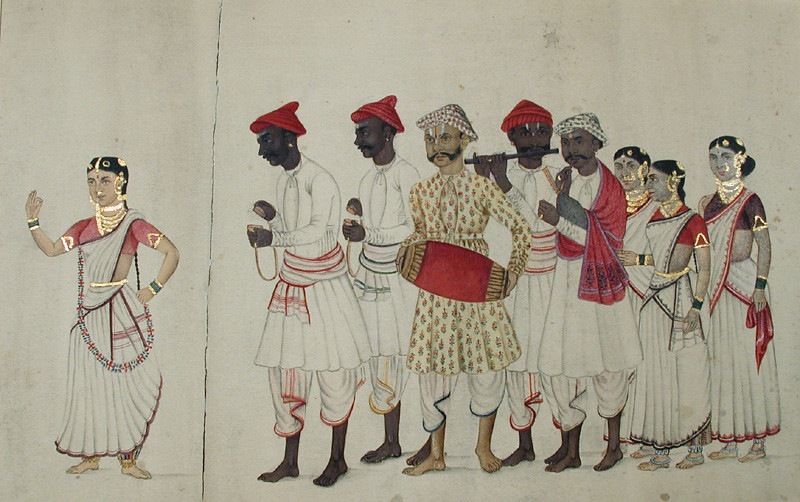
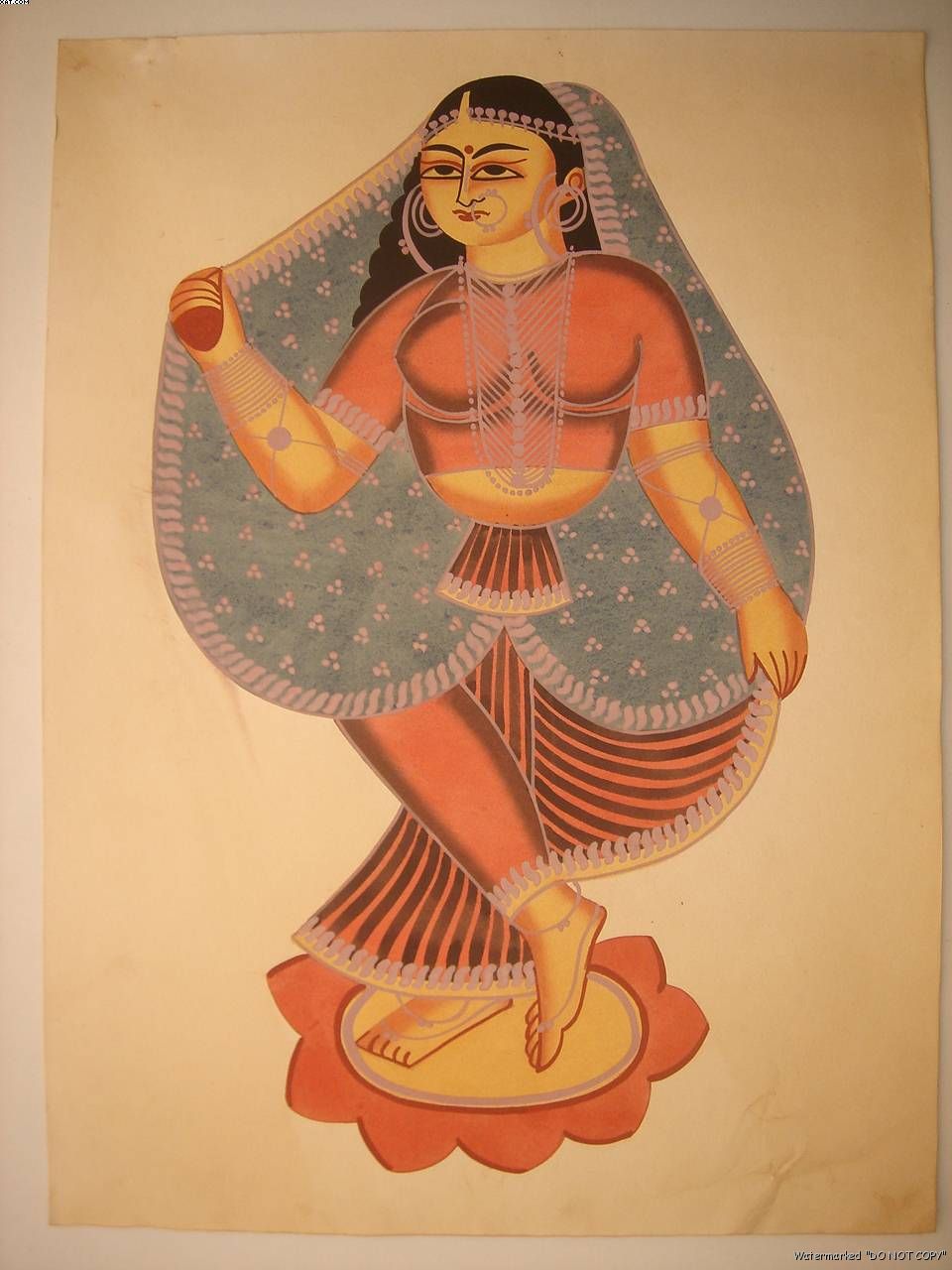
Perhaps it is the nature of miniature painting but for most of the 16th-19th century hairstyles are flat and either depicted loose or plaited (also in company paintings/Kalighat paintings.). As always with Indian hair jewels and flowers are present minimally or in abundance.  In miniature paintings additionally hair is often partially covered with an odhni.

The second painting depicts a nayika whose lover/husband is devoted to her (swadhinabhartruka).  Often paintings depict these nayikas having their foot decorated or having their hair dressed. This can also be seen in sculpture (e.g. Shringhar, Kushan period) but in miniature paintings the nayika and her lover are usually Radha and Krishna.

Pic 1 (Hyderabad, 1840)Pic 2: Kangra, 18th century.

This slideshow requires JavaScript.

simanta (sanskrit): sima + anta – boundary line/hair parting.

The hair parting itself may be a decorative aspect of the Indian hairstyle.  Additionally flowers or jewellery can be arranged along the parting (e.g. mang tikka as in pic 3 where a pendant is added and also substitutes for the bindi).  Apart from the decorative aspect, there are ritual aspects to the hair parting. E.g. the sindoor as a mark of marriage (on Konkona) in some parts of India or the simantonnayana (arranging the parting of the hair) ceremony.  See also X.

In the pics: Sulochana, Konkona Sen Sharma, Sitara Devi.

Their hair shimmered with an intense shine
and gave off a beautiful scent. Virsinghdev Charit, Keshavdas.

The hero was handsome
with oiled, curly hair, on which
fragrant pastes and perfumes
had been rubbed. The Handsome Hero, Kurinjipattu

You didn’t step out without a slather of hair oil, preferably scented, up until the middle of the 20th century in India.  Advertisements of the 40s and 50s promised black, glossy and groomed hair, many products were also strongly scented. Sometimes they made use of new ingredients like the glycerine of pic 3, sometimes they played on Indian tradition.

Pic 2 is for Himani.

1 2A look at hairstyles in a brief window of time: 1930s-1960s.

1930s: MS Subbulakshmi’s naturally wavy hair, a bit of finger wave for Miss Gohar.
1940s: The double choti on Baby Sulochana, perhaps a bit of a perm/roll for Brijmala.
1950s: Plaits and ribbons for Vyjayanthimala, a bit of wave and hairband for Roopmala.
1960s: Asha Parekh in a bun encircled with flowers, Unknown lady in a piled high hairdo.

1And even now, instead of working, I visualise her, a pale silhouette in a sari of blue silk, all interwoven with gold thread. And her hair! The Persians were right, in their poetry, to compare women’s hair to snakes. What will happen? I do not know. Maitreyi, Mircea Eliade.

Though there is many an Indian song dedicated to it, in my view the beauty of unbound tresses is most seen in Bengal (normally seen on younger women, older women tend to tie the hair in a bun or plait). Not the heavily styled and waved kind, just the natural fall and flow of tresses.  Usually it is worn unadorned but Mrinalini and Lotika, the daughters of Manmohan Ghose, have styled it with ribbons as was common in the late 19th/early 20th century. This is probably late 1910s or early 1920s.

Pic Source. See also X, X, X.

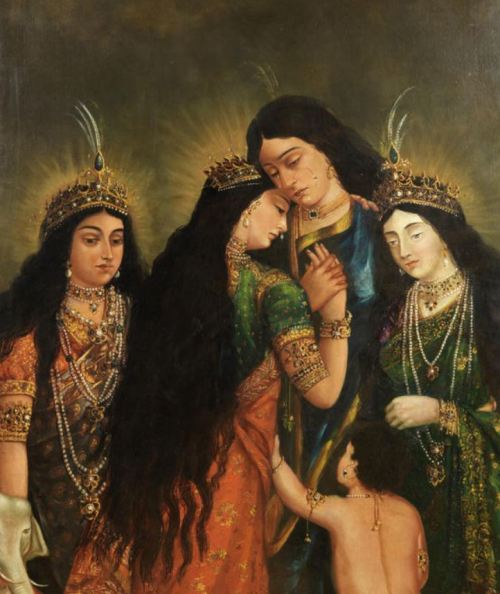
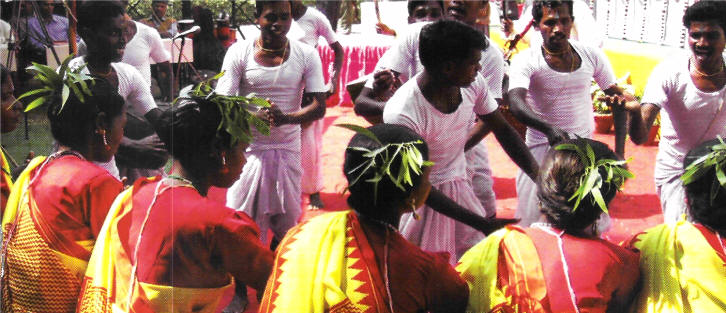
1Some forms of hair decoration (e..g the gajra) predominate in India. Like leaves are sometimes worn as a hair ornament in tribal communities in India (X, X). Flowers with elongated petals that resemble leaves are also worn. The arrangement of flowers of this sort, e.g. palash which is worn in the hair or lotus as in this painting is similar to the sun ray like hair ornaments often seen in vintage photos.

The painting: Charm of the East, AR Chughtai.

For previous posts on hair styles and decoration, see:

The 70s updosIn the 60s; The 60s bun; 1950s Ribbons; The evolution of ribbons; The 1950s hair style guide; The Jabakusum ad; The gajra post; Flowers in the hair; The plait; Nair hairstyles; Medieval Karnataka.

Posted in 1600s, 16th Century, 1700s, 17th century, 1800s, 18th century, 1930s, 1940s, 1950s, 1960s, 19th century, 20th century, Accessories, Ancient India, Art, Asia, Bengal, Bollywood, Colonial, Contemporary Style, Culture, Dance, Dancer, fashion, Flowers, Hair, historical fashions, historical hairstyles, History, indian art, Indian fashion, Indian History, Indian men, Indian Women, Jewellery, Medieval India, miniature paintings, Old Bollywood, Paintings, regional styles, retro, retro hair, Sanskrit Literature, Sculpture, Sets, Tamil, Tumblr, Vintage, vintage hair, vintage jewellery | Tagged , , , , , , , , , , , , , , , , , , , , , , | 5 Comments

The Buddhism Post

I had done this set of posts starting on Buddha Purnima on tumblr but it’s taken me till now to collate it on WP.  In some ways posts are more coherent on WP so despite the delay here it is.  As always it is not definitive but looks at parts of the Buddha’s life via various genres of painting. As for the costumes expect a heavy reliance on Ajanta art.

1The flowers of the flame trees, Which resemble parrots’ beaks, Make the ground resplendent, Like a congregation of monks Prostrate in worship at the feet Of the Buddha. [X]

For 4 May (Buddha Purnima).   Pic: Monks in Singapore. 2Painting at Bellanwila Rajamaha Vihara in Sri Lanka by Somabandu Vidyapathy (the murals were painted between 1990 and 1998). Buddhist temples usually have murals depicting the stages of the life of Buddha – I think this represents the marriage of Siddhartha and Yashodhara. A number of modern murals depicting Buddhist life draw on the costumes seen in Ajanta. 3The Great Departure of Buddha, Tempera on Paper, 1942 ( Manindra-Bhushan Gupta). This painting is evocative of miniature paintings with its detailed landscape and the pavilion with the sleeping Yashodhara and Rahul. The costumes are similar to depictions of Mauryan costumes. 4Yokoyama Taikan works depicting I think Sujata and the temptations of Mara. Again the costumes of the women have a lot of Ajanta/Ajanta as interpreted in the early 20th century influences.  I love the delicacy of this – Taikan visited India at one point and his influence is seen in early Bengal watercolours with a “wash technique”.

See also Roma Mukerji’s Amrapali. 5Yashodhara and Rahul meet the Buddha, circa 1880.  This is probably from a set made by students at the Bombay School of Art who made a number of copies of the Ajanta cave paintings between 1872 and 1885 when J. Griffiths was the Principal. The costumes therefore directly reference Ajanta art.

6[Mara:] That place the sages gain is hard to reach A mere woman can’t get there.

[Soma:] What harm is it to be a woman when the mind is concentrated and the insight is clear. [X]

Thai painting of Dhammadinna Bhikkhuni [X].  For more on women Buddhists see BhikkunisWomen in Buddhist texts. Rengetsu. For a discussion of Himalayan Buddhist Art go here.
Posted in 1880s, 1900s, 1940s, 1990s, Ancient India, Art, art recreation, Asia, Buddhism, Colonial, Costume, Culture, Early 20th Century, East Asia, historical art, historical costume, historical dress, History, Illustration, India, indian art, Indian Dress, Indian History, Indian men, Indian Women, Japan, Late 19th century, Paintings, Philosophy, Religion, Sanskrit Literature, Sari, Sri Lanka, Women | Tagged , , , , , , , , , , , , , , , , , , , , , , , , , | Leave a comment

The Regional Cinema Post

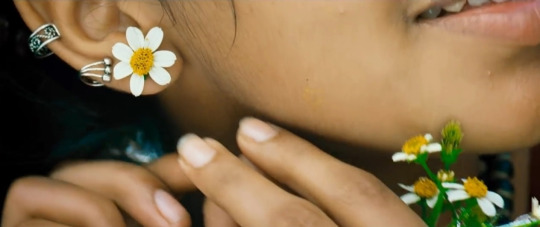
For very many reasons Bollywood is Indian cinema.  Now and then regional cinema makes a splash – especially at the National Awards – but for the most part the audiences are local.  You could however argue that all the interesting stuff happens in regional cinema, this was true even back in the day (I really miss the Sunday afternoon hour on DD2 which was regional cinema time). So here’s a little sampler – ideally I would have preferred to feature something other than a Tamil film from the South but here we go. 2 1Kumki (Tamil) and its heroine, Lakshmi Menon, are absolutely beautiful to look at. And I am a sucker for that weed flower jewellery. In the pics: goat weed ring and aster weed earrings. Captures from Onnum Puriyala, Kumki.

This slideshow requires JavaScript.

Postcard (Marathi) seems an interesting film but I can’t find very much on it and am completely uncertain about the decade it is set in. Note that the trailer seems to indicate a 1960s postmark. But the puff sleeves – and Radhika Apte seems to basically wear just these blouses outside of her dance costume – evokes the late 30s/40s.

Warm pink, orange and red. Dupattas and the salwar kameez. Its the 80s in Punjab. Sonam Bajwa and Diljit Dosanjh in stills of Punjab 1984 (Punjabi).  I like the warm palette of this movie.

This slideshow requires JavaScript.

Leipaklei (Manipur) is from the director of Imagi Ningthem. The first is based on a play, the latter is based on a novel. The innaphi (wrapper) of Manipuri dress is usually diaphanous. Here the wrap is more like a chador or shawl. I am probably biased because I love the Manipuri aesthetic but I love the muted colours here, especially the off white, checked innaphi. Stills from [X, X, X].

Posted in 21st century, Accessories, Actor, Cinema, Contemporary, contemporary fashion, Contemporary Style, Culture, fashion, Film Costuming, Flowers, Indian Cinema, Indian Dress, Indian fashion, Indian Women, Jewellery, Manipur, Marathi cinema, North East, North East India, Period Drama, Punjab, regional styles, Sari, Sari Blouse, Sets, South Indian Cinema, Tamil Cinema, Women | Tagged , , , , , , , , , , , , , , , , , , | Leave a comment

The North-East Post

This doesn’t cover all the North Eastern states of India neither is it chronological or thematic. Rather it’s a North East sampler that includes a fair bit of dance forms in the North-East.

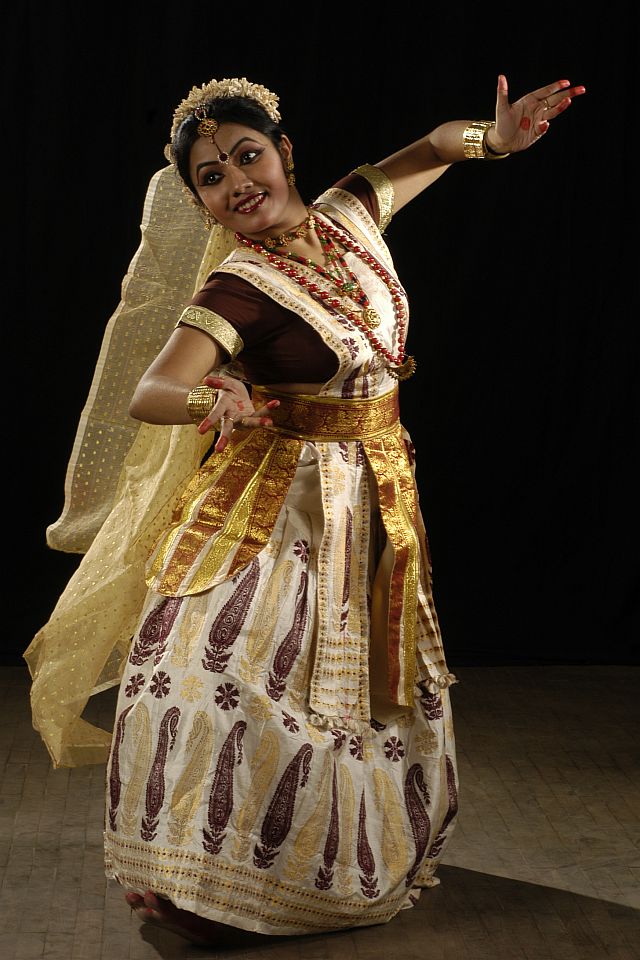
1The components of the Manipuri dance costume include a) kumin (the bright skirt) b) pasuan (gauzy overskirt) c) khwangyet (cloth belt) 4) meikhumbi (veil) and 5) koktumbi (tapering cap). Collectively the costume is called potloi.

While the stiffened skirt and frilled overskirt are now seen as characteristic of Manipuri costume and is also the bridal dress (though the overskirt is not frilled here), it’s history is fairly recent. See for e.g. manipurtalks and minai’s post. The kumin is a variant of  the phanek and seems to have acquired a cylindrical form for most of the 20th century. Though the simpler version is around for awhile as in this 1954 pic.

For more Manipuri costumes in paintings see here.

[X]

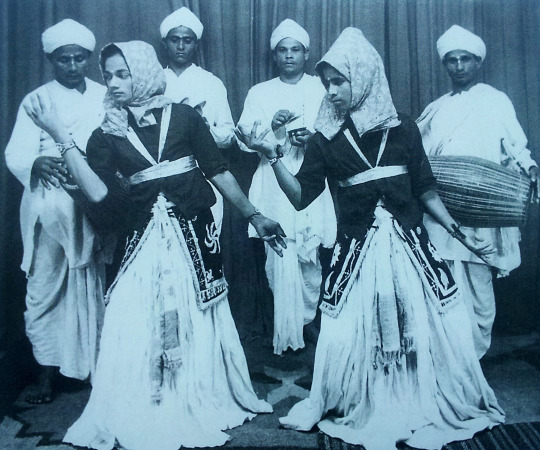
2 Monks from the old Kamalabari sattra impersonating gopis in Chali Nritya at the first All India dance seminar at Vigyan Bhavan, New Delhi, 1958. Pic source: Sangeet Natak Academy in X.

Traditionally Sattriya nritya was performed by monastic communities and female parts were performed by men as in this photograph (click for larger view). Now it is performed by men and women and outside the sattras or monasteries..

Per Mallika Kandali every Sattriya dance has its own dress code which is strictly followed in the sattras. But on the contemporary stage “ek-aharya” (single costume) prevails. Even here there is some difference from costumes of the 50s but a contemporary costume would include a ghuri (ghaghra) of pat silk, a riha (upper wrap) placed on both sides on the chest and a blouse. A belt with strips (kanci) completes the dress.

I did spot the velvet embroidered jacket in one contemporary costume but it is also a bit of its time given the popularity of embroidered velvet in the early 20th century.

Present day Majuli.

Given that States/Union Territories participate in the cultural part of the Republic Day parade in rotation, it appears that the North-East was well represented in 1956. In today’s photoset from photodivision, the folk dancers are from Sikkim,  Assam (Jaintia*), Manipur and NEFA**. Not many happy faces apart from cheerful Sikkim girl wearing a wristwatch:)

Some beautiful textiles and jewellery in there. These are not representative of the entire state given that there are a number of tribal communities in North-East India.

Other states: Nagaland (1960), Tripura (2011), Mizoram (2011).

*Now Meghalaya.
**NEFA, now Arunachal Pradesh.

Naga Girls-1956 and contemporary.

I am fairly sure the necklace of carnelian beads and silver flutes is indicative of the Ao Naga though probably not restricted to the Ao Naga – e.g the Tetseo sisters [X] wear it quite often.

Most folk will no doubt be aware of wearabout; it showcases some really cool northeast fashion.

9

Chalk and crayon sketch, Naga girl, 1955 by Lily Eversdijk-Smulders . She looks quite lovely and stylish.

I can’t quite identify the naga group based on contemporary  portraits, also wondering if  the ear ornament is rhododendron blossoms.

Posted in 1900s, 1950s, 20th century, Accessories, Art, Asia, Costume, Culture, Dance, Dancer, Early 20th Century, fashion, Folk Dance, Girls, indian art, Indian Dress, Indian fashion, Indian Textiles, Indian Women, Jewellery, North East, North East India, Paintings, photodivision, Photography, regional styles, retro, retro fashion, Tribal, Vintage Blouse, vintage costume, vintage fashion, vintage hair, vintage jewellery, vintage style, Women | Tagged , , , , , , , , , , , , , , , , | 2 Comments

The Islamic Dress Post

When you think of Muslim influenced fashion in India you think of anarkalis, gauzy dupattas, tight churidars, a North Indian style that has a tremendous grip on the popular imagination not least because of Hindi movies. While the Mughals with their jama/paijama/dupatta ensembles did influence the courts of India, in reality there is a good amount of diversity with local influences intermingling with northern as well as middle eastern influences depending upon faith and denomination. Often across communities the commonality is only in head covering.

Let’s start with the Bohras and their distinctive “quami libas” (loosely community dress).

This slideshow requires JavaScript.

Scenes from a Bohra Wedding, 1940s.

Bohra* Muslim clothing is quite distinctive and rich in colour and decoration, the latter of which is varied and includes laces, trimmings, zari, embroidery etc. I have been meaning to do a post forever on them but never found the right images.  Then a friend – Sakina Pittalwala – posted these photographs of her parents wedding in the 1940s on facebook which are quite wonderful and detailed.  Many thanks for her go ahead to post the photographs on this blog!

And now for the clothes. In Sakina’s words, “The dress in question is the ‘ghaghra badan’, a combination of a long flowing skirt, a blouse and an ornately decorated (on the borders) dupatta.  This is the traditional attire among Bohras.  It is also referred to as the ‘jori’, literally meaning a combination of the 3 garments. The dupatta is usually adorned by ‘koran’ which can take a variety of forms – hand tatted lace, brocade, a combination of painting and sequins and in the case of those worn for weddings, gold and silver threads. These can be extremely expensive and often outlast the garments; they then get recycled.  When clearing my mother’s things recently, we came across some koran which must have been at least 50 years old; each one was valued at about Rs. 60,000! The koran is usually created to fit in with the colours and designs of the ghaghra and badan.  These two garments are usually made of the same fabric (though certain sub-communities among Bohras may wear a plain blouse along with a printed ghaghra).  These two may be adorned with additional lace/painting etc. – though this is usually only for those worn by brides or those in the immediate family for a wedding.“

That’s just a little sampler, if you dive into the photographs there is a lot of detail, the most distinctive of which is the bride’s tiara and matha patti.

Notes: In pic 4 the older standing girl has a paijama under her frock – you can see something similar on the girls in this personal album from Karachi. More images of costumes at the site here.

The equivalent of the burqa or hijab for Bohras is the rida, this includes the upper garment (pardi) covering the head which comes down to the waist (some examples here). The rida is a garment which is worn outside the house and like all Bohra clothing has rich colours and decoration.

The girls in today’s photograph set are in frocks (fairly common in India in the 1940s) but here is a little charmer in HK wearing a jabla-izar (tunic-pants) and decorated topi.

Please do keep in mind that these are images from a personal album and do not misuse!

*See also X, X, X.

Atiya’s relatives have an unusual approach to women’s veiling, travel, and seclusion. Rather than ‘going native’ and adopting Western dress, Atiya wears a family version of the veil, the Fyzee charshaf, which is a Turkish women’s floor-length cloak worn with a head-covering and gloves. Instead of the ‘oppressive’ veil that is such a Western obsession to this day, it is a liberating garment that can be adapted to its context, as Atiya shows by teaming it with “good walking shoes” and thickening it to keep out the cold. This modest dress enables Atiya to travel where and with whom she wants.[X]


Atiya Fyzee (pic 1) and her sister Nazli with the Nawab of Janjira (Pic 2).

Atiya Fyzee’s parents were Sulaymani Bohra (her uncle was Badruddin Tyabji). Given that the Fyzee girls preferred to be unveiled and were amongst the first Muslim women to study aboard, it appears that their costumes include a number of modifications (much like Jnanadanandini)-here they seem to feature a full skirt, lace blouse and a half-saree like drape (this drape as can be seen is worn in a particular way). Like Parsi, Bohra and Khoja costumes in Western India, the garments make ample use of trimmings, lace and embroidery (please note however that the costumes here are different from the Bohra ghaghra-badan above – dress codes amongst the Sulaimani Bohras were different from the Dawoodi Bohras and often very flexible mixing a number of elements, there is no equivalent of qaumi libas).

Atiya Fyzee is now pretty much a forgotten author though she was well known in her time. Apart from her travelogue she wrote several books on music, including Indian music, which also features illustrations by her husband. She is also the subject of a recent book, on the cover of which you can see the Fyzee sisters costumes.

Here are Memon and Khoja women in shirt and trousers (“kurta” and “izzar”) of green and gold or pink or yellow, with dark blue sheets used as veils, wandering along with their children dressed in all the hues of the rainbow. By-Ways of Bombay by S. M. Edwardes.

MV Dhurandhar illustrations of Memon and Khoja costumes in Western India.  Pics 1 and 2 are of Khoja ladies. Lots of trimmings. The wide paijama harks back to the early 19th century in Northern India. Pic 3 is of a Memon lady, you can see the paijama beneath but hard to say if its a sari or two pieces of cloth. There was no specific dress code for Khoja and Memon women so there is an intermingling of elements, further it is likely the above costumes are no longer the norm.

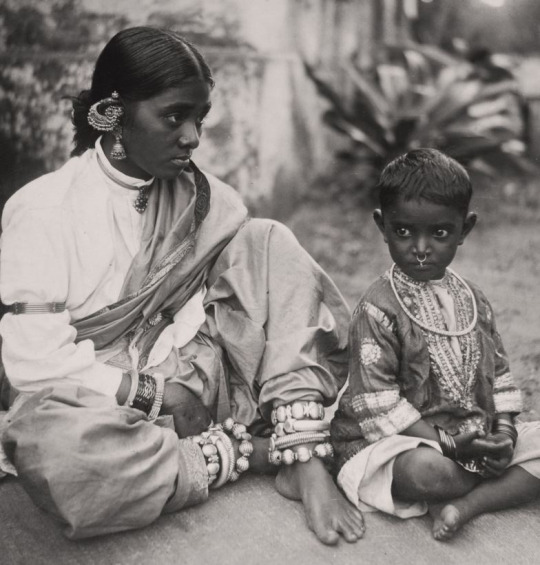
z1In some parts the sari or a version of it can be seen as in this photograph of a Muslim Lady and Child,  in Ongole, Andhra Pradesh. (1921, Maynard Owen Williams).  A lot of heavy jewellery (silver?) including an armband over a full sleeved blouse. I think the lady is wearing a sari. The child’s silk tunic is of a kind common at the time.

See also X, X.

Wife of Muslim NoblemanThe head jewellery in the above portrait seems to indicate that the lady is from the South of India, most likely the Deccan. There is a good deal of layering in the costume – I reckon this is a 19th century print. And curiously a bodice-common in South India for saris-over the open fronted tunic or jama.  Kind of indicates how the basic jama/paijama/dupatta was worn differently and accessorised differently in Islamic cultures in 18th and 19th century India.  [X].

See also Hyderabadi dress and Moplah dress.

This list is kind of incomplete, Eastern India is omitted. For one the sari is quite common. Plus not enough good images.

Posted in 1900s, 1920s, 1940s, 19th century, 20th century, Accessories, Art, churidar kameez, Colonial, Costume, Culture, Deccan, Dress Reform, dupatta, Early 20th Century, Family, fashion, Girls, India, indian art, Indian Dress, Indian fashion, Indian Women, Islamic Dress, Islamic style, Literature, Mughal, Paintings, Photography, Postcards, regional styles, Religion, retro, retro fashion, Salwar Kameez, Sari, Sari Blouse, South India, Vintage, vintage art, vintage costume, Vintage Dress, vintage fashion, vintage photography, vintage sari, Women | 3 Comments

The Love Post

l1l2imageedit_13_9934187136MADANA, a name of Kama, the hindu god of love. In the hindu religion, festivals are held on the 13th and 14th of the month Cheyth*, in honour of Kama, the god of love. Madana, he who intoxicates, with desire, Kama are both the epithets of the god of love. [X]

I have this morning sent Madhava too, having roused his curiosity, to the Makaranda garden where the festival in honour of Madana has commenced. I hear that Malati is to go there, so that the two lovers might see each other. [X]

If I am correct, the 13th day of the brighter half of Chaitra fell on April 2 or 3, 2015.  The day was once dedicated to Kama, the God of Love and known as Madanotsav or Kamotsav (Festival of Madana/Kama aka Festival of Love).  The festival – which usually took place in a grove on the outskirts of a town – occurs quite often in Sanskrit plays. In Mṛcchakaṭika and Maltimadhava it is the day on which the lovers first meet, both texts describe the festival. It is also mentioned in records of Akbar’s time and there is mention of the festival in Udaipur in the 19th century.  The festival was also celebrated in the South of India as Kaman Vilavu.  Despite its seemingly widespread nature, fairly early on in the country’s history it was largely replaced by Holi as the significant spring festival. Along with this a shift from the worship of Kama and Vasant (spring, Kama’s companion) to Krishna also took place, there are in fact no surviving Kama temples.

Given the spring association, Kama is usually represented with a sugarcane bow, a bowstring of bees and arrows tipped with flowers.

In the pics:
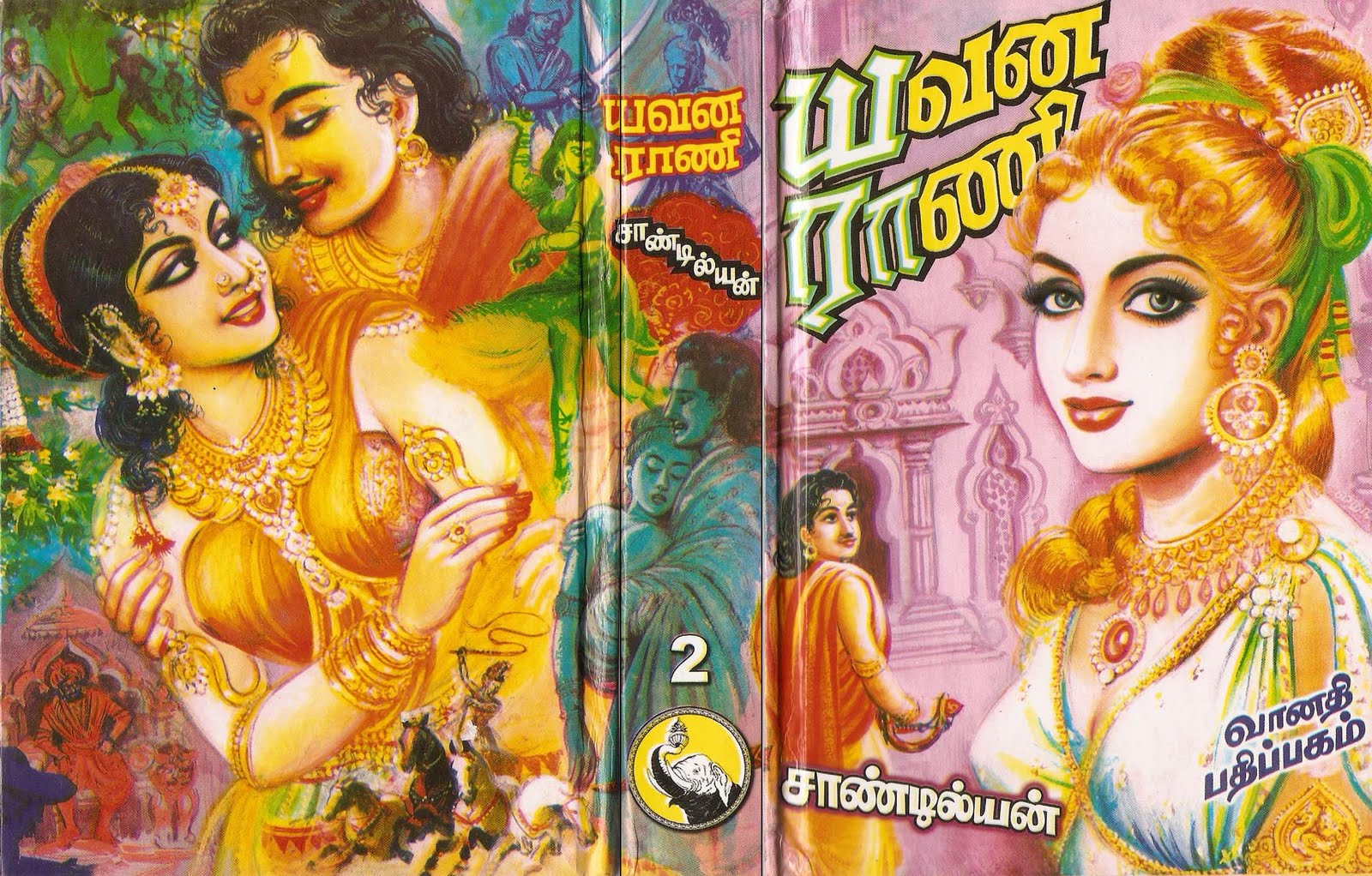
1: Cover of Yavana Rani
2: Krishna and Radha
3 & 4:  Vibhasa, a dawn ragini, where the man is usually represented as Kama. 5: Modern Kalighat by Bhaskar Chitrakar.
6: My cousin’s sketch entitled “Love Day”:)

*Chaitra

Posted in 1610s, 18th century, Ancient India, Contemporary, early 18th century, indian art, indian festivals, Indian men, Indian Women, miniature paintings, Romance | Tagged , , , , , , , , , , , , , , | Leave a comment

The Food Post

F1

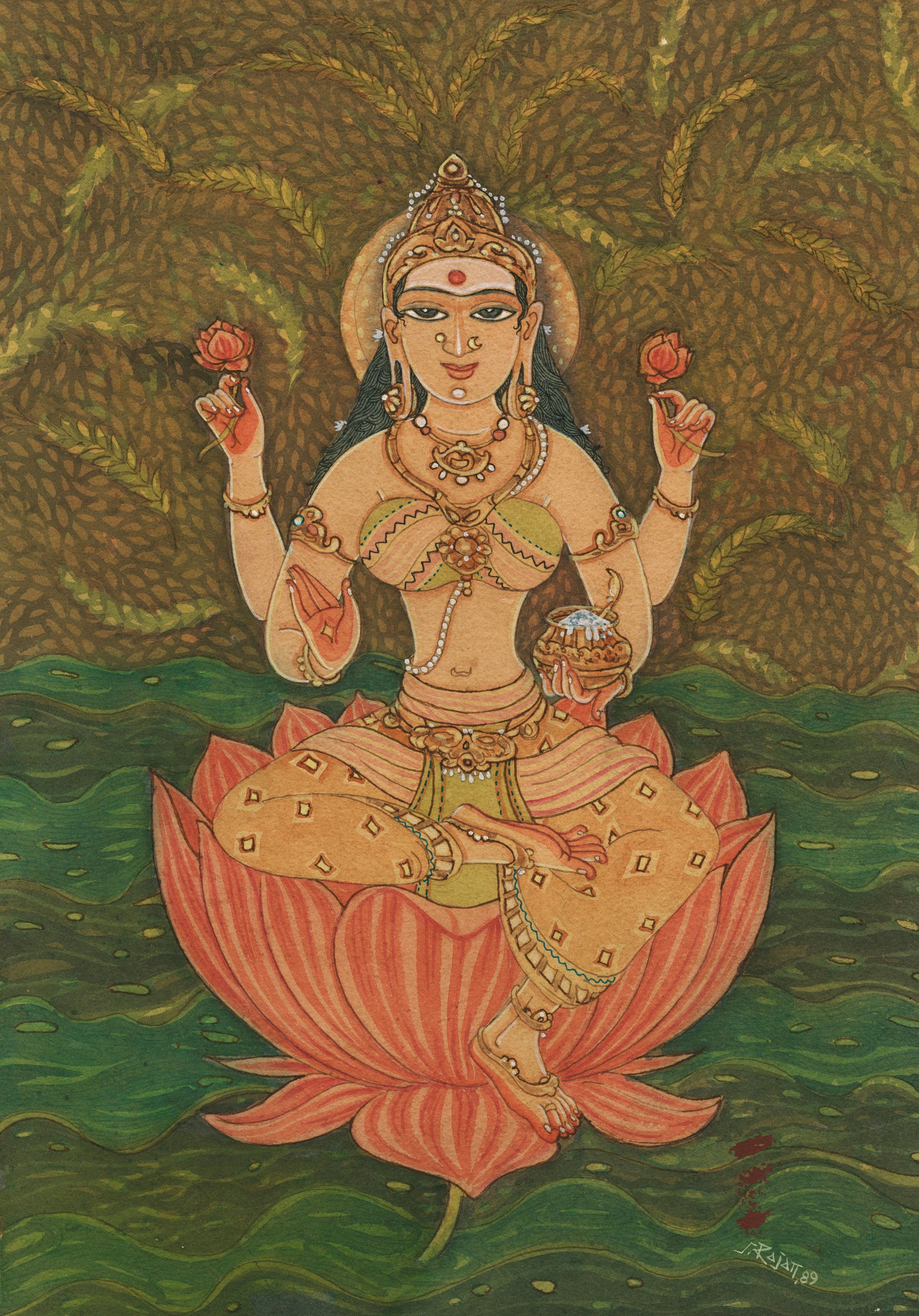
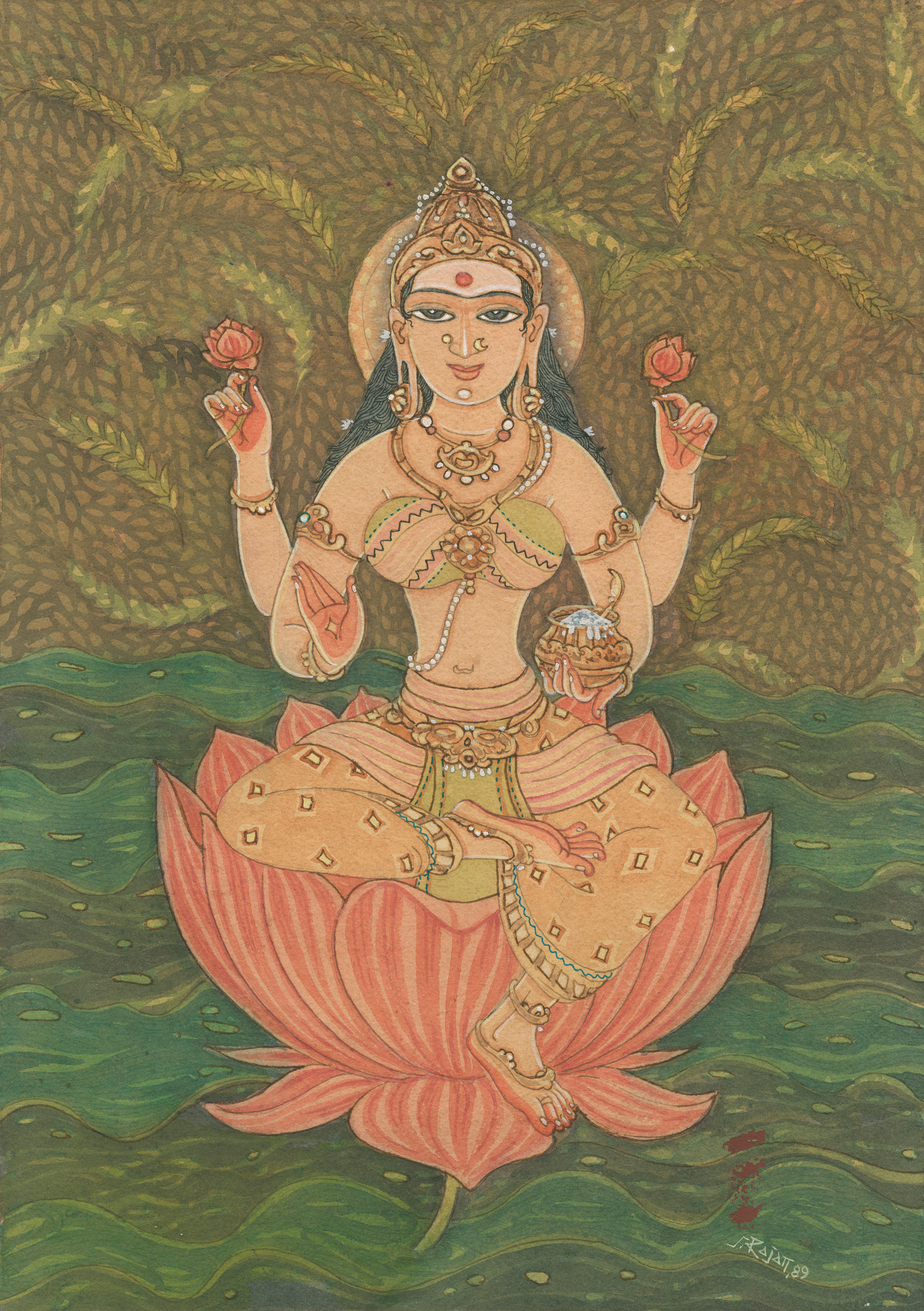
The iconography of Annapurna is given in the Agamas as a youthful goddess of red complexion having a face round like moon, three eyes, high breasts; the left hand carrying a vessel set with rubies and containing honey, and the right hand spread, holding ladle. [X]

Let’s begin with the goddess of food, Annapurna. Pic Source. More S Rajam paintings here.  Another Annapurna painting, more illustrative of the quote, here. The vessel is usually filled with rice (anna) in many illustrations.

F2

When he was bathed and had rubbed himself with oil and myrobalan, she laid a plank on a part of the floor well swept and levelled, on which he sat down: she then placed before him on a well trimmed plantain leaf two platters.  Having given him some water to drink, she served him with two spoonfuls of rice, to which she added ghee and sauce, the rest of the rice he ate with spices, curds, butter, milk and rice gruel. She finally brought him water to drink pure, cool, and fragrant in a new jug, perfumed with agallochum.  From the section on Mitragupta in the दशकुमारचरित (7th cent. CE)

And move on to a 7th century tale. You know its an Indian story when a rich 18 year old from Kanchi disguises himself as a poor fortune seller to find a bride who will agree to cook rice for him. The orphan girl who agrees to do so does a mighty fine job of it too from sending off the rice bran to the goldsmith (to clean jewels), scenting the rice water from her cooking for a bath for her guest and finally serving up the rice with various little preparations.  A most accomplished girl.

Still from Vaagai Sooda Vaa.

Another kind of Ghiyath Shahi’s samosas: take well cooked mince with the same amount of minced onion and flavour it with dried ginger (zanjabīl). Having ground a quarter of that with half a tūlcha of garlic, mix them all together.  Grind three tūlchas of saffron in rosewater and mix it with the mince.  Remove the pulp from aubergines and having mixed it with the mince, stuff the samosas and fry them with ghee.  They can be either of thin dry bread or fine flour bread or of uncooked dough. Cook each of the three kinds of samosas, they are delicious and good.
Another recipe for bhrat (mash or stuffing): fry aubergines on hot embers, add onions, fresh ginger, salt, pepper and much relish. Flavour it well. Add aniseed, then cook chapati and eat the bhrat with it. Extracts from the Ni’matnama Manuscript of the Sultans of Mandu.

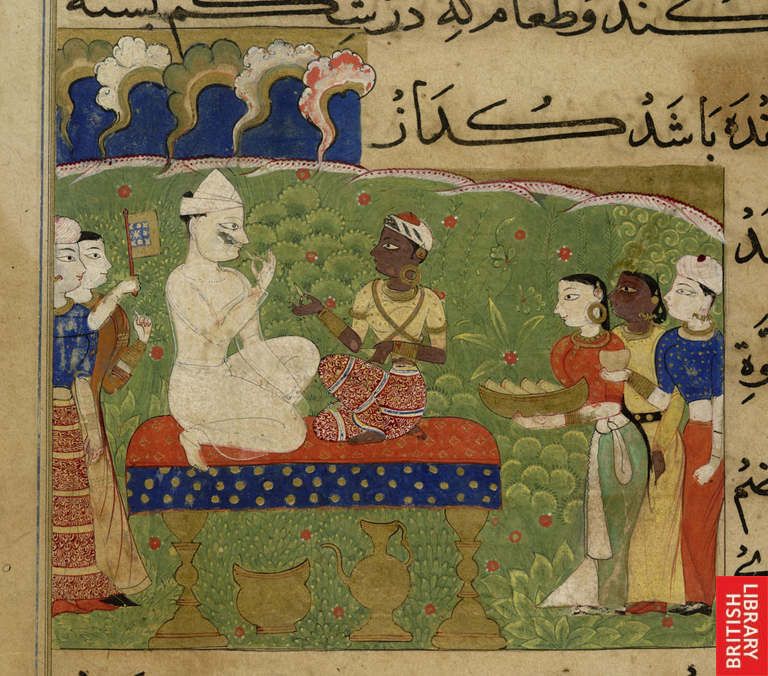
The Ni’matnama is a late 15th century illustrated cookbook completed in 1500 which contains the recipes of the Sultan of Malwa, Ghiyas-ud-Din Shah (the moustache man of the pictures). Apart from the exhaustive recipes (some of which are still around like samosas and baigan bharta in the extracts), the book is also important as it provides the first indications of the Indianisation of miniature painting as well as the Persian language.

And of course there are the costumes. Some are Turkish and Persian costumes (long layered robes, belts and headgear like a wimple or a turban). There are some Indian elements like the addition of a bindi (pic 1 and 4). Then there are Indian costumes as in pic 2 and 3 which are like ghagra cholis with a diaphanous dupatta and coiffures with elaborate ornaments. Some illustrations have costumes that combine both elements (e.g. an exposed midriff which is Indian combined with foreign headgear).

See also X, the illustrations on the whole have beautifully patterned cholis and skirts. Note that female attendants sometimes wore male clothing in some courts in this period.  Further the courts were a bit of a melting pot – the Ni’matnama for e.g. refers to Abyssinians and they also feature in a number of illustrations.

This slideshow requires JavaScript.

A typical meal at the court consisted of dozens of dishes of vegetables, grains, rice and meat including lamb, goat, chicken, waterfowl and venison.  A popular way of preparing meat was to put it in skewers and roast it over a fire or in an oven.  This dish, known as kebabs (which means “without water” in Persian), probably originated with the Mughals’ Mongol and Turkic nomadic ancestors, since it was easy to make over a campfire. Food Culture in India, Colleen Taylor Singh. 

Mughal influenced cuisines are probably the most written about and well travelled of all Indian cuisines. Given this it is a little surprising that almost all the dynasty’s Emperors were personally not very interested in food.  The late 16th and early 17th century were probably the most decisive in shaping Mughal culture and its cuisine but Akbar had frugal eating habits (tending to Sufiyana or vegetarian according to the Ain-e-Akbari) while Jahangir was more fond of wine.

This late 18th century repast in today’s pic is also decidedly simpler given it is outdoors. The figure cooking the kebabs is a yogini – many a miniature painting shows yoginis in forest settings visited by royalty. The ankle length jamas (tunics) of the prince, his companion and the attendant are are very much late Mughal period, note that the prince has riding boots.

Hope the attendant and grooms got fed!

This slideshow requires JavaScript.

In several texts written in medieval Bengal, cooking was done by women but they were not specifically seen as inhabiting the domestic space.  In other texts, specifically in Vaishnava literature, even if men did not directly cook for Chaitanya, the way they served him food symbolised acts of devotion to the preacher…….The aesthetics of cooking has been reflected to some extent in the Vaishnava texts as a form of devotional exercise. [X]

Food as devotion – detail from Radha in the kitchen, ~1810.

Ankle length jama/anarkali worn with a dupatta. Interesting colour scheme, the pink jama has a small green edging which is also picked up by the orange dupatta. Armbands with tassels appear to have a long history – you can see it even now in dance costumes.

One can also know from Pak pranali that cabbage seeds were brought into India every year from abroad. A detailed discussion on how to choose and clean a cabbage precedes the recipes in the first volume of Pak pranali, the periodical; this discussion became imperative since cabbage was a new vegetable. In the periodical, as well as the cookbook, so-called Bengali recipes happily co-exist with “new” recipes, which ranged from British to Italian to French cuisines. [X]

The first recorded recipe (as the King of Oude’s omelette) appears in Eliza Acton’s Modern cookery (published in 1845). This included onion, chilli, fresh mint, cloves and leeks. As time went on the cloves and leeks were eliminated and replaced with tomatoes and fresh coriander (a touch borrowed from the Raj loving Parsis of Bombay). [X]

With the arrival of Europeans in India came a whole host of new ingredients due to the Columbian exchange. Staples of Indian cooking like the chilli (one ingredient Indians took to fairly quickly), potato and tomato date from the European presence in India.

The influence of these cultures on Indian cooking itself was not as extensive though more than a few Goan, Parsi, Anglo-Indian dishes are a result of the mixing of traditions. However, though the cooking manuals of the 19th century are dominated by Indian influences on the British kitchen and club, there is some incorporation of new elements into Indian cooking or the Indianisation of these recipes – e.g. tea drinking, biscuits and cakes, cutlets, masala omelette and double roti or pao. Given that Bengal was amongst the first places to adopt new trends, they also seem to appear in early Bengali cookbooks.

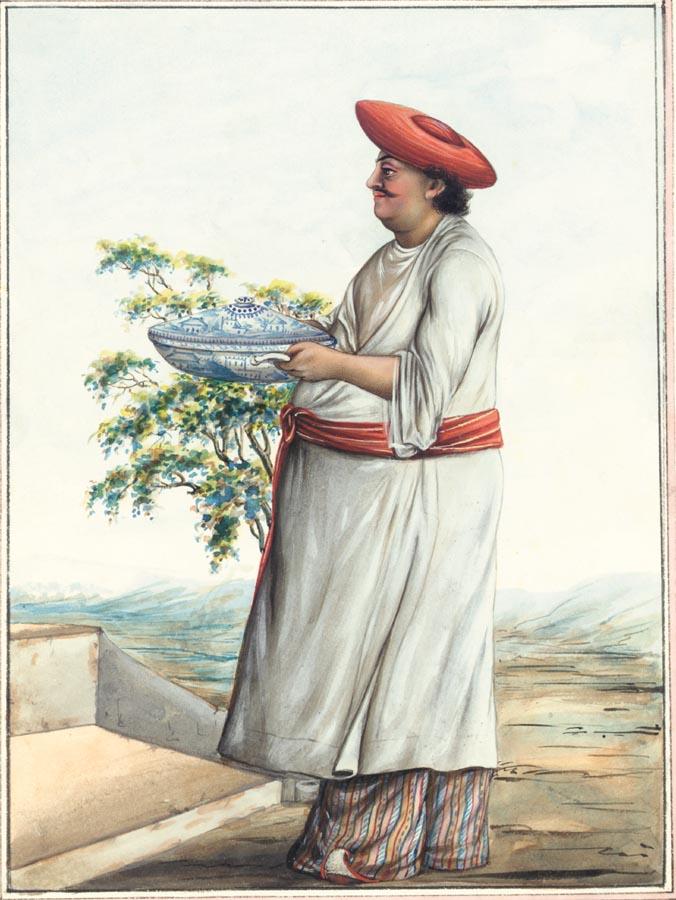
At least some of the adapted recipes must be due to the cooks of the British (and perhaps royalty) in India. The bawarchi or cook (along with the khansamah – somewhat akin to a butler) earned about Rs 12 in the early 19th century which was the highest for household staff. A helper earned Rs 4. Bawarchis – like the maharaj of Indian households – were generally men. They duly appear in portraits of the time.

The costume of the cook in 1880 (pic 1, probably in Bihar/Bengal) is not very different from the Lucknow khansama  circa 1825-1830 (pic 3).  The jama or tunic is very voluminous in the 19th century and the patka or sash equally expansive.  The paijama or trouser was very wide in the early to mid 19th century but is a bit toned down by 1880. The circular headgear is common for the time.

The cook at the Government House in 1914 wears a veshti with a shirt/coat, the turban is Northern and the kind of safa that was popular in many parts of India at this time.

It wasn’t uncommon for cooks in Indian houses to wear just a lower dhoti as in this 1840 pic (pic 2). Perhaps due to the heat in the kitchen as well as a number of purity and pollution taboos regarding cooking amongst Hindus.

VeeraswamyThe first Indian “curry house” in the UK was Sake Dean Mohammed’s Hindostanee Coffee House.

Veeraswamy which has been around since 1926 bills itself as the oldest Indian restaurant in the UK, probably because its a fine dining place and is still around.

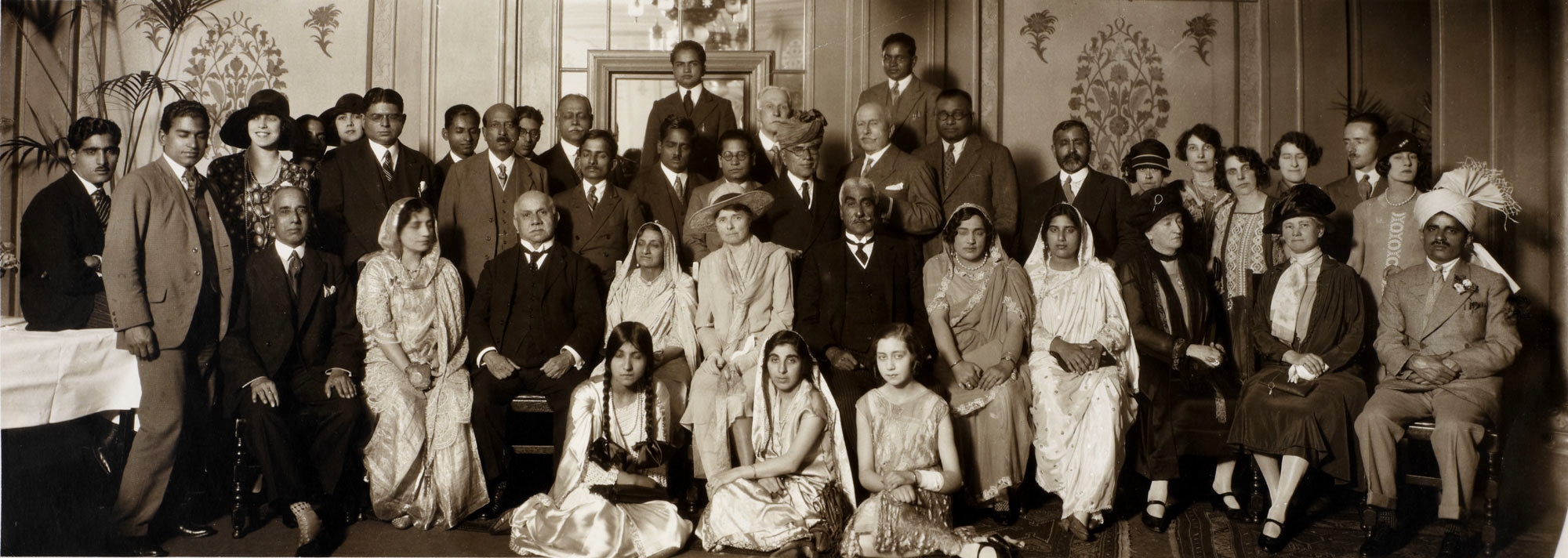
Today’s pic (click to see the large pic) is from 1928.  The flash probably resulted in a few closed eyes.  Lots of 1920s elements – slightly high sari, the drape over the head, Mary-Janes. shoulder brooch, thin zari borders on a few saris.

Raj cookbooks are in plenty [just two examples – X, X] and Veeraswamy’s cookbook, published in 1947, is still available.

This slideshow requires JavaScript.

Though cookbooks often refer to Indian food, it is a bit of a misnomer.  The country has a number of culinary traditions of which a few now constitute Indian cuisine in restaurants. Many cuisines remain local, it’s probably easier to spot a Thai eatery than an Assamese one in many major cities. So I intended to do a post on early/mid 20th century culinary books from as many Indian states as possible but this turned out to be difficult. While the education of women in the early 20th century and the rise of periodicals meant that there were books on food, perhaps quite often recipes were orally transmitted and not written down. Or maybe books are not online. Listed here are a few, chosen because of the covers.

Pic 1 is a 1915 Parsi cookbook, Vividh Vani. The cook’s long lacy blouse and the hair net make it both Parsi and early 20th century.

Pic 2 is a 1954 “expat” cookbook, Savitri Chowdhury’s Indian Cooking. The style of wearing the sari and the blouse makes it very United Provinces.

Pic 3 is the English version of the Saraswat cookbook Rasachandrika. This book was first published in 1943 in Marathi, in 1958 in Hindi and in 1988 in English. The cover painting by P.G. Sirur is of a 1940s Saraswat kitchen (the standing lady’s blouse and sari is very characteristic of the decade, you can also see a scalloped petticoat).

Pic 4 is Vanttalu – Pindi Vanttalu by Malathi Chunder, a Telugu cookbook probably written around the 1950s. Its cover is like representations of Indian women in the 1960s and 1970s.

Other examples are the Bengali Amish o niramish ahar by Prajnasundari Devi, Samaithu Paar by Meenakshiammal, Ruchira by Kamlabai Ogle and Mrs KM Mathews cookbooks. By the 1970s middle class women were more likely to read English periodicals and books but I won’t go into these books here.

See also X, X (Bengal), X (Punjab), X (UP),  X (Indian Jewish cooking), X (South Africa).

picnicMahendra proposed, ‘Let’s go on a picnic to the orchard at Dumdum this Sunday.’

He greeted the ladies and made them sit on a platform. Soon he served each with a hot cup of tea and a plateful of sweets.  Binodini remarked again and again, “Thank God that Bihari Babu had the foresight to come so well equipped. What would Mahendra Babu have done without tea?”

The day advanced but the servants coach did not arrive.  Bihari opened his box and out came the provisions for a full fledged lunch – rice, dal, vegetables, and finely ground spices in small bottles. Bnodini stared in amazement and exclaimed, “Bihari Babu, you put us women to shame. You’ve no one at home – where did you learn all this?”. Bihari smiled. “Necessity is my teacher. Having no one to look after me, I have to look after myself.”

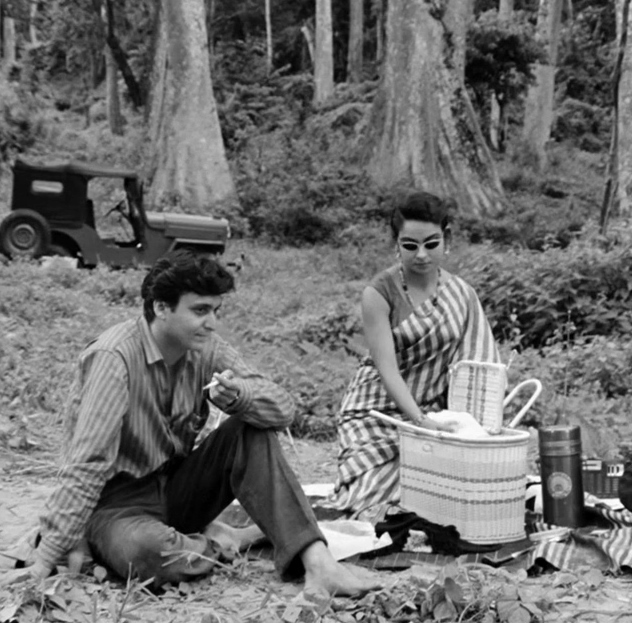
Picnics are common in Indian movies and literature. As expected memsaab has a picnic songs list. And I am all praise for the Satyajit Ray socially awkward picnic drinking game. But it is uncommon to have a man in charge of the refreshments as in the above passage from Chokher Bali. Pity the movie omits this but lets make do with another picnic in which Madhabi Mukherjee and Soumitra Chatterjee exude 60s cool.
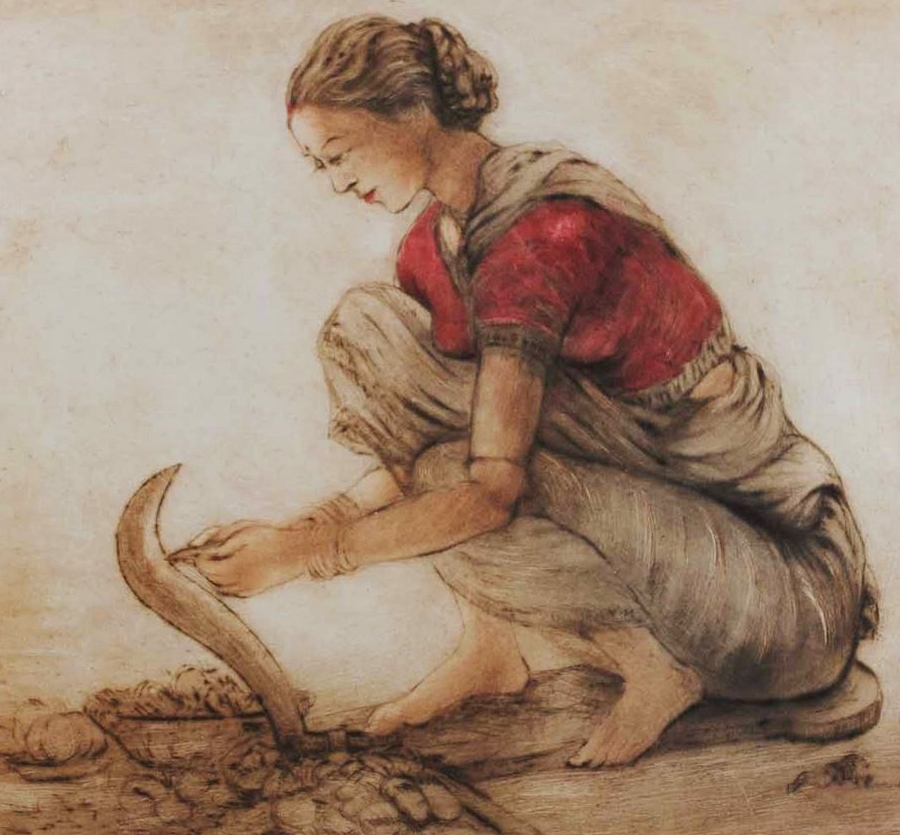
mukul dey sushilsenThe paintings: 1)  Getting Ready for the Meals, Mukul Dey (1916) and 2) Untitled, Sushil Sen, 1940s.  List of Indian names for the cutting instrument here.

Awhile back I had a conversation on tumblr regarding starched vs non–starched saris and how we preferred the latter. The two saris here only confirm that view.

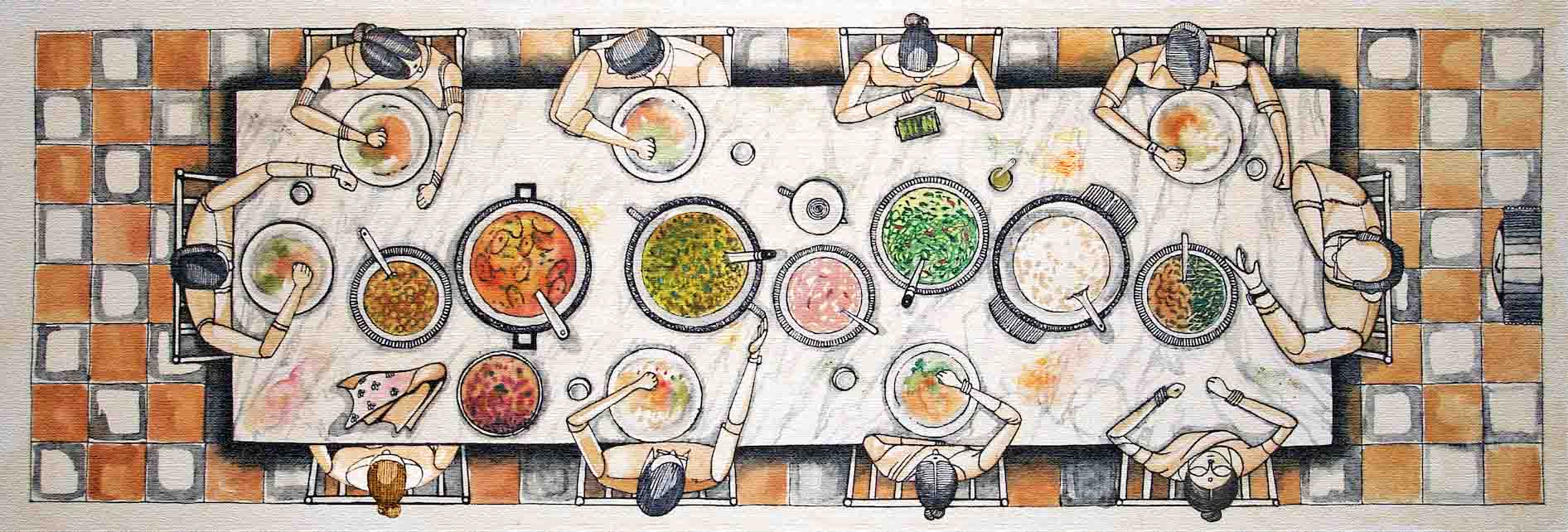
rahuldasnsharshaAnd last up how we eat. 1) Illustration by Rahul Das for My Grandmother’s Table and 2) Detail from N.S. Harsha’s We Come, We Eat, We Sleep. Click for bigger view.

120_11My personal view on food-though not on clothes! But hope you enjoyed the somewhat chronological food and fashion in India post.

Posted in 16th Century, 17th century, 18th century, 1910s, 1940s, 1950s, 1960s, 19th century, Ancient India, British Raj, Colonial, historical art, historical costume, indian art, Indian Cooking, Indian Literature, Indian men, Indian Women, Medieval India, Mughal India, Paintings, Sanskrit Literature | Tagged , , , , , , , , , , , , , , , , , , , , , , , , , , , , , , , , , , , , | Leave a comment

The Forest Post

Pic 1: Nandalal Bose, Evening, 1941.
Pic 2: Girl in  a Forest, Allah Bux, 1963.  [X]

Pic 1: Girl from Chotanagpur (1956)
Pic 2: One of a series taken of a Santhal festival in Santiniketan. Via Shibaditya Ray.

The original and best mori girls:).

Chotanagpur has dry, deciduous forests (though a lot of forest cover has now been lost) and is home to, amongst others, the Santhals, Oraons, Ho, Mundas and Kharias.

You can see the costume of pic 1 (as well as those worn by the accompanying dancers with this girl) here.  These look a little similar to Kotpad textiles. While the local handlooms as well as the silver jewellery remain, it is also common to see Southern Indian handlooms and modern costume jewellery as in pic 2.wp5

Looking around for contemporary Indian fashion with a forest theme I found very little. A little surprising given our long history with forests from the epics to musical traditions to “tree courtship” and dances on film.  The closest I suppose is all those labels and shoots that feature tribal textiles or motifs but “ethnic chic” in India is usually a mix of village, nomadic and tribal influences rather than specifically evoking forests.

Bar Anavila’s range based on Santhal culture (pic 1, stunning) and The Secret Life of the Forest (pic 2, X).

And there are clothes that evoke organic forms rather than drawing on myths or forest cultures. E.g. Padmaja Krishnan (pic 3).

Or labels like Injiri (pic 4) or Pero (pic 5).  Though they use Indian textiles their layering and cool palette is a very Japanese sensibility imo.

wp7

Forest Essentials. Very few ingredients are Indian forest produce (though I think grown locally) and their advertisement is very little forest and a lot of Raja Ravi Varma I think:) But posting for their lovely house models!

Posted in 1940s, 1950s, 1960s, 21st century, Accessories, Art, Indian fashion, Indian Women, Tribal, vintage art, vintage sari, vintage style | Tagged , , , , , , , , , , , , , , , , , , , , , , , | 2 Comments

Phryne Fisher Costumes

I saw the new season stills circulating on tumblr (stills from here) and Phryne and clothes look amazing as usual so I felt compelled to take an Indian fashion break!

With bonus Jack and Dot.

The exhibition is coming to Melbourne – the stills are from here. Now to plan the trip and wait for S3 to start!

Posted in 1920s, Australia, Costume, Period Drama, Television, Vintage, Vintage costumes, Vintage Dress | Tagged , , , , , , , , , | Leave a comment

Ladies Tailor

bl5

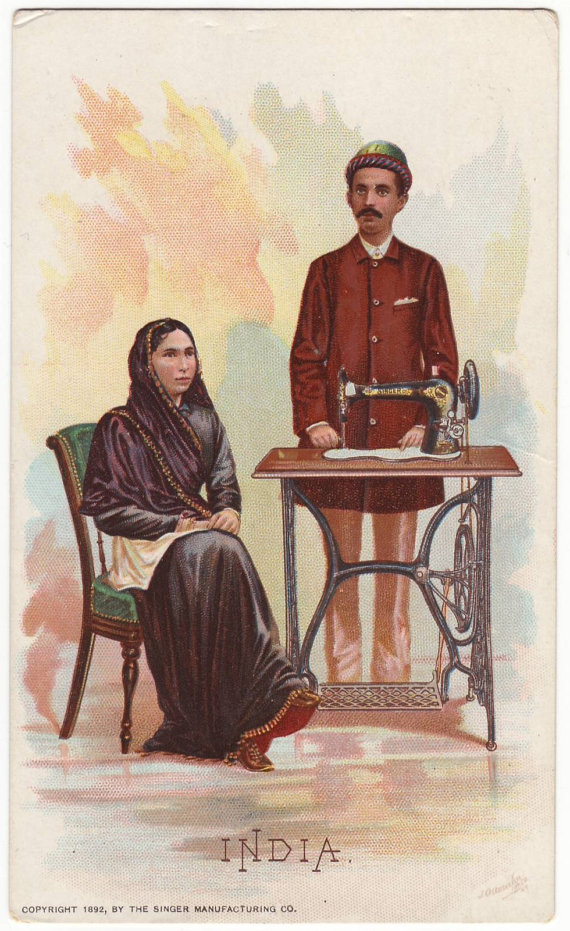
Singer Sewing Machine advertisement, 1892.

All my past attempts at making a vintage(ish) blouse have been rubbish, not least because I have never found a tailor with any interest in old patterns. Just a few months back I finally located a tailor who was quite enthusiastic about making stuff from old photographs. The blouse he stitched for me is a variation of a 1937 pattern (below).

bl1

Seriously boring guy – or dead – given the lady’s expression. Late 1930s.

Being a little obsessed with soft collars and Chinese frog closure buttons I added these (pic of my blouse below). I wear the blouse with a sari or a skirt. I like it.

Finished piece

Finished piece; Crap phone photography

While collecting the blouse I casually asked the tailor how and why he came to the profession. Something in the question must have set him off for he was still talking three cups of tea later (as anyone who might have gone to a non-mall shop in India may know, cups of tea are often ordered for customers). It turned out to be an interesting insight into the garment trade.

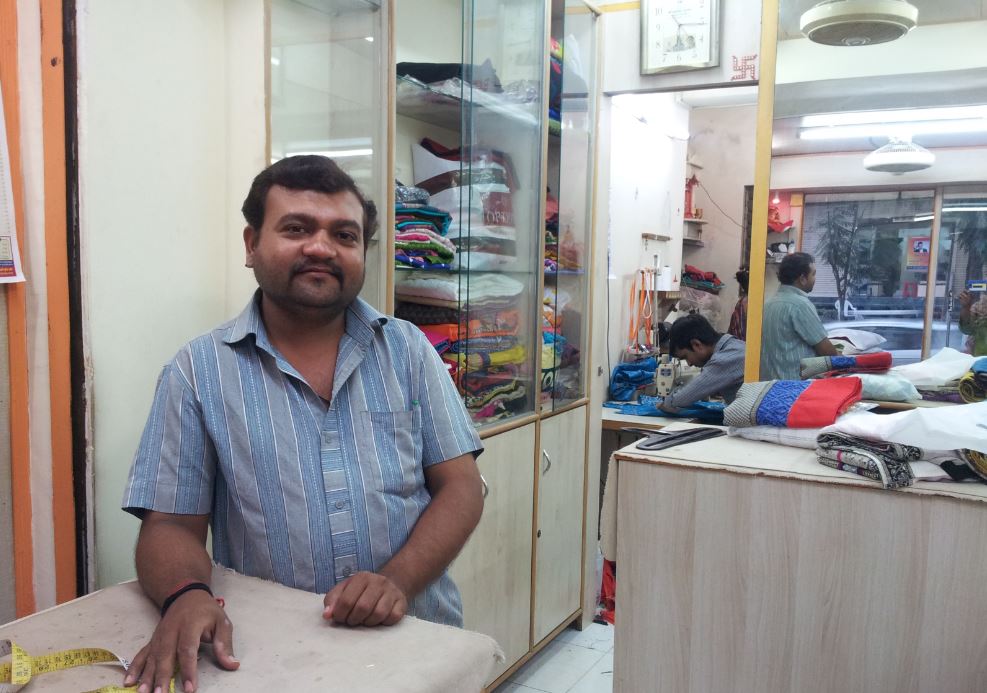
Mr S is a fourth generation tailor whose formal education was kept to the minimum given that he was expected to follow the trade. He took over the shop from his father in 2000. The shop is like many of the tailoring shops in Mumbai’s suburbs. Small, personalised and directed to the middle classes. Mr S thinks of himself as a creative person, he is in it not just because of his family but because he genuinely enjoys tailoring.

In 2000 business was brisk and regular even though the rise of malls and readymades through outlets like Shoppers Stop was on the rise. The shop had seven machines and a number of apprentices to handle work. In 2014 he has just 1 machine and business is intermittent. The fall in business he says is due to several factors.

bl3

Mr. S at his shop.

THE CLIENTELE

Naturally, the biggest factor is what Mumbai women wear today. The clientele of a shop like Mr S’s is largely middle class, the working classes tend to rely on their own tailoring skills or cheaper establishments. Given that amongst the former class the sari is everyday wear largely for older women the sari blouse is no longer the bread and butter of the tailor shop.

Salwars/Chudidars/Kurtas are commonly worn by middle class women in their 30s and 40s. These are usually store bought though it is not uncommon to get a piece stitched. As for Mumbai’s young women, few wear Indian clothing on an everyday basis. In fact visiting a tailoring shop for a mall bred generation is a bit declasse and left to the “aunties”. The business is therefore reliant on the demand for “fancy” one-off stuff – the wedding trousseau, the party dress, a variation on a designer dress in the magazines and the like. Occasionally he does Western dresses for younger and middle aged clients – Japanese design books are a great resource according to Mr S.
THE STAFF

Mr S himself is a more than competent tailor and does his share of the work. Some days his father comes in to assist and do odd jobs. He is also reliant on karigars (apprentices/workers) who are usually from UP or South India. Previously an apprenticeship would last several years and a tailor was expected to learn all aspects of the work from cutting to finishing to embellishments. For most karigars these days the small tailoring establishment is simply a stepping stone. As a starting job the shop is ideal as they are quickly hired even without experience or a formal education and are taught the basics. With a little bit of experience their employment options widen. As an example with designers, who typically run small establishments that pay higher wages. The garment factories in Surat/Valsad in Gujarat also offer jobs. As in China, newbies usually stay in dorms and do one part of the garment but the regular wages and fixed shifts make it a more attractive option. The most coveted move is to a mall job as a shop assistant. This offers regular hours (8 hours as opposed to erratic hours at a tailoring establishment, stretching at times to 12 hours during peak season) and wages of Rs 8000-10,000.
At present Mr S also has a young girl who comes in to do some of the work. Her parents live in the area and this makes the job ideal for her.

THE TECHNOLOGY

Apart from the conveniences of the readymade for the customer, factory made garments rule because of the technology. High speed machines are now the norm, though these aren’t anywhere on the Chinese scale in India. The assembly line machines of course are capable of producing very many varied pieces and the turnover time is so quick that the average tailoring establishment cannot begin to compete. The industry uses computer aided designs these days which makes the task quicker – Mr S showed me a piece and you can spot the monotonous regularity of motifs, finishing etc quite easily (I was a little taken aback with how this made even screen prints look a little softer and irregular).

THE FUTURE

In Mr S’s opinion tailor shops of his kind are dying, leaving just the high-end and lower-end tailoring establishments. At the very lower end, the hole in the wall shops that mend, darn and alter have a steady business. So do the smaller shops that charge nominally for tailoring and cater to a different clientele. At the higher end is the designer industry. Typically a designer employs 1-3 master tailors along with staff. An option for people like Mr S is to join such a place as a master tailor. However having got used to running his own shop he is a bit reluctant to do so. The business is also hereditary and old and he says it’s also a matter of pride to have one’s own establishment. Still Mr S thinks it quite likely that at some point he may be working from home given the cost of maintaining a shop.

EXTRAS

The frog closure button that I provided Mr S with got him quite excited. Apparently these were quite common about twenty years back (really, obviously I missed the memo) and young lads like him were put to work making them by the dozen. Very few of his young apprentices know how to make it now given it’s not very common in Indian clothing. In fact according to Mr S, factory workers cannot be called karigars as they slowly lose the skills to make an entire garment from scratch.

The situation for the “Gents Tailor” is even worse. Mr. S reckons only a  handful of establishments remain.

I also got a few salwar-kurtas made.  Having moved to readymades awhile back, I am now a bit of a convert to the tailored version. The suit fits perfectly and I realise I have been putting up with some really bad fitting (especially of the salwar) given I am a petite person and most suits are intended for someone a few inches taller.

bl4

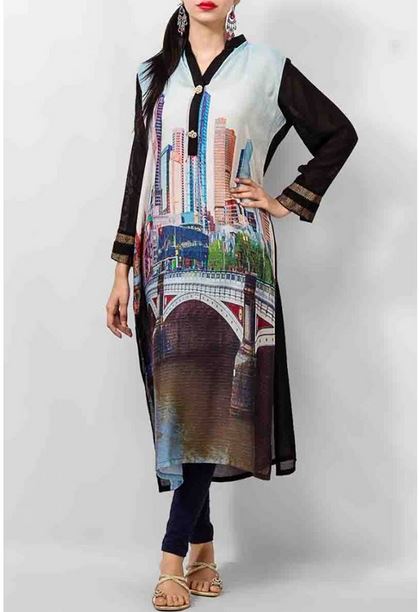
You can have a whole city on your kurta. Or a palace. Or a zoo.

As for what’s really popular now – move aside Anarkalis, it’s the digital print that is all the rage. Sigh, some day there will be a trend I can get on board with…..bring back the 1930s already!

Posted in churidar kameez, Contemporary, contemporary fashion, fashion, Indian Dress, Indian fashion, Indian Women, Late 19th century, Salwar Kameez, Sari Blouse, Tailoring | Tagged , , , , , , , , , , , , , , , , , | Leave a comment