The Artful Pose: Early Studio Photography in Bombay

This slideshow requires JavaScript.

The Artful Pose

A few pictures from The Artful Pose, Early Studio Photography, c 1855-1940.  All the photographs are by Shapoor Bhedwar to the best of my knowledge.

There are girls in short tunics worn with sarees (looking like early versions of Hakoba) with Grecian hairstyles in the picture titled The Flower Girl.

The picture with the holy man (The Mystic Sign/The Yogi – The Lesson) suggests Hindu women in short cholis and sarees.

One photograph features a Maharashtrian family, the women in traditional nine-yard saris with contrasting blouses.

There is a young girl in a drape and without a blouse in the picture titled Rose Bud.

There is the photographer himself, dressed like a saheb (it gets my approval, I love flat caps:)).  His mother is in a Parsi style sari, the children in clothing common for young Parsi children at the time (including little caps for the girls).

All are probably taken around 1890.

All pictures from [X].

Also posted at [X].
Posted in 1890s, India, Photography, Sari, Sari Blouse, Studio Portraits, Vintage, Vintage Blouse | Tagged , , , , , , , , , , | 4 Comments

The 1960s Post


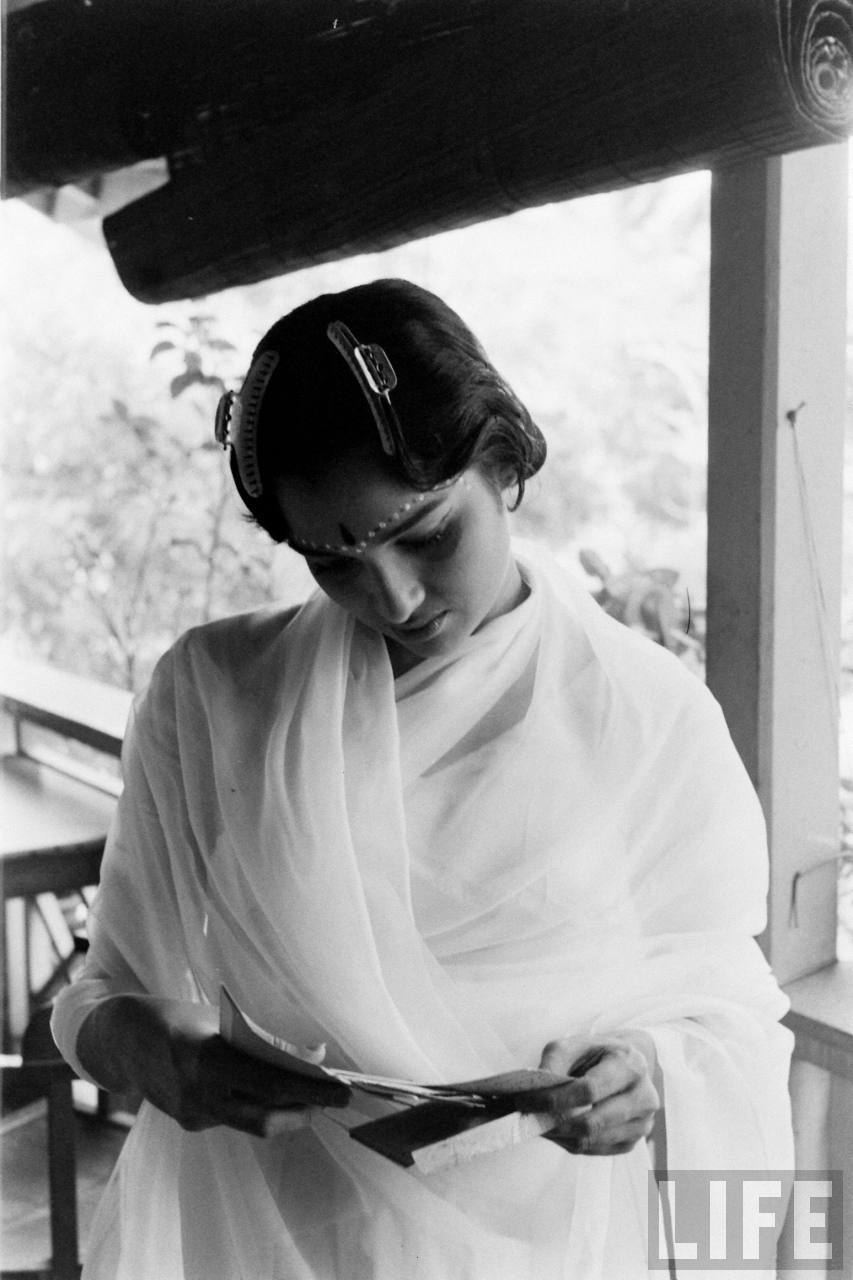
James Burke’s pictures of actresses like Madhubala and Nalini Jaywant are hopelessly cheesy so I was pleasantly surprised to find that his numerous pictures of Asha Parekh taken in 1963 are an interesting look at the actress on film sets, at rehearsals and in her home.  On the whole Ms. Parekh’s blouses are simply styled and have the three quarter/long sleeves of the early 60s.

More here:

Posted in 1960s, Actor, Bollywood, India, Movies, Sari, Sari Blouse | Tagged , , , | Leave a comment

The School Uniform Post

Image

14 November:  Mr Nehru’s birth anniversary and Children’s Day in India.

The older pupils of this girls school in 1880s India are all in Parsi style saris and long blouses.

 Source: columbia.edu
Posted in 1880s, India, Sari Blouse, Vintage | Tagged , , , , , | Leave a comment

The Diwali Post

Diwali Week. As good a time as any to bring out the bling and the little brocade blouse.

Posted in 1950s, India, Sari, Sari Blouse, Vintage | Tagged , , , , | Leave a comment

The Short Sari Post

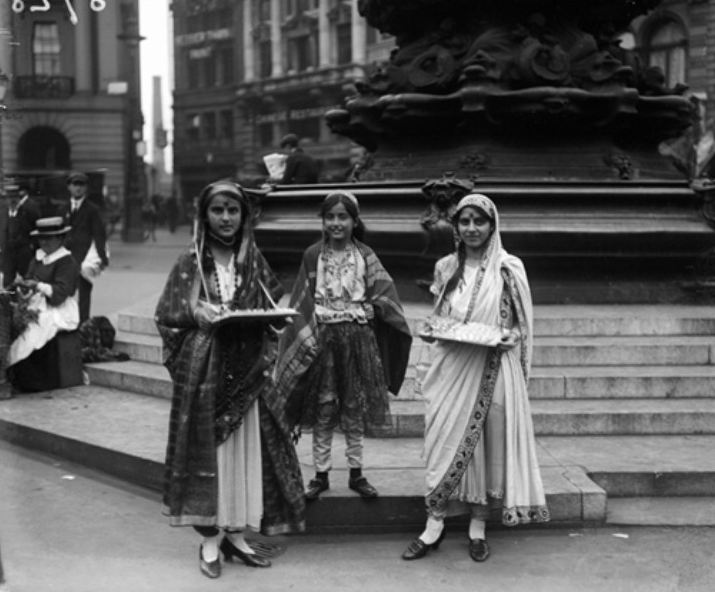
20th September 1918:  Flag sellers on India Day wearing national costume.  (Photo by Topical Press Agency/Getty Images)

Can’t locate what India Day was meant for – to raise funds for the war effort? The sari is probably a shawl wound around to give a sari effect.

And there’s the socks and shoes again.

Posted in 1910s, India, Sari, Sari Blouse, Vintage, Vintage Blouse | Tagged , , , , , | Leave a comment

The Long Sleeved Blouse

Image

[X]

Indian Christian Girls, circa 1900 with long sleeved blouses.

Posted in 1900s, Christianity, India, Sari, Sari Blouse, Vintage, Vintage Blouse | Tagged , , , , , | Leave a comment

Pandita Ramabai

Image

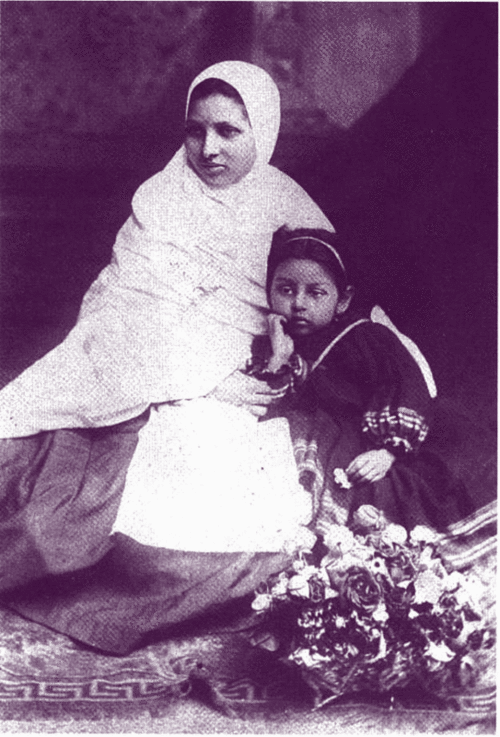
Pandita Ramabai, author of The High Caste Hindu Woman and an early feminist and social reformer, converted to Christianity and went on to found the Mukti Mission.

It isn’t completely clear in this picture, but Helen Dyer records in her biography of Ramabai that she chose to retain Indian dress. Lakshmibai Tilak, also records that Indian Christian women chose to adopt the pleated sari and blouses with wrist length sleeves and kept ornaments to a minimum.

PS: Ramabai also wrote an account of her visit to the US, which is now available in an English translation.

Posted in 1880s, Authors, India, Sari, Sari Blouse, Vintage | Tagged , , , , , | Leave a comment

The Missionary Post

Christianity has a fairly old history in India.

However, the arrival of “Christian soldiers” during the British Raj seems to have given rise to questions of attire for missionary work.  For the most part, most women missionaries appear to have adopted the sari and long sleeved blouse. An attire also adopted by Indian Christian women at the time.

As an aside, though Hindu women (and other religious denominations in India), seemed to have no problem in adopting the blouse, skirts, dresses and gowns were rarely adopted because it was far too identified with the Christian West.  Instead the sari at times seems to follow the silhouette of the dress/gown depending on the decade, sometimes wound twice to give fullness, sometimes draped tight to follow the lines of the body.

Image

[X]

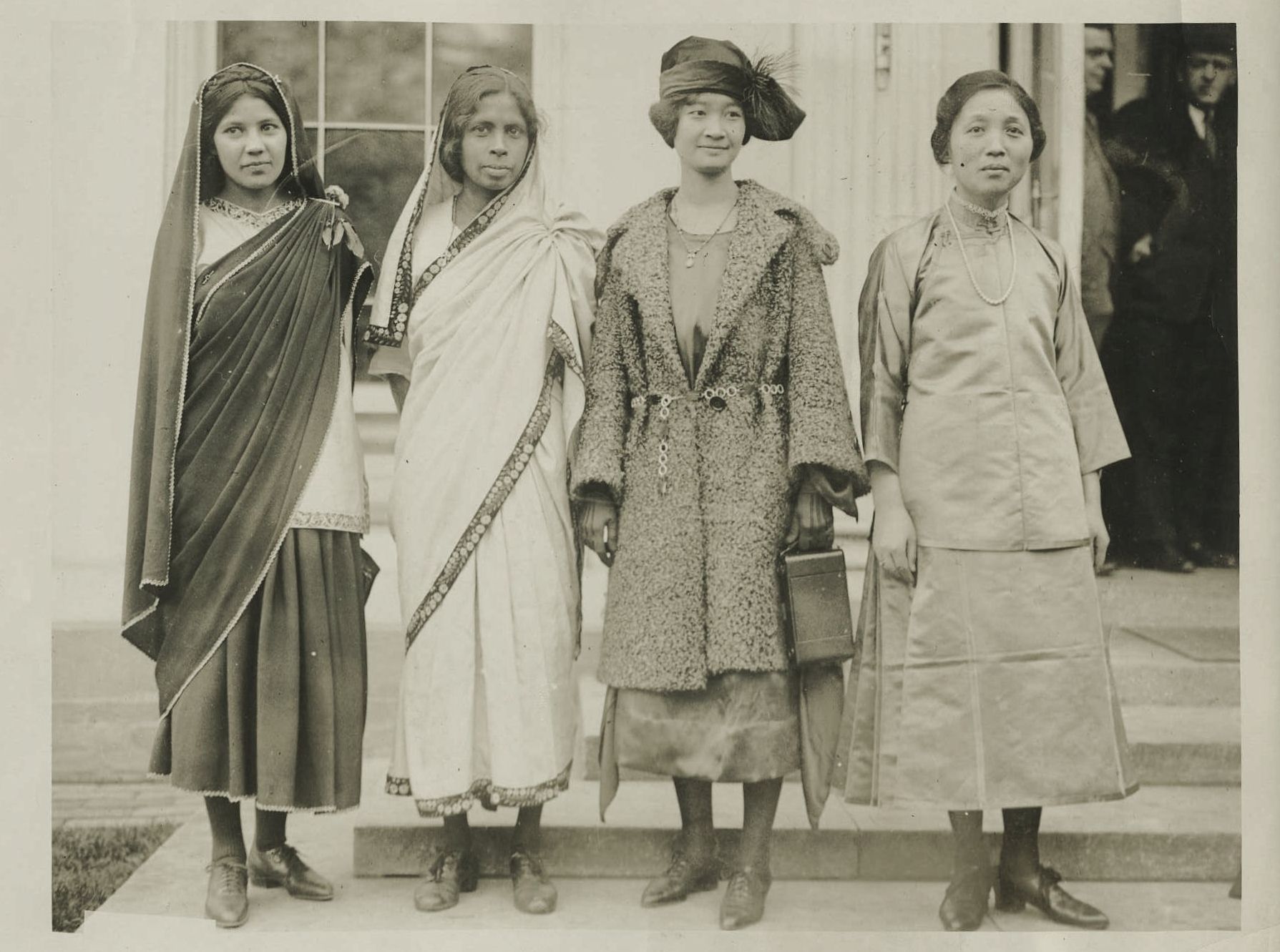
This picture is from a 1922 meeting of foreign missionaries in Washington. The women are Isabelle Dux (India), E.N. Thillayampalam (India), Leoedegaria Sapao (Philippines) and Mei-Lien Chang (China).

For awhile the short sari worn with boots was fairly common.  And as with many photographs of this time, the sari is pinned with a brooch and its loose end draped over the head.

Image

[X]

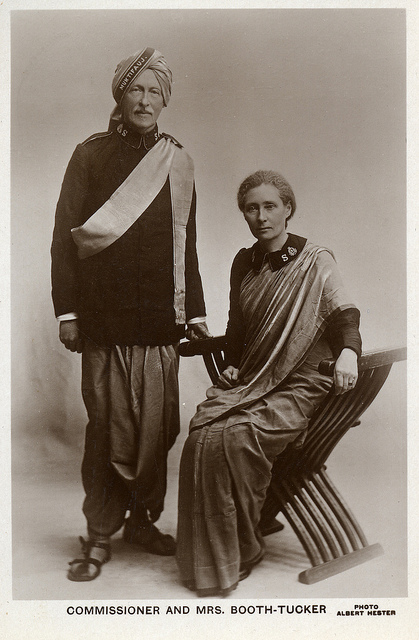
Almost all photographs of Salvation Army volunteers of the time have both men and women in this uniform. In fact there appears to have been a deliberate effort to adapt to Indian culture.

It appears the saris were a sort of sandalwood/saffron colour with a red blouse.

A bit on Booth-Tucker here.

Image

Samuel Stokes came to India as a missionary.  His wife appears to have converted to Christianity and in this picture she is in a long sleeved blouse.

Subsequently Stokes converted to Hinduism (as did his wife). His life story is the subject of a biography by his grand daughter. And those apples in Simla –he might have had something to do with them.

Image

In the same tradition, Mother Teresa in a sari tied Bengali style and again with the long sleeved blouse.

Posted in 1890s, 1910s, 1920s, Christianity, India, Sari, Sari Blouse, Vintage | Tagged , , , , , , , , , , | Leave a comment

The Scent Post

This slideshow requires JavaScript.

Both Maitreyi and Na Hanyate (books I referred to in my post on Mircea Elaide and Maitreyi Devi) refer to Indian flowers and scents. So I thought I would do a post on advertisements for Indian/Ceylonese scents. Though not all of them feature saris and/or blouses.

Grossmith, a perfume house which has been recently revived, was one of the first to introduce oriental scents in 1891.

The advertisement for Phul-Nana doesn’t feature a sari but is vaguely oriental (yet distinct from the advertisement for the perfume, Shem-el-Nessim which draws its name from the Arabic).

Wana Ranee (Forest Queen, advertisements from around 1914) uses Ceylonese women in all its advertisements and appears to be floral in nature. The picture here is suggestive of the half-sarees popular in South India. And I like that the Wana Ranee always has a rose tucked in her hair!

And lastly, by 1923, the advertisement for Ganika (Sanskrit for Courtesan) while still trading on the mysterious East is otherwise modern in nature.

[X] [X]

Posted in 1890s, 1910s, 1920s, India, Perfumes, Sari, Vintage | Tagged , , , , , , , | Leave a comment

The Book Cover Post

Image

Image

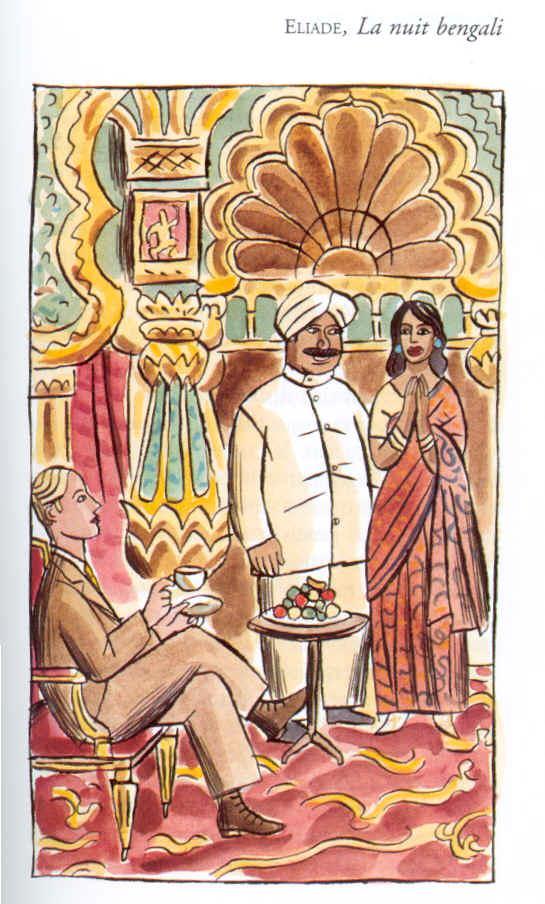
Apart from the movie based on Maitreyi/La Nuit Bengali, the book covers also leave much to be desired featuring as they often do a generic exotic Indian woman barely indicative of the decade in which Maitreyi takes place.

The first cover is the closest to a realistic representation given that it seems to be a painting from around the time (or similar to Tagore’s paintings around the time).

The second cover, while not entirely accurate, is at least an attempt to recreate a scene from the book with attire from the early twentieth century (though not necessarily Bengali).

[X]

Posted in 1930s, India, Literature, Romance | Tagged , , , , , | Leave a comment