

I must confess that all I knew of the Sri Lankan sari was that it was “a variant of the Indian sari”. It turns out that this is not entirely true. Sri Lanka has a rich and varied sartorial history that incorporates a number of local and foreign influences. What I know is just a little but I will post a few examples today. All photographs are from the 1880s-1910s because Sri Lanka was extensively documented by Skeen, Scowen (and Fiebig) – you can find many examples at Images of Ceylon and Lankapura.
Very broadly the types of attire are the Sinhalese costumes – the sarong+jacket outfits of the South and the “osariya” of upcountry. Then there are the Tamil sari styles (there are other styles in this period as well as styles from previous centuries that I am not posting here). As Nira Wikramasinghe’s extract above indicates, Sri Lanka went through its own process of inventing a national dress-I suspect the choice of the osariya also has to do with it being very elegant. The osariya blouse covers the waist and is rich in detail – what I find most interesting is that in almost every photograph the sari and blouse are harmonious, unlike the mixed results in India as we evolved the modern sari.
I haven’t got around to reading “Ceylon: Twentieth Century Impressions – Its History, People, Commerce” by Arnold Wright but I hear it has a bit on dress in Ceylon.
The Ceylon post here.

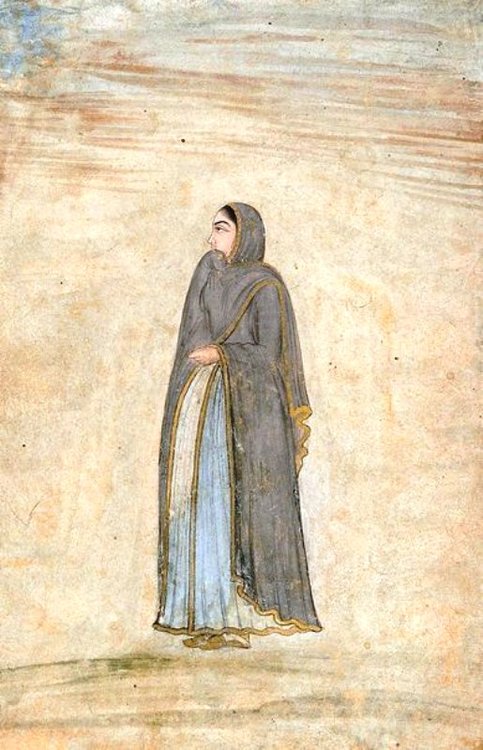
Damerla Rama Rao, who died in 1925 at the early age of twenty-eight…..paintings remained practically lost in an obscure collection in Rajahmundry till they were brought to Delhi and exhibited in 1991 by CMC, the public sector corporation. He did not rest content with memory images, but paid great attention to drawing from life…..his compositions, even when the themes are light and no message is preached, are painterly and pleasing. (A History of Indian Painting: The Modern Period by Krishna Chaitanya)
A few paintings by Damerla Rama Rao today. Like with Raja Ravi Varma, his paintings are centred around genteel and elegant women. And are also an indicator of sari and blouse styles of his time (possibly late teens and most likely early twenties).
More here.

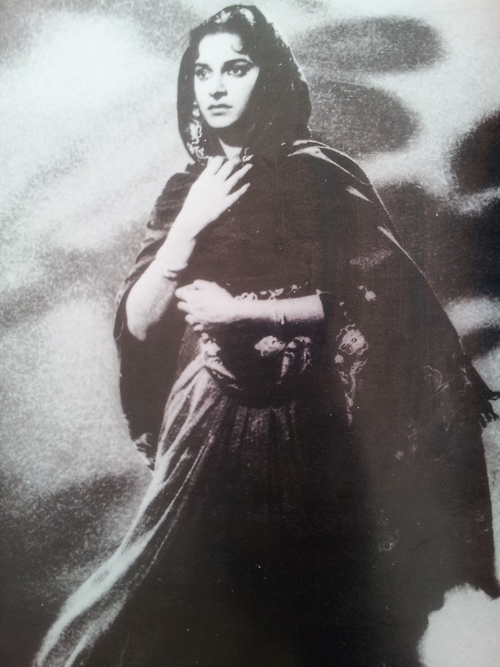
Shobhana Samarth, probably taken in the late 30s/early 40s.
A few posts don’t have a theme but are merely to provide a snapshot of a decade – I normally tag the decade so its easy to follow the tags.

Frills, ruffles, furbelows in the 1930s.
It is interesting to see the same feature employed differently in the three stills.
The women L to R: Imogen Cunnigham, Devika Rani, Kanan Devi

I didn’t do this post for awhile because I wasn’t able to locate any good pictures, apart from the usual ones of Devika Rani circulating on tumblr, though of course I have posted on fashions of the 20s and 30s. So this post is all thanks to filmkailm (I hope the person running it doesn’t mind my borrowing the pictures!) and its going to be a bit of a spam.
Did the Indian Flapper exist? Not in the true sense of the word, though the fashions of the 20s and 30s in India were definitely influenced by Hollywood and social trends in the West. But these influences were also curtailed by the nationalism movement in India (as book extracts I am posting today show). Like in the West, the modern girl was censured and mocked (though young men were apparently mad keen on the fashions!), with added censure for departing from Indian tradition. At the movies this meant a first half devoted to Western fashion, the second to a re-assertion of Indian values.
The post today is on Sulochana aka Ruby Meyers in Indira, M.A., since advertisements for the film refer to her as a “flapper”. And she was the biggest star of the 1920s and 1930s, epitomising beauty and glamour.
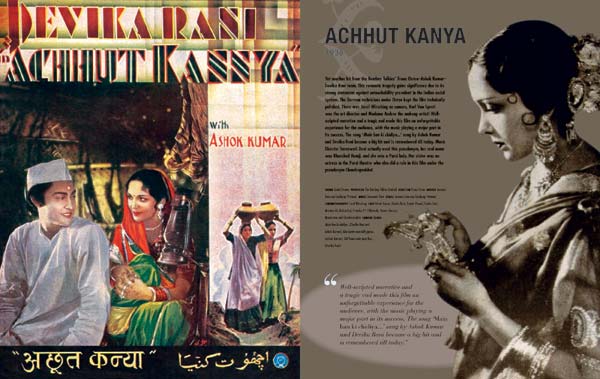
Eventually the modern heroine would be replaced by the nationalistic, traditional heroine. But in their personal lives and their public personas, most of the heroines were “modern”, e.g. Devika Rani (though perhaps her influences were more Weimar, given she spent some time in Gemany and collaborated a fair bit with German film makers like Franz Osten). As an e.g.,publicity material for Achhut Kanya (The Untouchable Girl), has the actress looking quite glamorous in contrast to her role.
And its a pity I don’t have any pictures of Ruttie Jinnah, who was quite the society beauty of the 1920s – the descriptions of her diaphanous silk and chiffon saris, tight blouses of brocade cut to the waist back and front with no sleeves, liberty scarves and jewelled bandeaus suggests a woman who was a 1920s trendsetter.
A snapshot below and more at tumblr here.

Just a few bits and pieces before I move on.
First, Kama Sutra: A Tale of Love, set in 16th century India. By this century there were a number of influences flowing though India but Mira Nair quite obviously roots her aesthetic in old Sanskrit dramas and erotica.
The accompanying quotes at the link are not from literature from the century but from Sugata Saurabha: The Life of the Buddha, a Nepalese text.
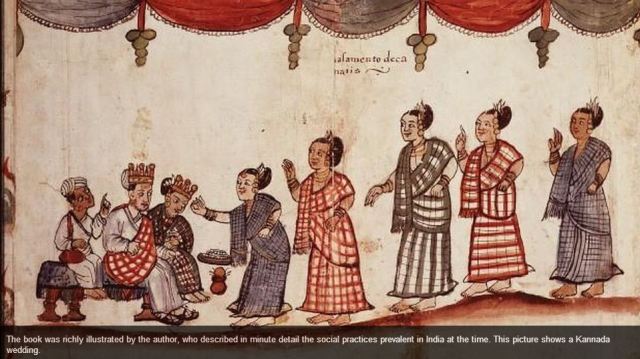
Second, something I stumbled on while researching this post. Illustrations from a “travel best seller”, Ludovico de Varthema’s Itinerary.
More (including attributions) here: http://vintagesareeblouse.tumblr.com/tagged/16th-century

Woman’s Court Costume: Silk with gold and silver braid and pompoms. Lucknow, C.1830-40.
This extravagant costume would have been worn by a dancer or noblewoman at the flamboyant Lucknow Court, although the fashion for exaggeratedly wide trousers like these worn under a full, shorter overdress was popular in several centres of North India during the first half of the 19th century. Women wearing such costumes are shown in Lucknow paintings of the 19th century and in Company style paintings from other centres in North India.
Traditionally reputed to have belonged to the ‘Queen of Oudh’, this outfit is more likely to have been worn by a very young girl for a betrothal ceremony, or even created specifically for an exhibition such as the Exposition Universelle in Paris in 1855, from which it was acquired by the India Museum in London.
A pair of women’s embroidered trousers with very wide legs. Each leg is made up of 17 triangular panels and one rectangular panel. The fabric is of thin silk with applied gold ribbon (gota) and gold pompoms.

Man’s robe of white cotton, with repeating staggered pattern of embroidered floral motifs in gold-wrapped thread and floss silk. Long sleeves, front opening, floor-length gathered skirt – 18th century, India.
This elegant robe would have been worn by a man at one of the courts of northern India. The floor-length gathered skirt was popular in the 18th century, in contrast to the shorter robes of the previous century. The staggered floral design is typical of late Mughal design, and is often seen printed on textiles, as well as embroidered as in this example.
Copyright: © V&A Images
Other examples at this post.
[X]
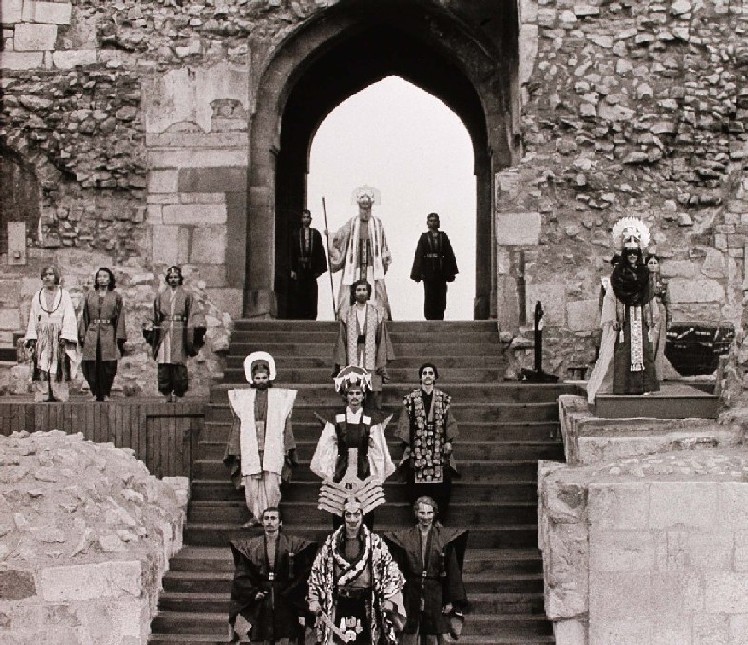
In the evening of the last day of war
Deep gloom is spread all around
A desolate lane of Kaurava’s palace
Only two guards on sentry duty.
The stylized costumes of Ebrahim Alkazi’s open air staging of Dharmavir Bharti’s Andha Yug (A Blind Age) which deals with the aftermath of the Mahabharata war. Sadly no up close ladies.

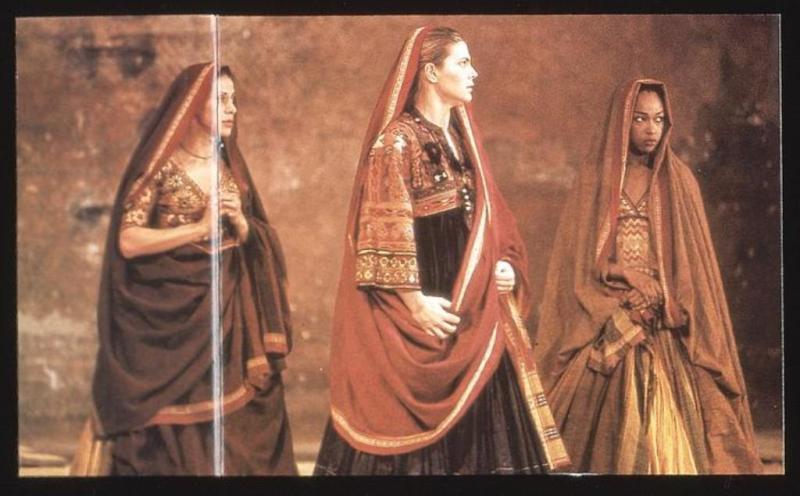
Peter Brook’s Mahabharata,with a multinational cast, takes the anti-Bollywood route with voluminous, austere garments that are nevertheless not accurate for the time.
The first photograph is of Mallika Sarabhai as Drapaudi.
The second is possibly the three elder queens of the epic.
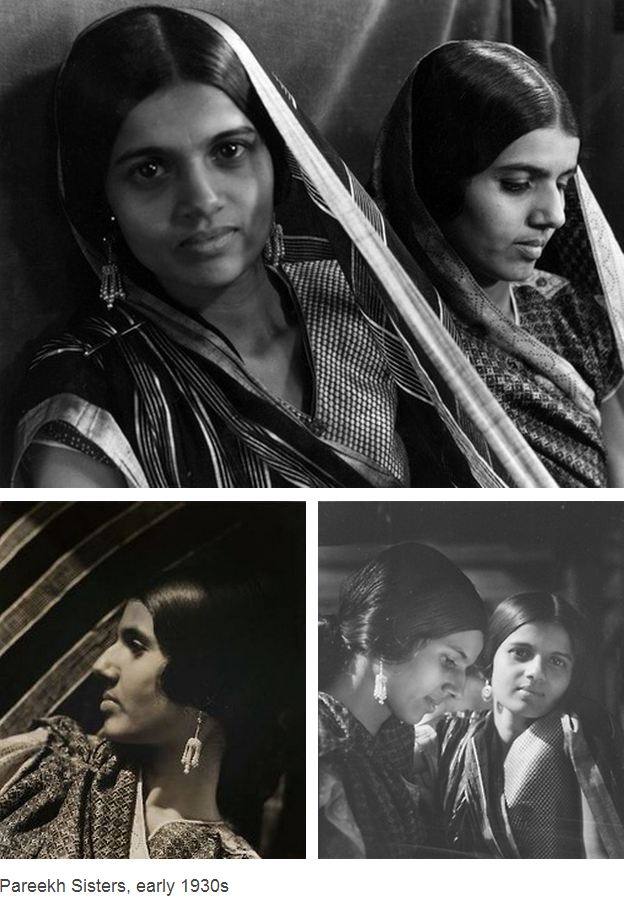
 Vintage Indian Clothing