The Red Ribbon Post

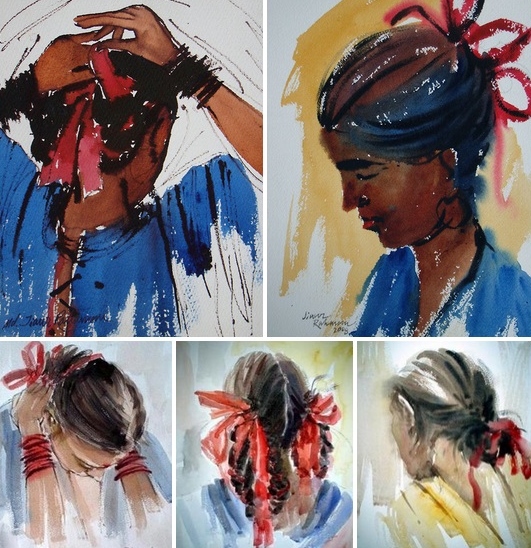
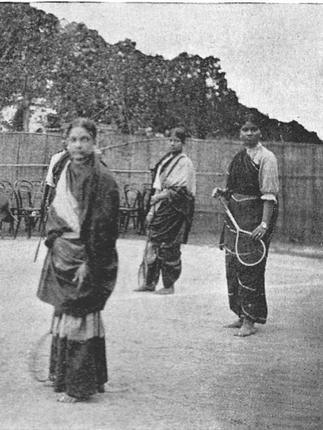
wp1I have written a bit on how ribbons went from being youthful fashion to something worn at best by village school girls-though a lot more can be said on the subject. Indian readers of a certain age will no doubt be aware of these ribbons for schoolgirls – in shades of red, white ad black and strung from a hawker’s pole which also displayed other merchandise.

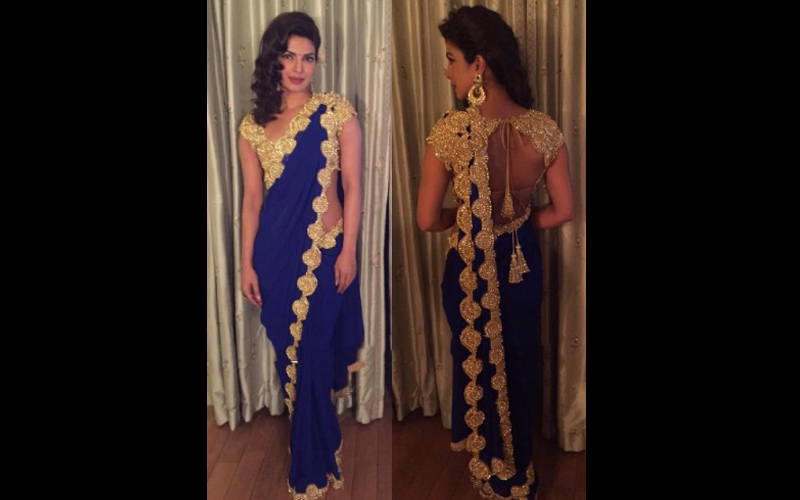
Jiaur Rahman‘s red ribbon series (~2007-2008) captures these ribbons perfectly.

Posted in Accessories, Art, Contemporary, Girls, Hair, indian art, Indian fashion | Tagged , , , , , , | Leave a comment

The 1990s Post

This slideshow requires JavaScript.

The Sari Etc. – 1991-2000

I am not in the least bit a fan of the 90s + its not exactly vintage. For the sake of completion of the series though I will compress everything into a single post.

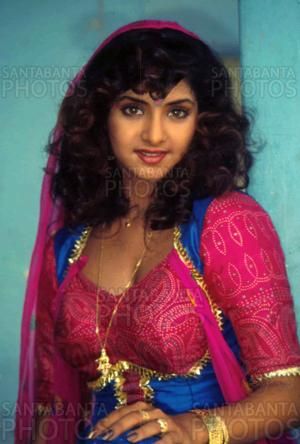
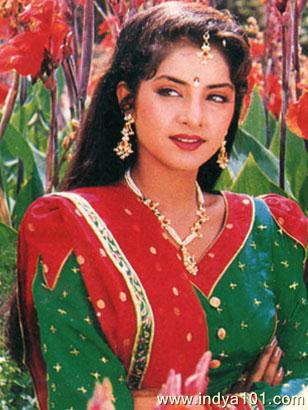
It is kind of hard to say exactly what stamp the decade left on fashion except that “globalisation/liberalisation” happened. And we suddenly had a number of beauty pageant wins. There were a whole lot of foreign influences – especially via TV – but the effect on fashion was more 1980s than the indifferent pared down 1990s. Kurtas had shoulder pads and puffy sleeves. The skirt part of the kurta was often voluminous – luckily I couldn’t locate a pic of kurtas with numerous alternating panels that were popular in the 90s.

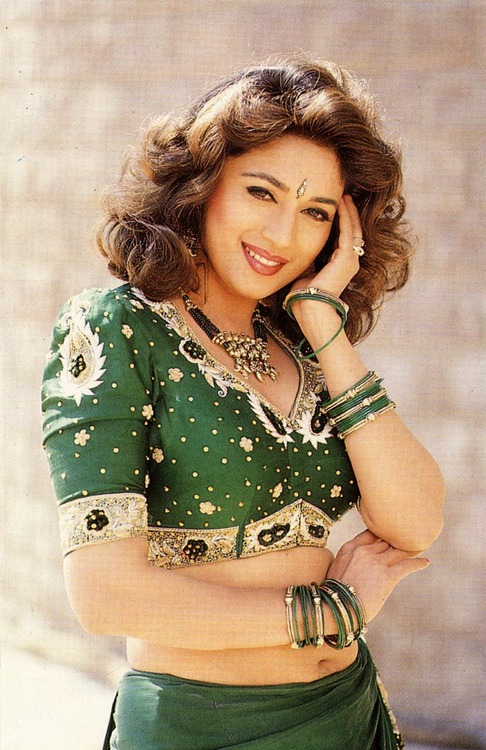
Pink and green saris (on Sridevi) were quite the thing starting with the tail end of the 80s. Variations of it pop up all the time in the 90s (X, X, X). And there were the film inspired fashions like the HAHK purple sari on Madhuri, ghosts of which live on today. By the end of the decade, it was also time for the Manish Malhotra era of skimpy lace blouses and flimsy saris, as seen in Kuch Kuch Hota Hai. I can’t think of too much experimentation with the sari but pic 3 (R) suggests that someone thought marrying the sari to 1980s power dressing was a good idea.

Hair was also big in keeping with the 1980s throwback. And embroidery like on Madhuri’s blouse for Raja was ubiquitous and it’s larger motifs a  bit puzzling given Indian gold embroidery tends to be intricate and maheen (refined).  It’s also hard to find simple bindis, the stick-on revolution meant a lot of colour, gold and elaborate designs for bindis.

Manish Malhotra was also responsible for two other trends – the NRI Punjabi fashions of DDLJ – this was the decade of the NRI in many ways – and the toned yuppie fashions of DTPH that involved a good deal of aerobics gear.

A lot of this died away with the new century but that last pic – the fashions have moved on but the influence of the fashions in the 3 panels remain.
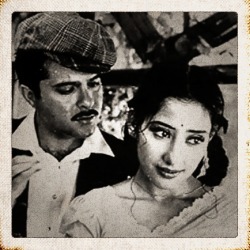
90s3The retro movie of the 90s was 1942: A Love Story. It’s fantasy 1942 so a fidelity to the period is not required. All it needed to do was prettily evoke an imagined pre-Independence India, which it did (the costume designer was Bhanu Athaiya). So for Rajjo it is lace edged saris and blouses, salwar-kameez & ribbons (though I can’t help thinking 1942 = hair down, not tied up with ribbons like the 50s). For Naren, initially an Anglophile, it’s western attire including suspenders and a tweed cap (what no fedoras or trilbies?!).
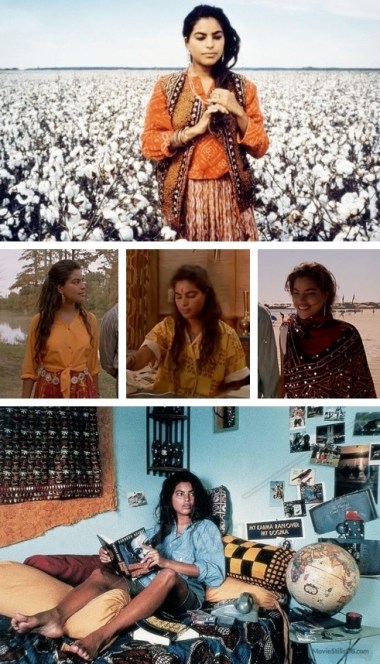
90s4Mississippi Masala is probably not the first film dealing with India’s diaspora (in the movie’s case a double diaspora) but one amongst a clutch of much discussed diaspora films of the 1990s (X, X). It is also well documented on tumblr so the images are a bit superfluous. Except to say that Mina’s wardrobe is very much 1980s influenced “ethnic chic”, kind of a Gurjari in Greenwood aesthetic. With a dash of Janpath market (pic 3). It combines this with 1990s American fashions (that denim…) and a nod to Africa in some of the prints Mina’s parents wear as well as the African wax print furnishings in Mina’s room (pic 5).

More pics at link.
Posted in 1990s, Indian Cinema, Indian Dress, Indian fashion, Indian Women, retro, retro fashion, Salwar Kameez, Sari, sari history, vintage sari | Tagged , , , , , , , , , , , , , , | Leave a comment

The Red Sari

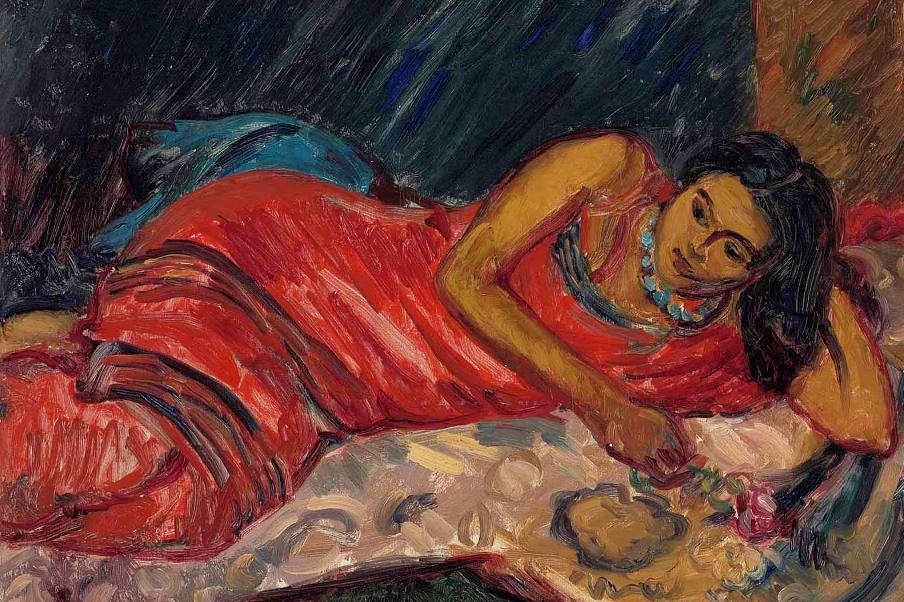
rs1rs2rs3rs4Then when the lamps were lit, I should put on my red dress and it would be thin as a veil, and would wind about my body, and billow out as I came into the room, pirouetting. It would make a flower shape as I sank down, in the middle of the room, on a gilt chair. The Waves, Virginia Woolf.

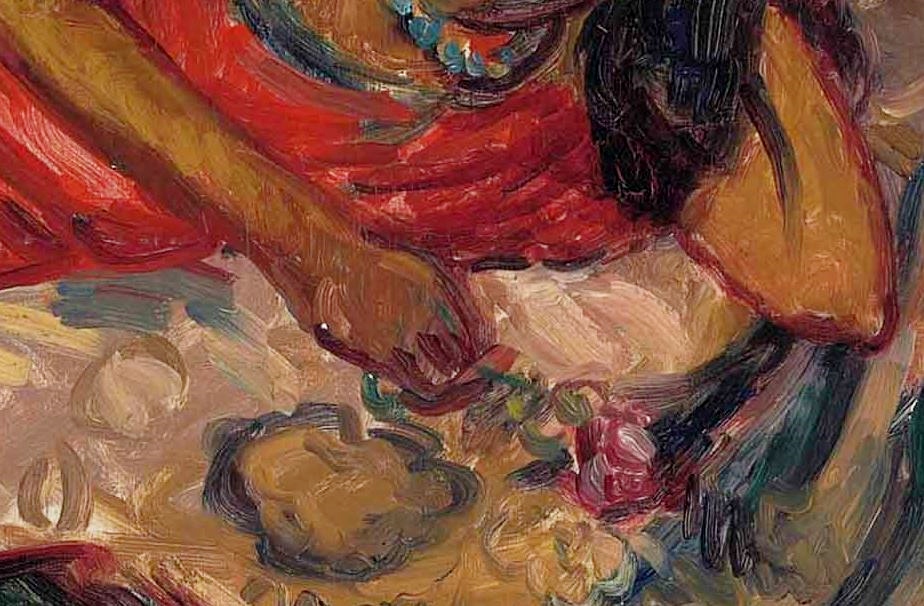
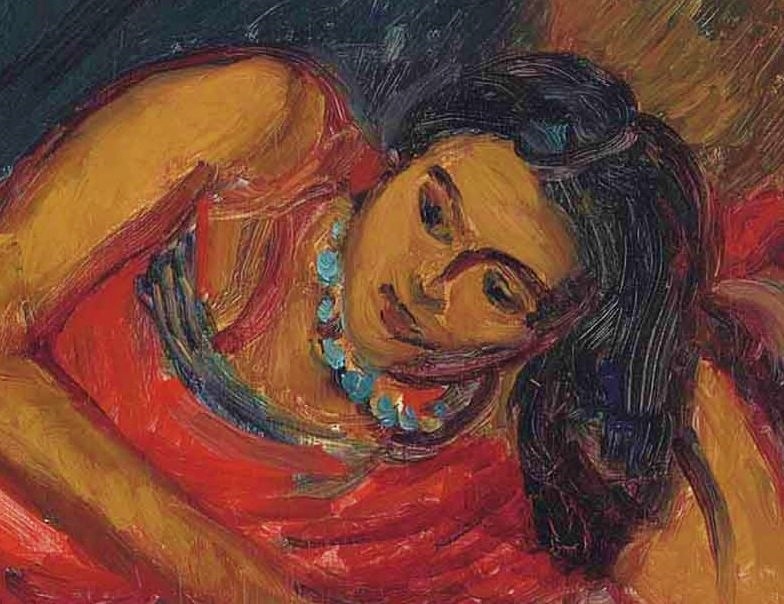
The Red Sari,  Sunita Reclining/Matthew Smith (early 1930s).

The 1930s features: Sleeveless blouse and the sari wrapped twice to give the three tier effect below waist.

Posted in 1930s, Fashion Quote, Indian Dress, Indian fashion, Indian Women, Paintings, Sari, Sari Blouse, sari history, vintage art, vintage fashion, vintage sari | Tagged , , , , , , , , , | Leave a comment

Sadequain

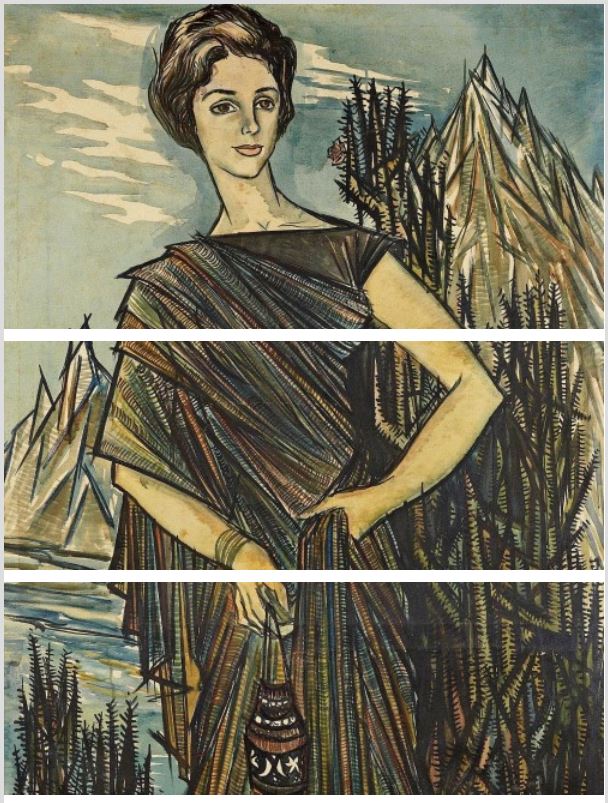
sd1In an interview, he recognized the centrality of these forms to his work: “In the anatomy of these gigantic plants I found the essence of calligraphy. Everything that I have painted since then — a city like Rawalpindi, buildings, a forest, a boat, a table or a chair, a man, a mother and child, or a woman—has been based on calligraphy, which in itself issues from the structure of the cactus.” The transition is evi­dent in works such as Genesis: Lady amidst Mountain Cacti (ca. 1957) ,  in which the woman’s face and limbs are painted in a realist manner but the landscape around her and her sari have been fractured into thorny, angular planes. [X]

The Pakistani painter Sadequain on the calligraphic roots of his paintings and the recurrence of cacti in his work. This work is Lady Amidst Mountain Cacti (~1957).

Notes: I am very uncertain about the notes for this painting – and it’s not the first time I have found auction notes suspect –  looks less like Hestia with a lamp and more like a lady in a sari (albeit kind of reversed) with a batua (like a reticule).

Posted in 1950s, Calligraphy, Islamic Art, Pakistani Art, vintage art, vintage fashion, vintage sari | Tagged , , , , , , , , | Leave a comment

The Kebaya Post

w1 w2 w3Now and then I like to look at fashions east of India. Especially the kain-kebaya which you can still spot in everyday use.

I spotted an Indonesian book of fashion illustrations (Cantik Elegan dengan Kebaya XL aka  Beautiful and Elegant in Kebaya XL) on my travels. It has a 100 odd illustrations of kain-kebaya for larger women (apparently to break away from the sarong-kebayas are for slender Singapore Girl kind of feeling). The illustrated lady looks pretty cool and there are numerous patterns and vivid colours in there – I always miss colours when in Australia. Kind of a mix of indigenous Indonesian and Islamic influences

The pics are not the best, I only had my phone on me.

Posted in Contemporary, Contemporary Style, Indonesia, Islamic style, kain kebaya, Kebaya, Plus Size, South East Asia | Tagged , , , , , , , , | 4 Comments

The Pallu Drape Post

w1

Though in our times the fashion is to leave the pallu (the loose end of the sari) largely unsecured,  historically there were several ways of securing or draping the pallu of a nivi sari.

In the 1930s-1940s when the nivi style was fairly new amongst the many modes of doing so were the kinds shown in these paper dolls.

From the left: 1) the loosely draped over the shoulder style (more common in South India) – sometimes the pallu would be loosely secured at the waist much like for a nine yard sari 2) the pinned to the shoulder with a brooch and then draped over the head style, more common in Bengal and Western India 3) similar to style 1 but with possibly a brooch at the shoulder and something like a belt – though this style doesn’t always require the drape over the shoulder and 4) the loose end of the sari tucked in at the waist (common in vintage Tamil photographs and also a bit of a 1950s thing)

Posted in 1930s, 1940s, paper dolls, sari drape, Vintage Blouse, vintage sari | Tagged , , , , , , | 2 Comments

The Fashion Illustration Post

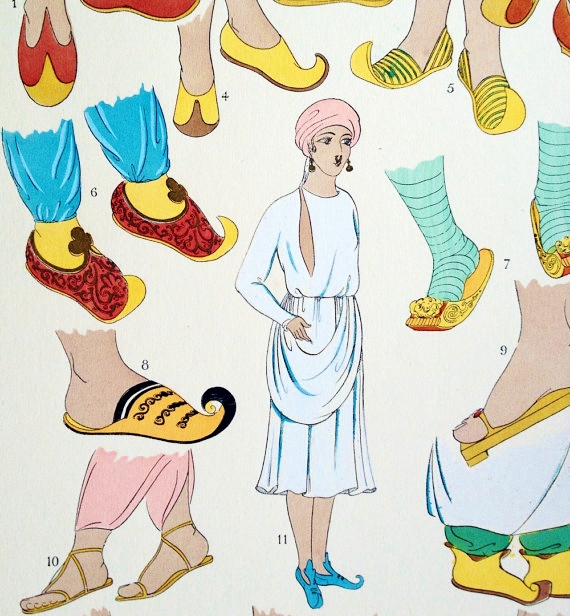
Paul Louis de Giafferri’s pochoir prints which cover a number of historical costumes, including India (~1925).   Some are accurate and probably based on photographs of India at the time, some are a bit whimsical and fanciful and European in execution.  E.g. No 11 in pic 2 looks nothing like Indian fashions of 1925 or antiquity yet wouldn’t be out of place on an Indian runway today. And of course I love some of the blouses in pic 3.

Images via bananastrudel.

Posted in 1920s, french illustrations, historical costume, Illustration, Indian fashion, Sari, Vintage Blouse, vintage fashion, vintage illustrations, vintage sari | Tagged , , , , , , , , , | 1 Comment

The Cartoon Post

From SD Phadnis’ cartoons of the 1950s and 1960s.

The lady in pic 2 with that excellent dog is a woman after my own heart.

Also I have a sudden desire to do something anything in white shoes and a sari.

And of course one totally needs a sari with cats on it!

Posted in 1950s, 1960s, Illustration, Indian Illustrators, Indian Women, Sari, Sari Blouse, vintage illustrations, vintage sari | Tagged , , , , , , , , | Leave a comment

A Birthday

WP

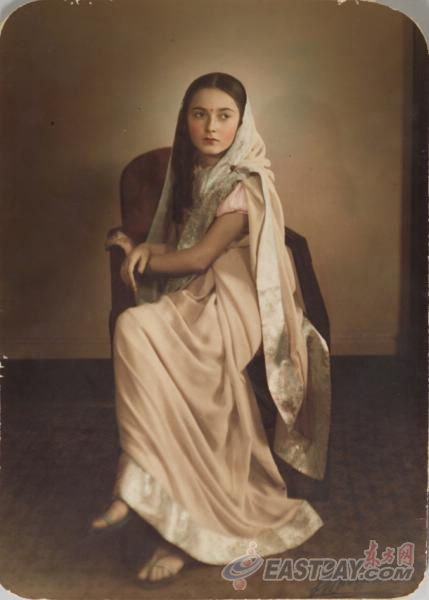
My grandmother died not too long back, she would have been 88 today.  The studio pic is of her as a wee thing in about 1930-she was the eldest child so this must have been a special trip. She looks pretty good all decked up in a pavadai, loose “chattai” and bits and bobs. I like that ribbon touch the best but that’s just me, I love ribbons.

Later in life – and I don’t have a picture handy –  she was a slim 5’6’ who always wore a nine yard sari even as her peers abandoned it. She also  retained her two nose studs. Her abundant hair was always oiled and plaited, her person always neat and elegant. She was a calm and methodical worker, not the kind who cooked up a feast but the kind who would make two faultless dishes. Like many Tamil women of her age she had been instructed in music and was good at it.

Though we had a fractious relationship at times – she was strict and serious, I carefree and unruly – her influence on me in matters aesthetic is very strong. Most of all my fascination with the 30s-50s is thanks to my grandparents accounts of the times.

My grandmother gave me this photo as a keepsake when I was 21, she trusted me to preserve it and take joy in it. It’s a little battered with all my moves but still intact. In a way it was the first piece on my vintage inspiration board.

My personal journal has a lot of entries on my grandmother. When she died I found that she had kept copies of those pieces. To be remembered in a public post, to know that this first photograph of hers is still around, would make her happy. So here it is!

Posted in 1930s, Girls, India, Indian Dress, Indian fashion, Personal, Photography, Tamil Nadu, Vintage | Tagged , , , , , , | 9 Comments

Roop and Baz

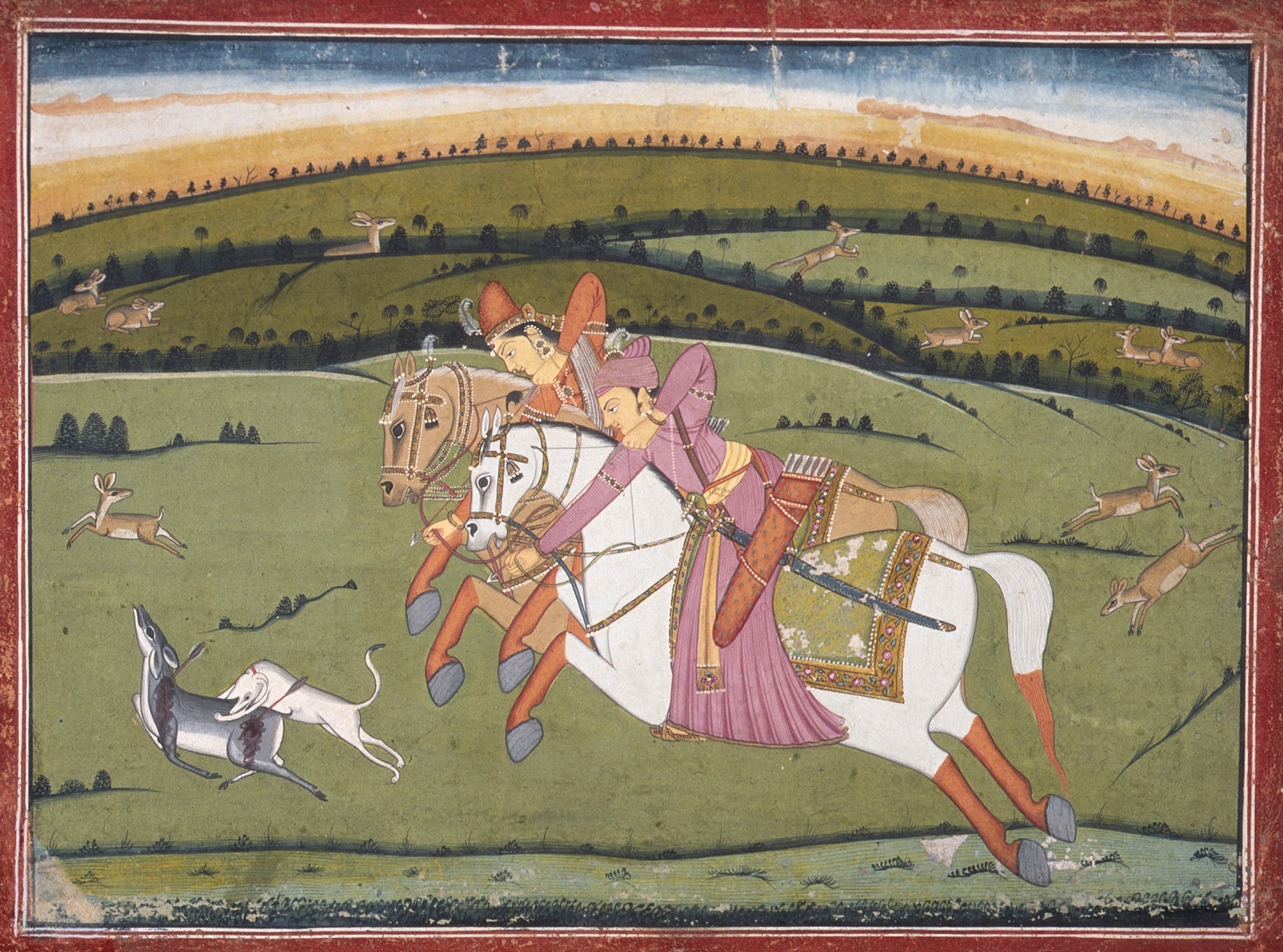
At first love seemed easy but after hard. [X]

For a couple whose legendary relationship was built on a love of poetry and music, Baz Bahadur and Rani Roopmati appear an awful lot in hunting scenes in miniature paintings. Their poems are celebrated + there are enough subsequent songs on the romance, unfortunately hard to track down good translations. A few snippets here.

There seems to be a single English translation dating to 1926 of the original Persian language romance of 1599 on Baz Bahadur and Roopmati authored by Ahmad-ul-Umri.

Pic source: X, X and X.

PostScript: Baz Bahadur was defeated by Rani Durgavati, the Gond Queen, around 1556. That decisive defeat left him averse to war. In 1561 however Baz Bahadur was forced to defend Malwa, lost to Akbar and fled.  Roopmati poisoned herself rather than surrender. The Mughals then turned to Gond.  Despite resistance the Gond army eventually lost, largely due to the lack of artillery. Rani Durgavati died in 1564 on the battlefield by her own hands resulting in the Gonds of Garha Mandla becoming a vassal state of the Mughals.

Adham Khan aka Baz Bahadur’s nemesis was more than taken up with the famed musicians and dancers of Baz Bahadur’s court retaining more than a few of them for his own pleasure and sending on only captured elephants to Delhi. Eventually Adham Khan was killed in 1562 by royal order. Those dancing girls? Akbar did get them, you can see them in the Akbarnama. And Baz Bahadur? He too ended up – probably as a musician – in Akbar’s court.

Posted in 16th Century, Art, Asia, churidar kameez, Costume, Culture, Deccan, fashion, historical art, historical costume, historical dress, History, hunt, indian art, Indian Dress, Indian History, Indian men, Indian Singers, Indian Women, Mughal, Music, Paintings, Poetry, Romance, Royalty, Women | Tagged , , , , , , , , , , , | Leave a comment