All About the Bindi

The bindi/pottu/sindoor/tikli – whatever name it be known by – is probably the most emblematic of Indian elements of attire and also has a long history. It is symbolic (as a signifier of marital status or of caste),  part of the daily ritual as well as decorative. While several terms exist, I will use the term bindi in this post.

wp1The bindi as a symbol of marital status in women (Kumkum/Sindoor) is familiar to most Indians.  This can vary from region to region and does not always involve the hair parting,  but in almost all parts of the country it is a part of Hindu marriage, festive and temple rituals.  Its origin is obscure but it possibly was a blood mark of sorts to mark the bride’s entry into a new family, this later being replaced by kumkuma which was a mix of turmeric and slaked lime.  Not as commonly worn as a few decades back it remains a part of rituals and is often applied in conjunction with decorative bindis.

Her friends apply coolants: fresh lotus leaves, bracelets of lotus fiber, sandal wood paste; they fan her with palm leaves. [X]

Decorative designs for the face and body are found in plenty in Sanskrit texts, some seem to have been very elaborate given they start at the breasts and literally bloom on the face.  The practice was more common in spring and summer and the ingredients used were cooling in nature, with the coming of winter the paste was minimally applied, if at all. Designs were usually made from a paste of sandalwood, musk and/or saffron and were commonly known as पत्रावली/patravali (a garland of leaves/foliage).

Sandal paste patterns in conjunction with kumkuma and ash were also indicative of castes and sects, the latter persists now and then among men. For women the practice of using sandal paste on the forehead is now reduced to a spot or dash often worn with a bindi or as bridal decoration.

While sandal paste is used to make designs and applied as lines/a band, turmeric was used on the forehead as a band.  Like sandal it has decorative and cultural aspects and is used for skin care.

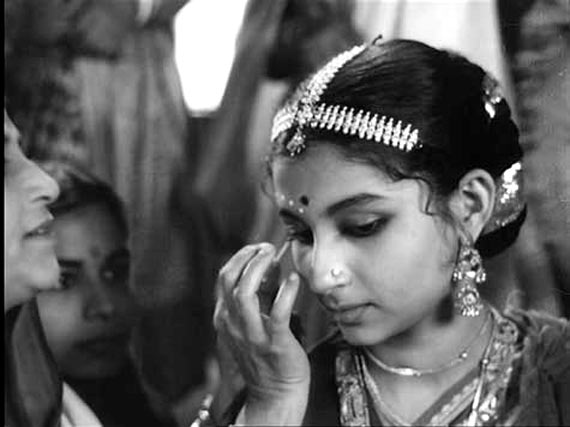
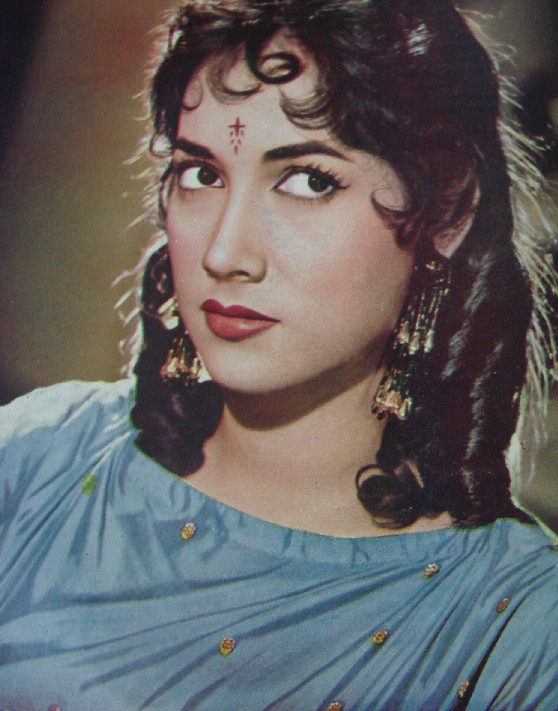
Pic 1: Veena in Samrat Ashok (1946), Pic 2: Portrait of a Lady, 18th cent., Pic 3: Untitled B.Prabha (1960).

wp5

A spot of chalk and another of vermilion shone upon her forehead, like the sun and moon risen at once over a lotus leaf. On Radha as a bride, Harkh’nath.

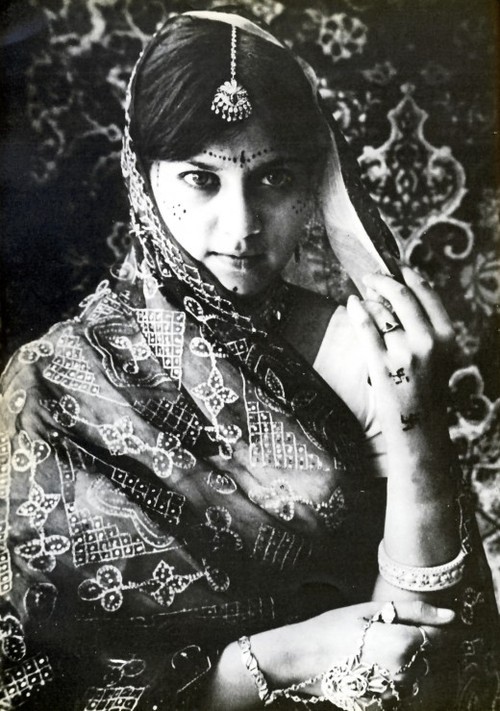
The designs referred to earlier persist in some ways, e.g. bridal designs for the forehead are seen in several parts of India and especially in Bengal where sandal paste is often applied to make the design.   The photograph here is of a Gujarati bride (an Asha Parekh role?!), I think perhaps in the 60s-70s. Another Gujarati bride here.

Must be the purist in me but I can’t get on the sticker train for this:)

Decorative facial designs by way of tattoos or black dots is common in rural and tribal India. The application of three dots on the chin is one of the more common rural designs and expectedly often made a screen appearance.

In the pics: Sreela Majumdar in Mandi (via dhrupad), Vyjayanthimala in Ganga-Jamuna and Nargis in Mother India. 

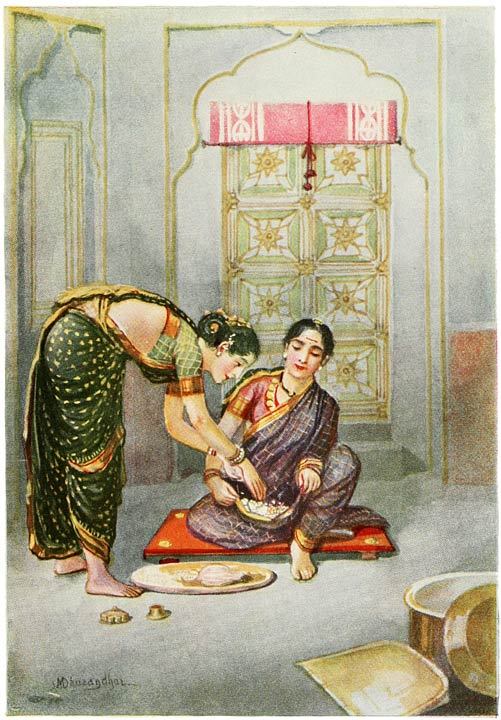
Specific designs are often seen in medieval and later Indian paintings. An e.g. is the straight line on the forehead seen on Deccan women as in this MV Dhurandhar illustration.  Another example is the chandra-bindu or the moon bindi. Which is also a Sanskrit character. In bindi form the dot may be placed within the half circle or outside it.  Though worn elsewhere in Western India,  it is characteristic of Maharashtra (pic 1) and can be combined with further lines and dots. A mang tika (forehead pendant) can also function as a similar kind of  bindi like in pic 4.

While all kinds of bindis from the sindoor to a round dot to lines to designs are seen in 20th century India, some types seem to dominate in the popular images (read cinema) in certain decades. The 1940s and 1950s stills often have a lot of different designs, sometimes these appear to suggest a particular aesthetic in historical or mythological films but they also appear in more modern looking publicity shots. The designs can be quite varied and complex though the flower bindi (pic 4) with its Bengal hints (red core with white dots) pops up quite often on 1950s actresses.

Pic 1: Nalini Jaywant, Pic 2: Sushila Rani, Pic 3: Shakila (courtesy photodivision) and Pic 4: Madhubala

The 1930s/1940s urban woman look required a very basic and small bindi . Where it is positioned on the forehead depends on the wearer.  Shaping the eyebrows also seems to have been a thing in the 1930s and 1940s.

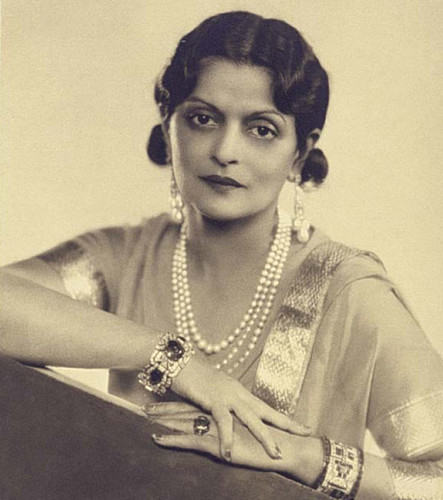
In the pics: Amrita Sher-Gil, Gayatri Devi, Devika Rani, Shanta Hublikar, Leela Chitnis, Miss Gohar.

These were also decades that did not require a sari to be worn with a bindi as in these pics (pic 1: Hansa Wadkar, pic 2: Neena).

The “tilaka” or the elongated forehead mark takes many forms, some of which have a religious function. It can also be present as an ornament (माँग टीका).  It has a decorative aspect and can be drawn on as required by the wearer.  While quite commonly seen in South India on young women, it is also prevalent in other parts of the country. Quite often seen in the 1950s and 1960s when it was worn by young women- you can see a few examples in today’s post.

Last pic courtesy photodivision.

By the 1970s and 1980s the simple round bindi was around, it could be applied as a powder or liquid but the presence of Shringar kumkum as well as the initial simple felt bindis meant that the latter were preferred. By the 1990s of course the felt decorative bindi we are familiar with had appeared.

In the pics: Rekha, Aruna Mucherla, Swaroop Sampat (still the Shringar kumkum girl).

7

And between the lac bindis of the early 20th century and the felt bindis of today there was the plastic stick-on bindi.  Made of a stiff but pliable plastic, it had a bright and smooth surface and came in more than a few colours.  It’s not hard to spot in photographs of the 60s and 70s but never replaced powder and liquid bindis like its felt counterpart.

This slideshow requires JavaScript.

Finally he appears with white fragrant paste on his body, a bright crest jewel, white silk garment with a yellow border of swans, tilaka mark on his forehead and ornaments round his hair, neck and arms. [X]

Various forms of the bindi, largely the round dot and tilaka, were also used by men. A band of sandal or turmeric across the forehead was also be worn by men. Often these serve as caste marks and include a mixture of lines, dots and tilaka. Usually drawn with sandal, ash or kumkuma they are more common in the Southern and Western parts of India. They also serve a decorative purpose, especially for a bridegroom.

In the pics: Gandhara head (photograph mine), Krishna, Maratha chief, 1860, Maratha prince, late 19th century,  Madhava Rao and Sir Pannalal Mehta painted by Raja Ravi Varma, Maharaja Sayaji Rao in 1902, Mysore raja in 1906, M.K. Thyagaraja Bhagavathar, bridegroom.

This slideshow requires JavaScript.

PostScript: Facial decorations are of course known all over the world, especially in tribal societies.  Decorations similar to the bindi in more urban cultures occur in Mycenaean Greece and Tang Dynasty China (and can also be seen in Korean wedding rituals today). The Tang Dynasty in particular had many kinds of designs and a number of colors were used, though red predominated. As well as a story re its origin, the falling of petals on a princess’ forehead. Nevertheless the persistent and diverse uses of the bindi for ritual and decoration appears to be peculiar to India.

Mycenaean sculpture here. Recreation of Helen of Troy here. Tang dynasty lady here. Tang Dynasty recreation source here.


Posted in 1860s, 18th century, 1930s, 1940s, 1950s, 1960s, 1980s, 19th century, 20th century, Accessories, Ancient India, Asia, bindi, Culture, Deccan, Early 20th Century, East Asia, fashion, Hinduism, historical fashions, India, Indian Bride, Indian Cinema, Indian fashion, Indian men, Indian Women, Late 19th century, miniature paintings, retro, Sanskrit Literature, Sets, Women | Tagged , , , , , , , , , , , , , , , | 3 Comments

Autumn/Festive Season

We are in autumn but it remains very warm.  Reading autumn poetry is about the only one to keep one’s cool.

wpautumn

The skies, growing gradually peaceful,
flow like long rivers across heaven,
with sandbanks formed of the white clouds
and scattered flights of softly crying cranes;
rivers which fill at night with waterlily stars.

Vishakhadatta on Sharad ritu (autumn) in Mudrarakshasa.  Autumn arrives in India post monsoon so the feeling and emotion in many poems is quieter. And full of bird imagery.  Vyjayanthimala as a waterlily is a bit of conceit though my mother once told me this particular part of Nagin (1954) was considered to be full of a beauty never seen before.

Vyjayanthimala gifs thanks to @zamaanapatsi-bollyfan

Detail of painting (1760-65) from X.

wp1The garba around our parts has been subdued, perhaps they will ratchet up the enthusiasm (and noise ) in the weekend.

While in Singapore I found this postcard of a textile piece showing dandiya dancers in the 15th century. Made for the Indonesian market (see also X), you can see the decorated sticks in the hands of the dancers (click for larger view).

There are three designs of printed cottons, one for the kaccha or dhoti type garment below, one for the waist wrap knotted over the dhoti and one for the fitted long sleeved bodice.

wp2And here is a rasamandala aka the circle dance of Krishna and the gopis. Jaipur, 1750. Note the full skirts and voluminous upper drape of the 18th century

A fuller version of the painting here.

Pic Source.

monsoonweddingOctober is Marigold.

And indeed that first line holds true for Navaratri when the markets in parts of India are full of marigolds.

And marigolds as a recurring motif symbolising love had their own starring turn on Monsoon Wedding.

And now I am going to take some time out for marigold appreciation. See you in a bit.

Posted in 1760s, 18th century, 2000s, Actor, Ancient India, Art, century, Costume, costumes in art, Culture, Dance, Dancer, Flora, Flowers, ghaghra, Goddess, historical costume, historical dress, indian art, Indian Cinema, Indian Costume, indian festivals, Indian men, Indian Textiles, Indian Women, Literature, miniature paintings, Paintings, Sanskrit Drama, Sari, Sari Blouse, sari drape, sari history, Seasons, Women, women in art | Tagged , , , , , , , , , , , , , , , , , , , , , , | Leave a comment

Comments

Just a heads up that I don’t usually post messages that have links so apologies if I haven’t approved any such posts from people who follow the blog.

Posted in Uncategorized | Leave a comment

The Rangoli Post

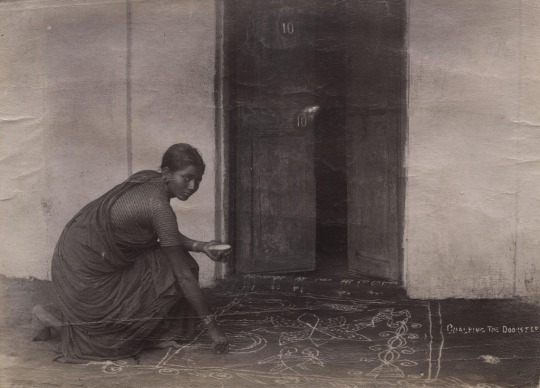
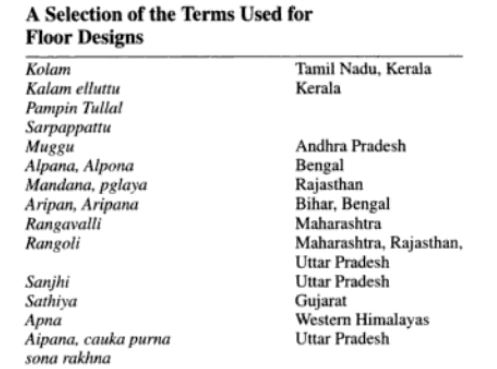
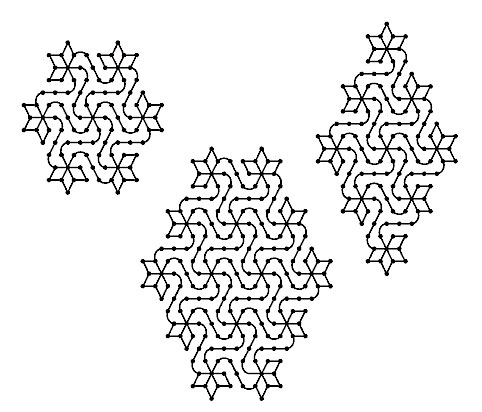
wp7wp8Source for Rangoli terms-X.  Pic Source – X. (~1890s, click for larger view).

wp5Making an Alpana, Santiniketan, 1954.

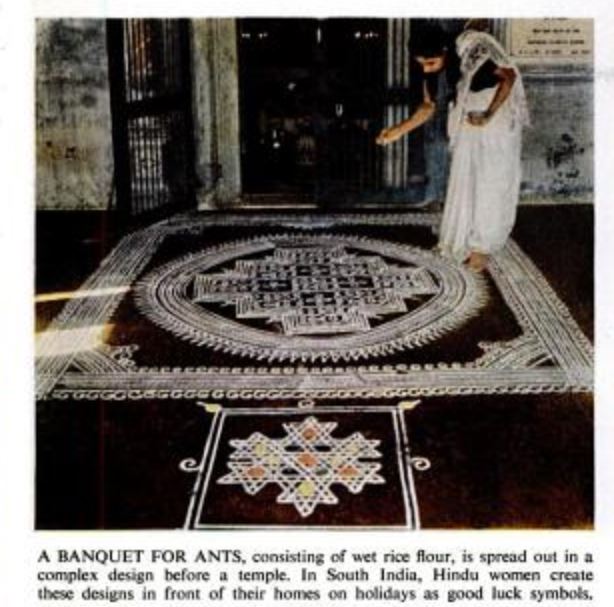
wp6Life Magazine, 7 February 1955.

From what I know, the use of rice flour or paste is intentional and is meant as a meal for insects, in particular ants. Hence too the daily application and not just on holidays – though holidays usually result in elaborate decorations.

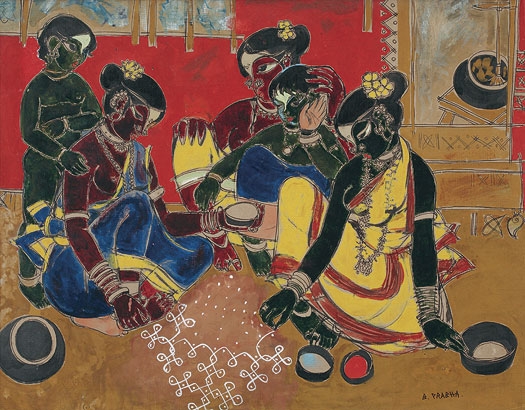
wp4Untitled, B. Prabha.

This slideshow requires JavaScript.

At the age of 54, she took a post as a visiting professor at India’s Tagore International University and was charmed by India. She continued to visit India occasionally thereafter, and produced works incorporating motifs based on India’s scenery, landscapes, temples and so on.

Rangoli/Kolam in Akino Fuku’s paintings.

[Pic 1: Morning Prayer, 1988]

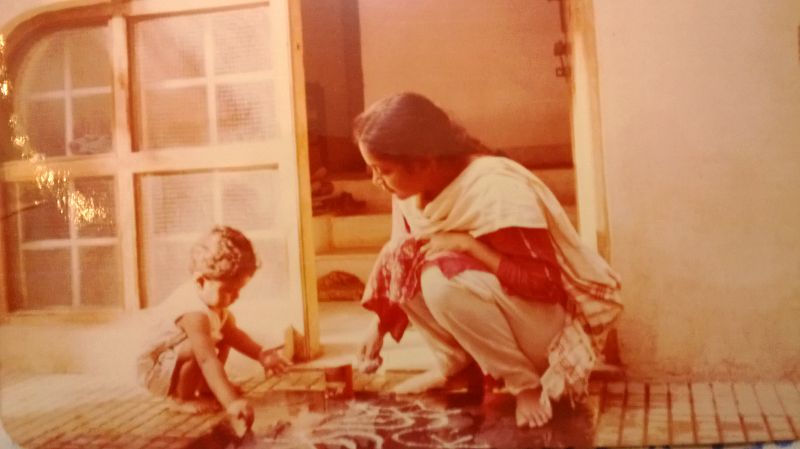
wp10To end a personal post. My cousin and I making a kolam. The design is a simple version of kolams based on the parijat flower.

This struck me as a bit faded for the mid 90s and then I realised its 20 years since the mid 90s. Like truly retro:).

The salwar-kurta is a handloom ‘set’ – my mother bought it on a Chennai visit.

Posted in 1890s, 1950s, 1980s, 1990s, Bengal, Culture, Decorative Arts, Early 20th Century, Hinduism, India, indian art, Indian Dress, Late 19th century, Photography, regional styles, Salwar Kameez, Sari, Sari Blouse, Vintage, vintage art, Vintage Dress, vintage photography, Women, women in art | Tagged , , , , , , , , | Leave a comment

Lit Post – 3

wp1Kamala was simply dressed in a pink silk sari, fastened on the right shoulder with the diamond coronet which Tara had lately given her. The thick soft tresses of her long jet-black hair were wreathed with white roses, and she wore in it the ruby rose, Tara’s first gift. Hindupore, SM Mitra.

In the 1900s it must have seemed like the sun would never set on Empire judging by two novels that deal with the coming together of east and west by way of inter-racial romances. In Lilamani the British are the civilizing influence, in Hindupore, given the title, the Hindus. While I haven’t read the novel in its entirety – tbh I didn’t care for either novel –  the descriptions of the clothes can be puzzling. Some of these are unclear (a teagown and a sari?). But it is likely a lot of Western dress elements are included to make it understandable to the British public at whom the book is aimed.

The book includes a photograph of the author and in a way his rather unusual attire reflects the coming together of some of the themes of his book. There is the starched collar.  There is the safa which is also cravat like. The coat has Chinese influences in the frog closures – the book has passages from Okakura’s Ideals of the East and discusses Pan-Asianism.

wp2I had waited for an opportunity, ever since I first set foot in England, and felt that cold aloofness which is ladled out with spoonfuls of condescension to those like me who do not belong to a pure white race.

Intellectually I felt I belonged to the West, emotionally to the East.  I Go West, DF Karaka.

DF Karaka’s 1938 book I Go West is an account of his student life in the UK – a time when he became the first South Asian president of the Oxford Union, wore Savile Row suits, gambled away a good deal of money and wrote about the colour bar – before he returned home in 1938. He subsequently covered the War and then went on to found Current magazine after the War.

Not exactly a fashion post (though Savile Row…) but part of a few books and authors of early 20th century India that I was looking at this week. Unlike Hindupore, the book is written for Indians familiar with English.

Pic Source.

wp3

Extract from DF Karaka’s Chungking Diary (1942), an account of the Chinese wartime experience contrasted with the Indian situation.

Karaka records that Kung Peng who had been in the hospital for five months after being with the Eighth Army was full of vitality, spoke English well and that she was attempting a translation of Grapes of Wrath during her hospital stay: Elsewhere he records the dress of Chinese women – in Chungking* some women are dressed in sombre dark blue and have black shiny hair and a high colour in their cheeks (very similar to Marseilles women according to Karaka) , others are rouged modern Chinese girls wearing an adaptation of the traditional gown and high heeled slippers.

*now Chongqing, in 1942 the city was the base of the Kuomintang.

Posted in 1910s, 1940s, Authors, British Raj, Chinese, Colonial, Early 20th Century, fashion, History, India, Indian Authors, Indian Dress, Indian fashion, Indian Literature, Indian men, Literature, Men, Photography, Studio Portraits, Vintage Books, Vintage Dress, vintage fashion, Vintage Men | Tagged , , , , , , , , , , | Leave a comment

Lit Post – 2

lit3अब मेरी बेटी का मामला है मेरी कोख में जन्म लेने वाली मैत्रेयी का। मैं इसको उस खड्ड में नहीं गिरने दूंगी, जिसमें गिरकर औरत जीवन-भर निकलने को छटपटाती रहती है और एक दिन खत्म हो जाती है।

Now it is a matter of my daughter, of Maitreyi born from my womb. I won’t let her fall into that pit into which women fall and spend the rest of their lives yearning to escape and then one day they are no more. [X]

Kasturi Kundal Base* is an autobiographical novel by Maitreyi Pushpa that appears to deal a bit with her mother’s life and her early life in Bundelkhand. The still is from the TV series of the same name.

Autobiographies by women in Hindi are thin on the ground. Exceptions include Maitreyi Pushpa’s work (her other autobio is गुडि़या भीतर गुडि़या (Russian Doll)). One of her works, Alma Kabutari, has been translated into English.

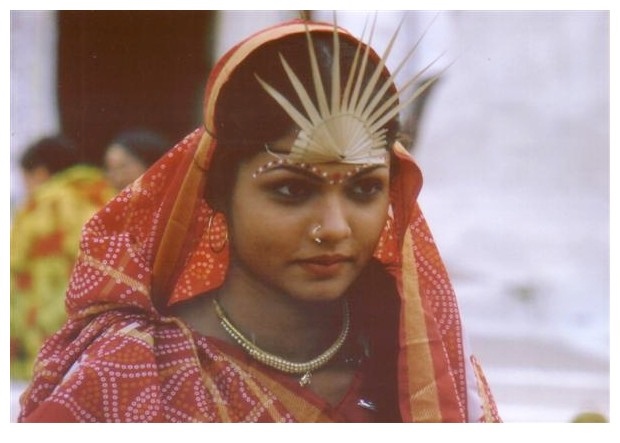
The costume here with a plam leaf woven crown is likely Bundelkhand but I haven’t been able to corroborate this (though the palm leaf crown is cited in marriage customs in Central India).

*Title from a Kabir doha.

Posted in 1940s, 20th century, Accessories, Central India, Culture, Indian Authors, Indian Bride, Indian Dress, Indian Literature, Indian Women, Literature, Novels, regional styles, Sari, Sari Blouse, Television, Vintage Blouse, Vintage Books, Vintage Bride, vintage costume, vintage fashion, vintage sari | Tagged , , , , , , , | Leave a comment

Lit Post – 1

lit2 lit1After a few days, he began to visit the boy’s home in Palayamkottai and met his sisters who, dressed in the daring new style of pavadai, blouse and dhavani, strolled about book in hand. Extracts from Padmavati, A. Madhaviah, Trs by Meenakshi Tyagarajan.

A three piece dress comprising a blouse (choli), skirt/lehnga/dhoti and a shawl/dupatta is the most common of all forms of Indian historical clothing.

The pavadai-davani or langa-voni was probably not entirely uncommon for young girls in South India (see this 1868 pic) but as the extract from this 1898 novel shows its evolution into a dress for young, educated women probably dates from the end of the 19th century. At this point it was a “Christian” style, the girls referred to in this paragraph are Christian.  I have to add that I haven’t seen too many pics to support this since most pics of Christian girls have them in a sari.  However Madhaviah was writing in that period and as such the observation has to be take as correct. It then seems to have been universally adopted over time but by the 70s or so it is increasingly more of a rustic garment.

The stills for today’s post are from Vaagai Sooda Vaa set in the 1960s.

Over the years of doing this blog one of the frustrations is finding Indian texts that allow one to construct a rudimentary fashion history. Unfortunately if you primarily read English there is a good deal that is inaccessible. As an e.g. even though Madhaviah was one of the pioneers of modern Tamil writing and this book has a number of references to clothing in Tamil Nadu of the time which I wasn’t aware of, it is accessible only because the family arranged for a translation. Similarly a Tagore novella has numerous details on the clothes of upper class Bengalis, a work I recently read makes a casual reference to famous stores for buying saree jackets. That kind of detail is only possible if one is able to read the original or has access to translations, the latter are far and few in India.  Finding and then working through the texts is a bit difficult but I will try and refer to extracts now and then.

Posted in 1890s, 19th century, Christianity, Colonial, Costume, Culture, Dress Reform, Fashion Quote, Girls, Indian Dress, Indian Literature, Indian Women, Late 19th century, regional styles, sari history, Tamil, tamil Literature, Tamil Nadu, Vintage, Vintage Books, vintage costume, vintage fashion | Tagged , , , , , , | Leave a comment

Indian Royals – 2

The daughters of the Diwan of Travancore in 1868. They appear to be Bala, Neena, Sundara, Sati?. The Diwan was a Maharashtrian from Thanjavur, the sari and ornaments are similar to that seen in Maharashtra and South India in the late 19th century (in fact these styles persisted well into the 20th century). Except for Sundara in pic 3 – wearing what looks like the half saree – they all appear to be wearing nine yard sarees. The colour of the saree in three of the pics is akin to what in Tamil is called araku.  At least in pic 2, the sari end is secured to the body at the shoulder by a brooch as here.

Source.

Jamnabai in 1875-6. (For Jamnabai see here).  Apart from the blouse which is a Victorian influenced style, the sari and anklets and other elements are also seen in the 1911 portrait of Chimnabai who was her daughter-in-law.

Suniti Devi, Maharani of Cooch Behar (also the grandmother of Gayatri Devi) in 1887. The sari is worn Bengali style, the blouse cannot be seen but is possibly the fuller versions worn in this period. You can see a bit of the high collar (and the jewels) in the close up.  Suniti Devi has a quiet elegance and is probably the grande-dame of House of Cooch-Behar aka Ladies who knew how to dress well.

The Maharani of Mysore, 1900.

Apart from the characteristic way of pleating the lower half of the sari, note the belt and also the way the pallu is pinned to the body of the sari over the shoulder (this is the first time I have seen this arrangement).

r4‘Rubbish, rubbish!’ she exclaimed when she saw them, and picked out over 200 superb saris for her tomboy daughter, in plain and patterned chiffon, with and without borders, some hand-embroidered, others appliques, some embroidered in gold and others of simple, heavy silks.

Ayesha, I am afraid, doesn’t wear her sari half as well as her mother,’ said a family friend. speculating that Ayesha always stood in her adored mother’s shadow, defining her self against Indira at the same time as fearing she could not live up to her example. Maharanis, Lucy Moore.

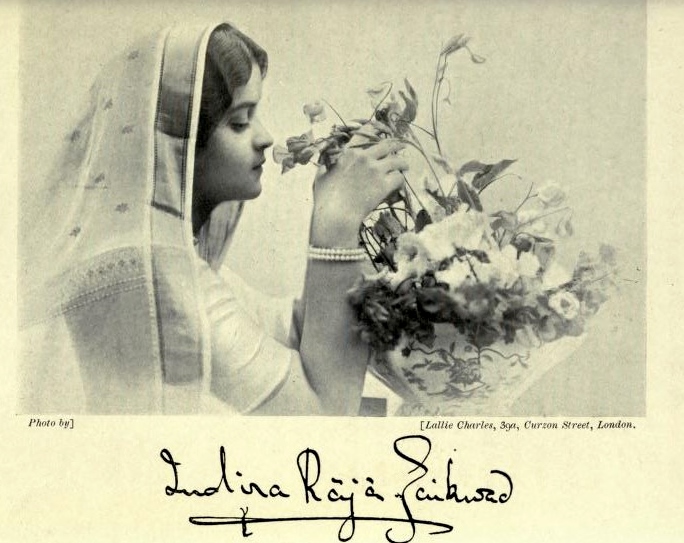
More often than not if you think of a royal style icon, Gayatri Devi is the name that comes to mind. Her style is to some extent derived from her mother, Indira Devi. Indira Devi’s initial 1910s look as a young woman (on her way to a wedding that did not take place, Edwardian style, wedding in London) gave way to a more sophisticated look in the 20s and 30s (X, X, X, X) which employs a lot of chiffon sarees and you can see her influence on her daughter. She didn’t entirely discard the nine yard sari (she was the daughter of Chimnabai)  it appears in paintings and photographs.

Today’s pic from A Year with the Gaekwar of Baroda (1911), the book has a dedication to her. The sari is probably a Chanderi/Maheshwari sari.

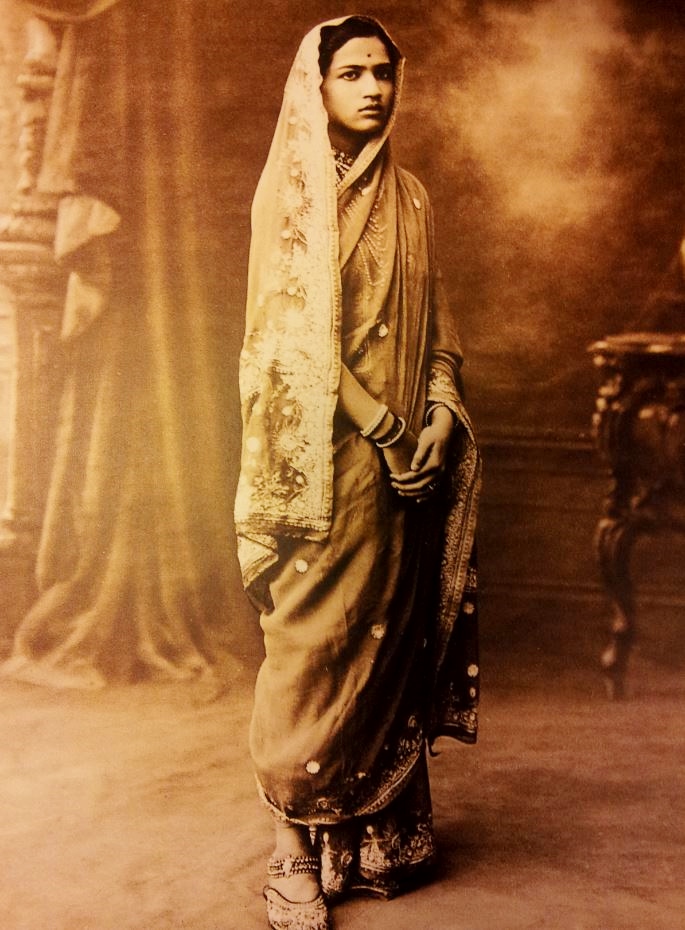
r3Unidentified Maratha Princess, 1930s. The saree is worn in the nine yard style (nauvari) but appears to be a sequinned/embroidered chiffon with a stitched border characteristic of the decade.  Though the gold butis are kind of traditional. Like in this pic, thick anklets, but worn with a mojri kind of shoe.


Posted in 1860s, 1870s, 1880s, 1900s, 1910s, 1930s, Costume, Culture, Early 20th Century, fashion, historical dress, historical fashions, Indian Dress, Indian fashion, Indian royalty, Indian Women, Late 19th century, Maharashtra, regional styles, Royalty, Sari, Sari Blouse, sari drape, sari history, Sets, Studio Portraits, Vintage Blouse, vintage costume, vintage fashion, vintage sari, vintage style, Women | Tagged , , , , , , , , , , , , , , , , , , , , | Leave a comment

Indian Royals – 1

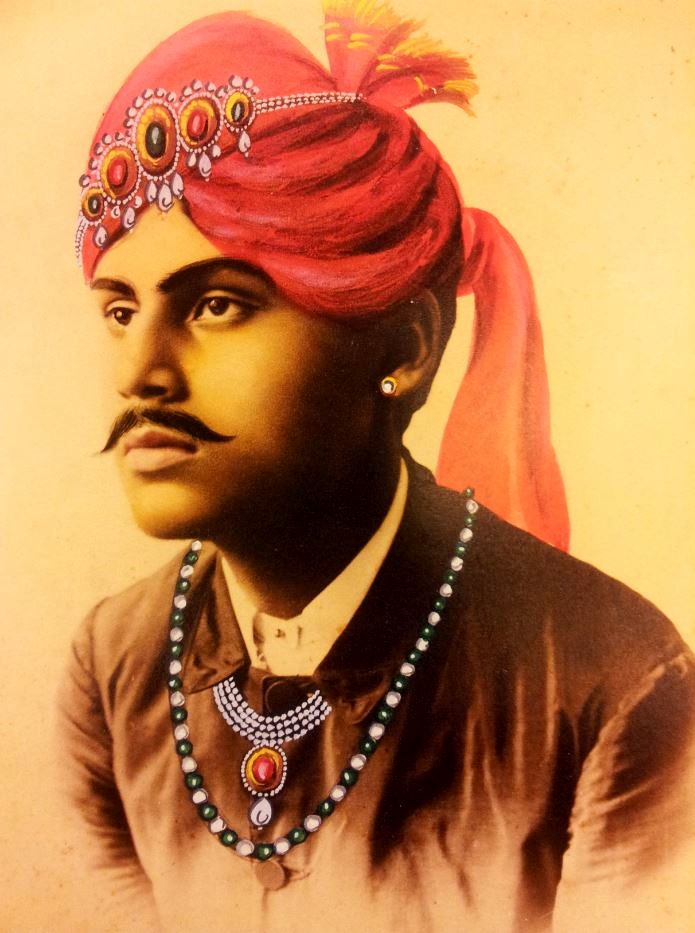
r11Unidentified man, Jaipur, possibly royalty. Painted portrait (gelatin silver print and watercolour) from the 1930s.

The collared coat is possibly a sherwani – a garment that displaced the jama, angarkha kind of tunics of the Mughal and Rajput courts by the late 19th/early 20th century. As in this pic you could wear a shirt under the sherwani. Collars were less common than the bandhgala or mandarin collar version.   While there is a lot of variation in turbans in India in the 19th century by the 1930s this kind of safa pagri was common in North India (South India favoured the Mysore peta). Ear piercings for men was common in India but it’s use declined over the 20th century.

This slideshow requires JavaScript.

Rajasthan princes, 1920s. Possibly grooms since both wear sehras. Rather different from the Punjabi sehra you normally see, also looks a little uncomfortable. The sherwani of pic 1 is probably silk with gold embroidery, pic 2 looks like a brocade/silk jama. Pic 1 also reminds me of Sushant Singh Rajput🙂

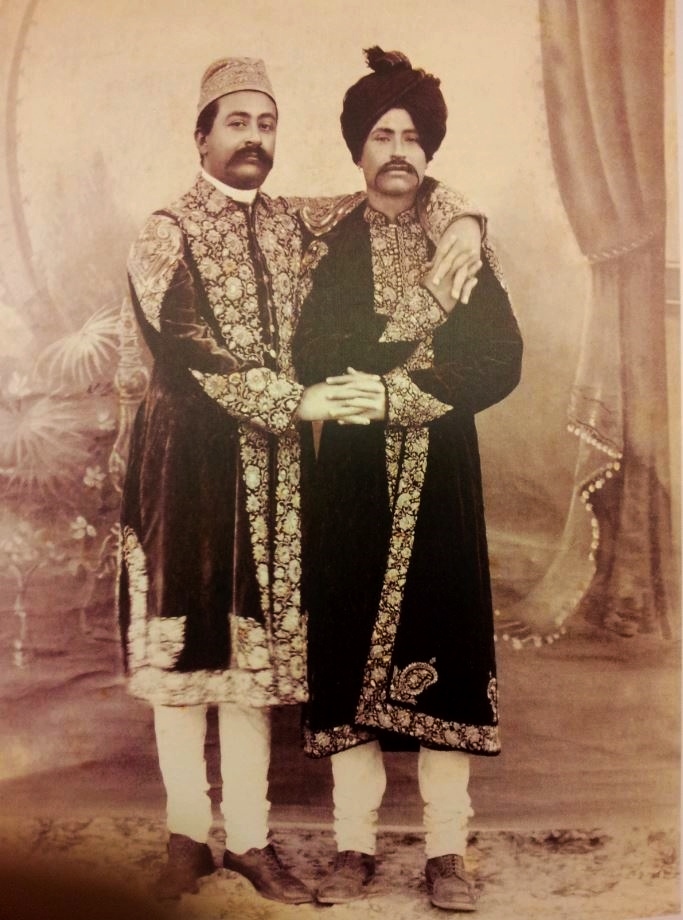
r12Sahibzada Abdul Aziz Khan* and Sa’adat Ali Khan of Tonk in 1925, the latter became the Nawab in 1930. The sherwanis are possibly velvet with gold/silver embroidery. Even though this style is seen in many historical, it is more late 19th/early 20th cent. – it is seen in a number of portraits in this period.  Caps (topi) as seen on the Sahibzada were also often of velvet with gold/silver thread embroidery.

Sometimes the edging of the sherwani is not embroidered but more in the manner of trims as on the senior Nawab of Tonk.

Source.

*per my notes poisoned two years after this photograph was taken.

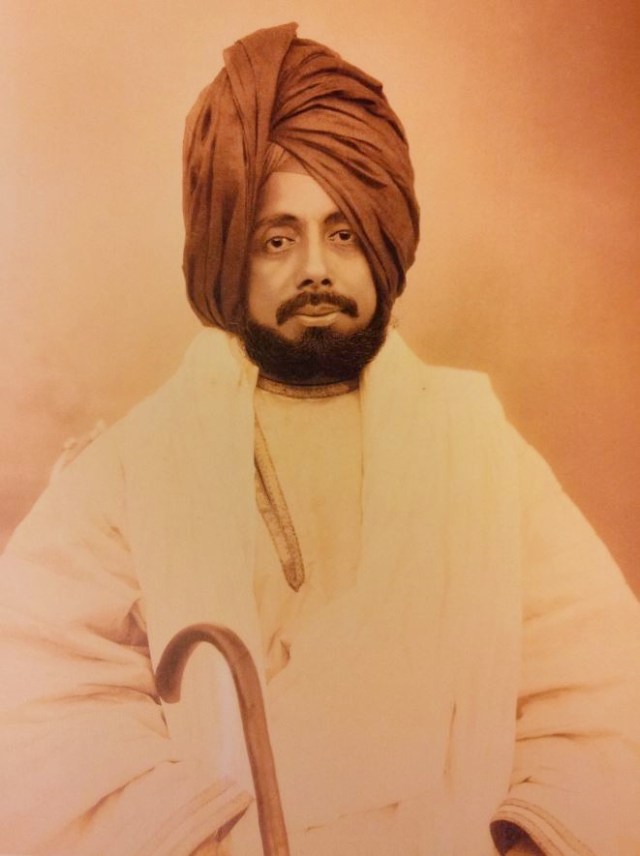
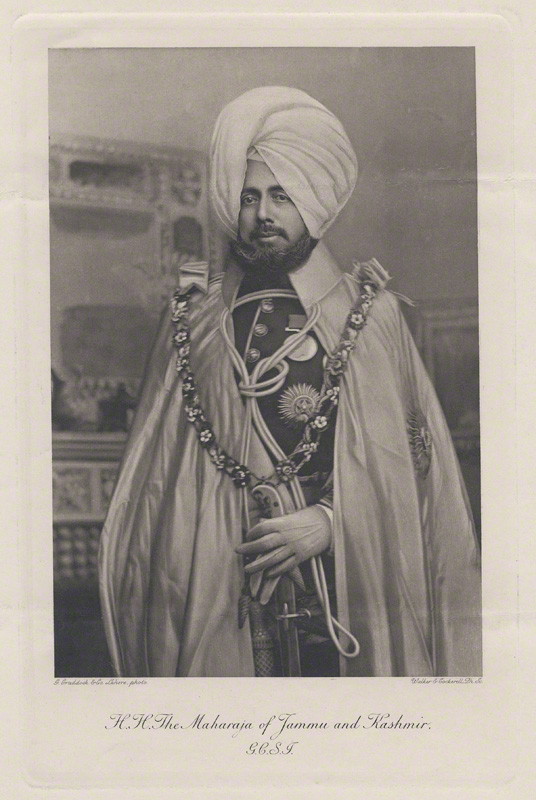
r15Maharaja Pratap Singh, Jammu and Kashmir, circa 1900. [X]

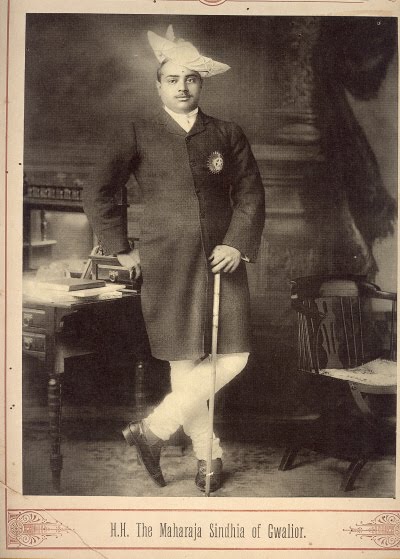
More often than not vintage photographs of Indian royalty display a good deal of finery and jewellery so that the two seem synonymous. But dressing styles in fact varied a lot and were sometimes austere as in this portrait of Pratap Singh (see also the Gwalior Maharaja).

The jama with the side open flap and turban is seen in other 19th century portraits like this one of Raja Deen Dayal.

Official portraits were a different matter. Even in this portrait the Maharaja wears little accessories bar what I think is the Star of India paraphernalia.


Posted in 1900s, 1920s, 1930s, 20th century, Colonial, Costume, Culture, Early 20th Century, historical costume, historical dress, historical fashions, History, India, Indian Dress, Indian fashion, Indian History, Indian men, Indian royalty, Islamic Dress, Islamic style, Painted Photographs, Photography, Royalty, vintage costume, Vintage Men | Tagged , , , , , , , , , , , , , , | 6 Comments

Sobha Singh’s Art

‘an accomplished but somewhat sugary style that reminds us of Edmund Dulac’, as Partha Mitter describes it (The Triumph of Modernism: India’s artists and the avant-garde 1922-1947, London 2007, p. 146)……approximate date for the pictures….between 1931 and 1941. X.

Sobha Singh, Wine Drinking.

Pic 2, 3 and 4 – click for larger view and closer details of the hair ornaments (jhoomar and mathapatti), the jewelled fringe for the choli, waist sash and the somewhat unusually shaped payal.

The other painting (Devotee) has simpler details, the clothing is *very* diaphanous here which is kind of common in some of the popular art of the 1920s and 1930s (e.g. Hemen Mazumdar).

Posted in 1930s, Art, Costume, costumes in art, Early 20th Century, indian art, Indian fashion, Paintings, vintage art, vintage style, women in art | Tagged , , , | Leave a comment