
Vijayaraje Scindia in the 1940s in a gold bordered sari. A style so popular in the 30s/early 40s.
Also Durru-Shehvar though admittedly my attention was diverted by the splendid Diana Vreeland.
Vijayaraje Scindia in the 1940s in a gold bordered sari. A style so popular in the 30s/early 40s.
Also Durru-Shehvar though admittedly my attention was diverted by the splendid Diana Vreeland.
I did a couple of posts on tumblr on minorities in India, including the Jews and Armenians.
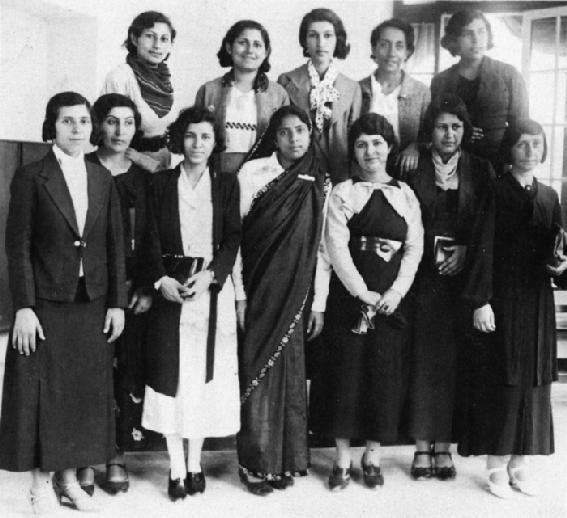
And while doing the Armenian post, I came across this at the Iranica site, a photograph of the first female students of Tehran University circa 1935. The site lists the group as “Plate III. The first women students at the University of Tehran (September 1936). Front row (left to right): Batūl Samīʿī, Zahrā Eskandarī, Mehrangīz Manūčehrīān, Serāj-al-Nesā, Badr-al-Molūk Bāmdād, Šams-al-Molūk Moṣāḥeb, Ḵānom Šāhzāda Second row (left to right): Zahrā Kīā Ḵānlarī, Forūḡ Kīā, Tāj-al-Molūk Naḵaī, Šāyesta Ṣādeq, Ṭūsī Ḥayerī. After Bāmdād, I, p. 99.” Most of the women went on to bigger and better things.
The woman in the sari – per this Chehabi paper, Seraj-al-Nesa Begum was one of the first three women to enroll at the Teacher Training College in 1935. It appears the British Consulate interjected with the authorities on her behalf and eventually the authorities allowed foreign women to retain a head covering as long as they wore their national costume (Iran was at this point in the throes of Westernisation and a banning of the veil was part of this).
The shirt-blouse is a tad too modest for the mid 1930s but the explanation behind the photograph and the fact that this is a student’s dress explains it.
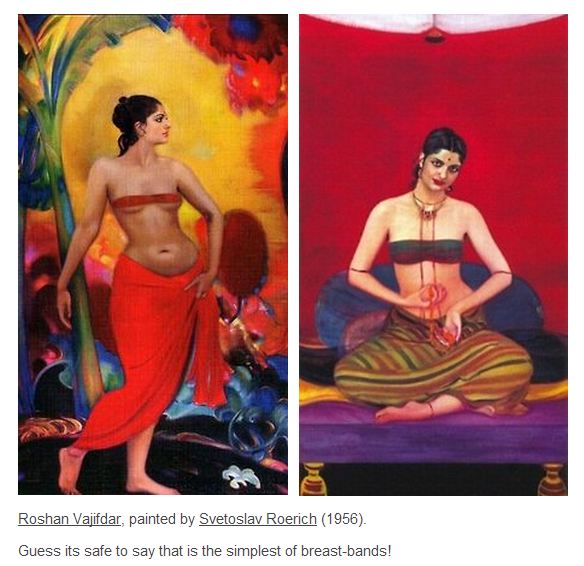
 There are plenty of representations of the lotus in Indian art, more often than not religious iconography. Here is a (non religious) selection.
Additional posts on the choli and nihonga paintings of Indian women can also be sampled on tumblr.
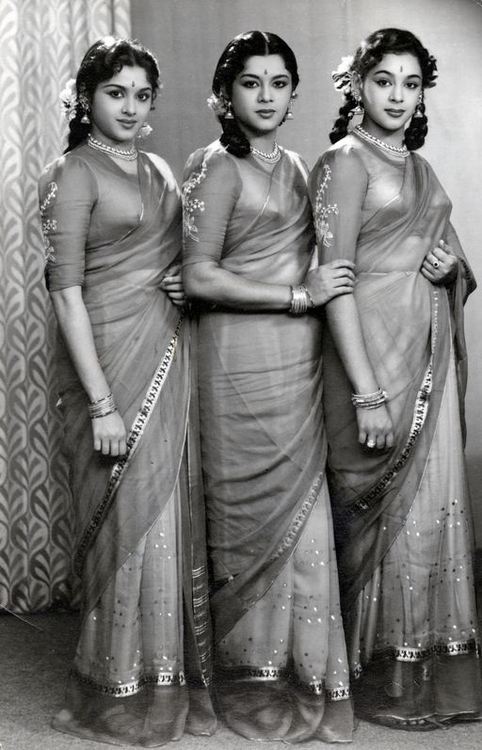
The Travancore Sisters were a famous dancing trio and one of them, Padmini, was a major star in South Indian cinema and also acted in Hindi films.
Betsy Woodman’s family lived next door to the sisters and her blog is full of fascinating details about both expat life in India in the 50s (her mother also learnt dance while in India) and the everyday lives of the sisters. The picture here is from her family album and appears thanks to her. I love the matched nature of the outfits, the little embroidery details on the blouses. And am wondering if the brassiere (really an inner bodice) is handmade as was quite common back then.
Used by permission of the Woodman family – source here.
PS: The sisters dancing in an early film.
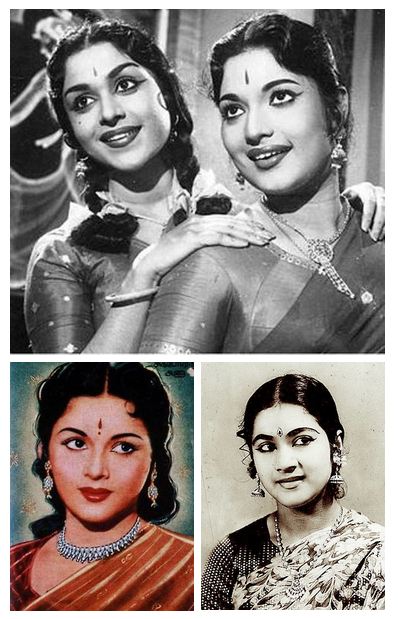
A brief photoessay on the fashions prevalent in the south of India.
And a bit on the practice of kolam/rangoli.
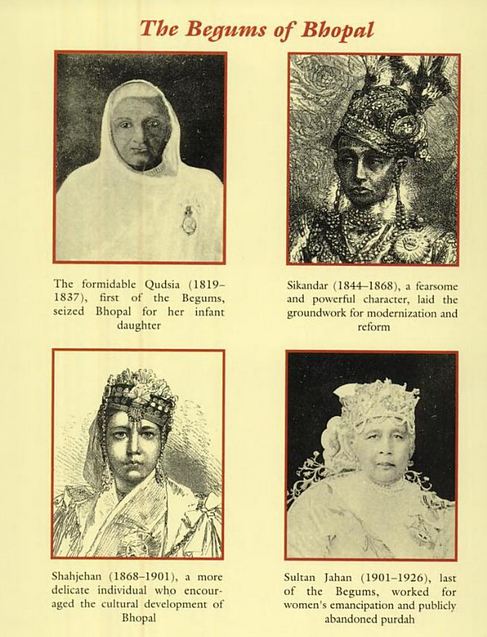

Between 1819 and 1926, Bhopal was ruled by an unbroken line of 4 women, the Nawab Begums of Bhopal.
Bhopal had a distinctive culture with Turkish, Persian and Northern Indian Islamic influences. Bhopali dress consisted of a Turkish-style long and flowing kurta/tunic that flared in a circle from a tight fitting waist (known as the bhopali/turki/pishwas and akin to the anarkali) often bordered with gold and silver. The bottom half appears to be wide pantaloons, Peshawari paijamas or tight chudidars depending upon the decade. Perhaps the most distinctive part was the dupatta that measured about 5 meters and was draped across the body and over the shoulder.
Some of the Nawab Begums of course followed their own rules. Louis Rousselet for e.g. describes the Nawab Begum Sikandar thus:
The Begum is a woman of about 50 years of age. Her thin face, lighted up by a pair of intelligent eyes, expresses such a singular amount of energy that one must be aware of it beforehand in order to realize that a woman is standing before you. The costume itself aids the illusion: tight fitting pantaloons, an embroidered jacket, and a poniard at the belt, have, as a whole, anything but a feminine appearance.
Hamidullah Khan was the last Nawab of Bhopal. His eldest daughter, Abida Sultan, was the heiress apparent and ran the state until she moved to Pakistan.
Here she is in a long sleeved soft blouse with collars typical of the 1910s/1920s. Though she was to later abandon this for shorter hair and often more masculine attire.
Post independence, her sister Sajida Sultan (in a modern context perhaps better known as Saif Ali Kahn’s grandmother:-)) was titular ruler of the state.

A few posts at tumblr on women in medicine/science in the period from the 1880s-1940s. More often than not, in the early days the sari prevailed and the photographs reveal a sober and professional attire. These are the precusors of the kind of sari/blouse that became prevalent in workplaces in India.
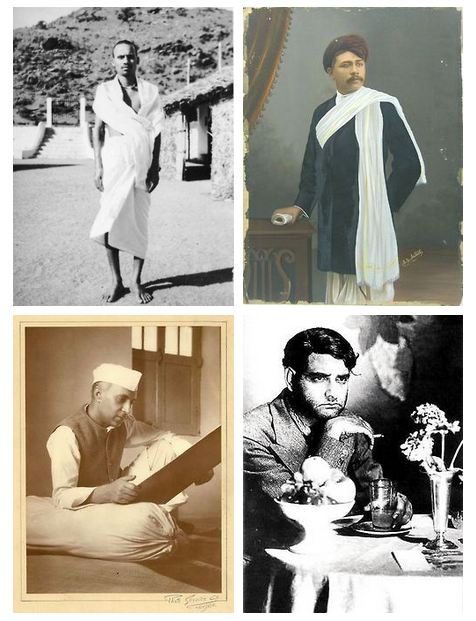
 Vintage Indian Clothing
