Puff Sleeve

The puff sleeve blouse. Always popular in almost every decade of the 20th century, particularly for young women. Judging from photographs I have seen, the simpler version (unlike the exaggerated sleeves of previous decades) was kind of de rigeur in the 40s (MS Subbulakshmi loved them if the photographs are any indication).

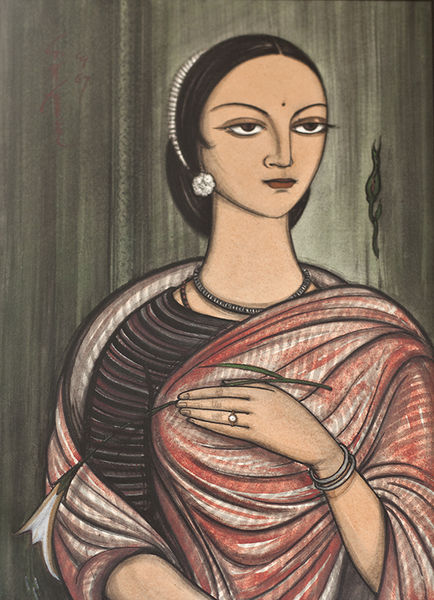
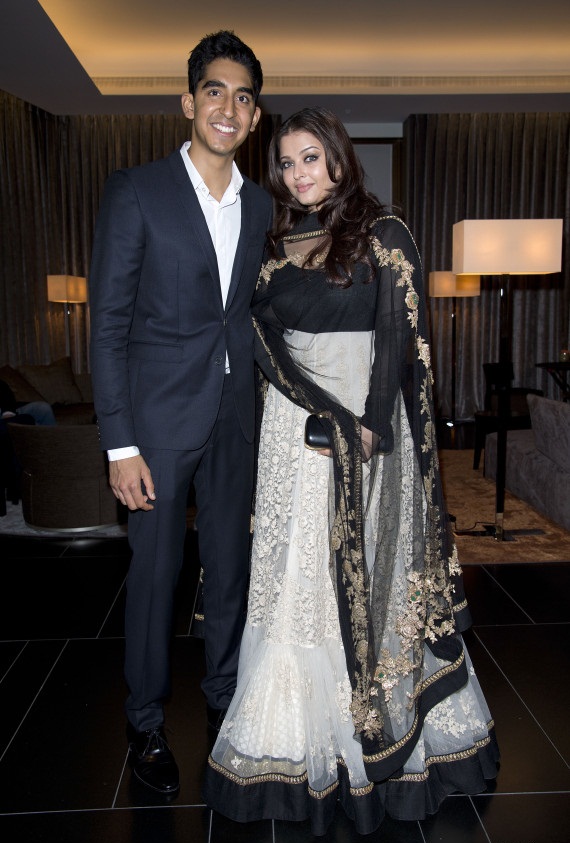
In the pics: Postcard of a Prabhu woman; MS Subbulakshmi; Aishwarya Rai; Nayantara;  Aarabi Veeraraghavan (Swarna Rethas); Konkona Sen Sharma

Posted in 1930s, 1940s, 1950s, 1960s, 20th century, 21st century, Actor, Colonial, Contemporary, Early 20th Century, fashion, Indian Cinema, Indian Dress, Indian fashion, Indian Women, Sari, Sari Blouse, Sets, Vintage Blouse, vintage fashion | Tagged , , , , , , , , | 6 Comments

Midweek Post- 3

In the closing decades of the nineteenth century in a land already thronging with all manner of gods and goddesses there surfaced a novel deity of nation and country who at some moments in the subsequent years seemed to tower over them all. Invoked in English as “Mother India” and most usually in most Indian languages as “Bharat Mata” (literally “India Mother”), she was over time imagined as the substantial embodiment of national territory – its inviolable essence, its shining beacon of hope and liberation – and also as a powerful rallying symbol in it’s long hard struggle for independence from the modern world’s largest empire.The Goddess and the Nation: Mapping Mother India, Sumathi Ramaswamy

wp1Most representations of Mother India are similar to Ravi Varma’s paintings of  goddesses, a woman in a sari juxtaposed against  a map of India and often with symbols of Shakti like the tiger or trident. In early artwork she is often present along with national leaders. [X] [X]. There are exceptions, most notably Abanindranath’s early painting of the country as a goddess.

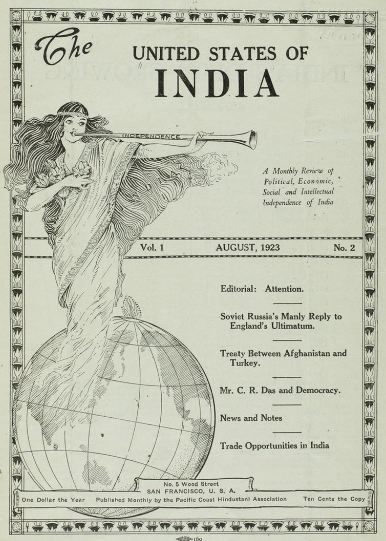
There are a few other exceptions to this in the early 20th century. Decidedly the jauntiest of “Bharat Matas” is the one on the cover of the publications of the Gadar Party, [X] [X].  Arguably the figure is not a goddess given the founder of the party was an atheist, nevertheless the illustration does evoke representations of the era where a woman embodied the spirit of an independent country. The party was based in the US which perhaps also accounts for the illustration, which is part goddess, part modern Indian woman.

As to fashion notes, note the headband which came into vogue around the 1910s.

Posted in 1910s, 1920s, Art, British Raj, Colonial, Early 20th Century, Flapper, Goddess, History, Illustration, Independence, India, Indian History, Sari, Sari Blouse, vintage art, Women | Tagged , , , , , , , , , , | 2 Comments

Midweek Post-2

wp1Women in blue saris playing cards, B Prabha

wp2George Keyt‘s cubist work, Woman in a Blue Sari, mid 1940s

Posted in 1940s, 20th century, Art, Early 20th Century, India, Indian Dress, Indian Women, Paintings, Sari, Sari Blouse, Sri Lanka, vintage art, vintage fashion, Women | Tagged , , , , , | Leave a comment

Midweek Post-1

wp1First up, Jayalalitha looking quite magnificent as Cleopatra [X]

Not as magnificent but Ranveer Singh nicely fills out Arjun Saluja’s designs in a photofeature for Platoform Magazine.

Posted in 1960s, 2013, Contemporary, Costume, fashion, India, Indian Cinema, Indian Dress, Indian fashion, Indian Women, Movies, Tamil Cinema, Women | Tagged , , | Leave a comment

The Ayah Post-3

A look at how past fashions influence modern fashions:

wp6Detail from Warren Hastings with his wife and Indian maid, painted sometime between 1784-87.

Floor length “anarkalis” (no doubt known by a different name) can be spotted in 18th century/19th century paintings.  The girl here is obviously dressed in her best, teaming it with a gold edged dupatta, jewellery and red and gold jootis. This was probably teamed with tight trousers underneath, they can sometimes be seen when the tunic is translucent. This is quite similar to styles today, including the long net/chiffon sleeves that are seen today.

I was at a store recently and the man there informed me that the anarkali trend is about 7 years old and still popular.  A few recent examples – [X] [X]

A floor length variant was worn by men too, as in another painting by Zoffany.

wp7Serving Maid, Goa, 1880s.

There are a number of 19th century versions of the “sari” which are more like the half-sari or the ghaghra-choli. More than a few modern interpretations of the sari, including the lehenga sari, rely on variations of this kind of attire. Some do away with the pleats, some retain them.

[X] [X] [X] [X] [X] [X]

Posted in 1780s, 1880s, 18th century, 19th century, British Raj, Colonial, India, Indian Dress, Indian fashion, Indian Women, Late 19th century, Paintings, Photography, Sari, Sari Blouse, servind maid, Vintage, Vintage Dress, vintage fashion, Women, Working Women | Tagged , , , , , , , , , , , , | Leave a comment

The Ayah Post-2

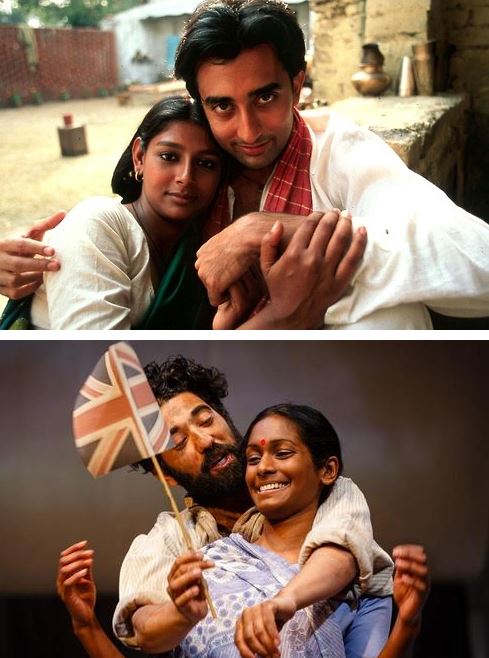
wp5Ayahs on film: Nandita Das in Earth.

Ayahs on Stage: Anneika Rose in The Empress.

Posted in 20th century, Actor, British Raj, Colonial, Contemporary, India, Indian Dress, Indian fashion, Indian Women, Movies, Period Drama, Sari, Sari Blouse, Vintage, Vintage Blouse, Vintage Dress, vintage fashion, Women, Working Women | Tagged , , , , , , | Leave a comment

The Ayah Post-1

By the 1930s the image of a cherished ayah had been enshrined in the nostalgia of the Raj that had been generated at the close of the nineteenth century. As that image took on a life of its own, individual recollections of British colonials were compressed and compelled into the one abiding memory, as Margaret MacMillan put it, of “a much loved ayah, usually a small, plump woman with gleaming, oiled hair, dressed in a white sari, who had sung to them, comforted them, and told them wonderful Indian stories”.  Responding to the West: Essays on Colonial Domination and Asian Agency, edited by Hans Hägerdal.

In addition to the ubiquitous ayah, cooks, gardeners, syces, and many other Indian domestics in colonial households influenced the daily lives of young residents. The results were predictable: British children grew emotionally attached to their ayahs and other Indian attendants, and they frequently acquired more familiarity with and fondness for the language and culture of these people than they did for the European heritage of their parents* The Magic Mountains: Hill Stations and the British Raj,  Dane Keith Kennedy.

The British in India, from the very beginning, were expected to maintain an establishment with a good number of staff. There are several accounts of the expenses incurred by domestic staff as early as in the late 18th century.  In letters home the problems and the conveniences of maintaining an establishment are detailed. Of all the employees a British household had, the ayah was the most cherished (though there are negative accounts too, particularly in the initial years of the British in India).  Functioning as domestic help but largely associated with being an Indian nanny, they appear in paintings and pictures on the 19th and early 20th century (the earliest probably being Joshua Reynolds portrait).  Partly this was to document – and perhaps boast – of their lives in India. Partly this was because social intercourse with Indians for the British was often restricted to their domestic staff, few Indian middle class families permitted the inevitable interaction in the public sphere to spill over into the private.

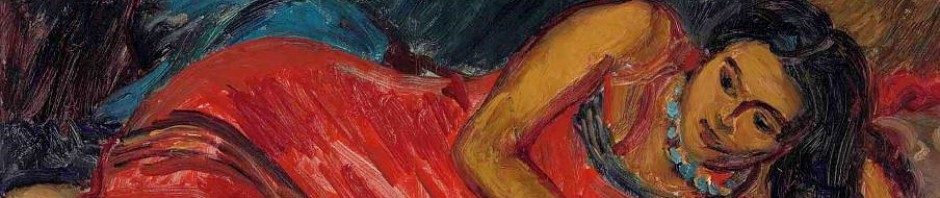
There are numerous photographs of ayahs, often seen with their wards and sometimes as part of a family picture. Almost always they appear in white saris with coloured borders, teamed with a printed or plain blouse. Ayahs were amongst the first Indian women to travel abroad on work, often finding themselves in a precarious position. By the 1950s, the saris are depicted a lot brighter as in this oil painting in London.

[X]

*For precisely this reason, many British children were sent back home to boarding schools at an early age.

Note

Note: Maids, attendants and the like also occur in Indian miniature paintings and in ancient Indian art, often as intimates, in for e.g. a woman at her toilette, delivering love messages etc. I won’t be covering that at the moment.

wp3Portraits of ayahs. Some initial works show ghaghra cholis and coloured saris while later works often show women in white saris.
Sources (incomplete): [X] [X] [X]

Other examples: [X] [X] [X] [X] [X] [X]
Posted in 19th century, 20th century, British Raj, Colonial, Early 20th Century, History, India, Indian Dress, Indian Women, Late 19th century, Sari, Sari Blouse, Vintage, Vintage Dress, Women, Working Women | Tagged , , , , , , , , , | 4 Comments

The Ayah

A number of fashion blogs feature couture, pretty stuff, beautiful fabrics, embellishments, trends and women admired for their beauty. Which is fine for the most part, it is what elevates clothing above the mundane. Once in awhile though it is more interesting to look at everyday, hard working clothes. The way they speak to us about the dignity of the women who wear them, the feminine embellishments incorporated in it and the beauty of worn and sparse clothing.

Today’s post is on the Ayah. A term prevalent during the Raj that is no longer used but once a catch-all term for the domestic help ubiquitous in Indian households, especially with regard to the care of children.  I myself had an ayah as a child. She was a Burmese Indian who had been expelled in 1962 and quite old when she began working for my parents. I still remember her sweetness and warmth, the comforting smell of her much worn sari. These posts are dedicated to her.

Posted in 19th century, 20th century, British Raj, Colonial, Early 20th Century, History, India, Indian Women, Late 19th century, Sari, Sari Blouse, Uniforms, Vintage Dress, Women, Working Women | Tagged , , , , , , , | Leave a comment

The Goa Post – 2

z1 z2

Angelo da Fonseca, who was known for his Indianised Christian themed art.

The two paintings, dated 1967 and 1959, represent the two most common dress forms worn in India, the sari and the three piece that includes a dupatta and kurta teamed with a salwar/chudidar.

Source: X

Posted in 1950s, 1960s, Art, Christianity, Goa, Indian Dress, Indian fashion, Indian Women, Paintings, Salwar Kameez, Sari, Sari Blouse, vintage art, vintage fashion, Women | Tagged , , , , , , , , , , | Leave a comment

The Goa Post – 1

The Reis Magos Fort in Goa has an exhibition of Mario Miranda’s 1951 illustrated diary. It is an amusing and  interesting look at Goan society (largely the Catholic part of it) circa 1951. I loved the captions and little quirky insert panels as in the one featuring a village woman with a pot on her head. A lot of late 40s/early 50s fashion. Often influenced by Portugal (in one Mario records the clothes ordered from Portugal) and closer home, the then Bombay.

t4In the illustrations Kashi is definitely the loveliest of the women featured. That kind of top as well as Goan fashions is featured in many movies set in Bombay and Goa (e.g. the 1952 Jaal, the 1973 Bobby), albeit in it’s Bollywoodised version.

Posted in 1950s, Art, Christianity, Comics, Early 20th Century, Goa, Illustration, India, Indian fashion, Indian Women, Travel, Vintage, Vintage Blouse, Vintage Dress, vintage fashion, Women | Tagged , , , , , , , , , | 2 Comments