The Tilaka Post

z

On the tilaka/bindi/the red dot. I wish I had proper referencing for this but it is a bit difficult since there are stray lines here and there in texts which discuss costume on the whole or the odd artwork and nothing substantive.

And the much more ubiquitous sandalwood mark in Ancient India and its presence elswwhere

Posted in Ancient India, Culture, Hinduism, India, Vintage, Women | Tagged , , , , , | Leave a comment

The South Africa Post

z3 z1


As with many diasporas, the clothing of South African Indians harks back to India and also takes in local influences.  A few pictures here.  In the photographs here there is a distinct Gujarati influence (some of Stern‘s paintings in the set below seem to be of women who are of Gujarati Muslim origin). The first photograph is of a bride – probably taken in the 60s – again the sari is very evocative of tie n dye saris in Gujarat (also note the swastika markings on the hands which are probably henna).

Posted in 1960s, Diaspora, South Africa, Vintage Dress, Women | Tagged , , , , , | Leave a comment

Regional Dress in the 1920s

z1

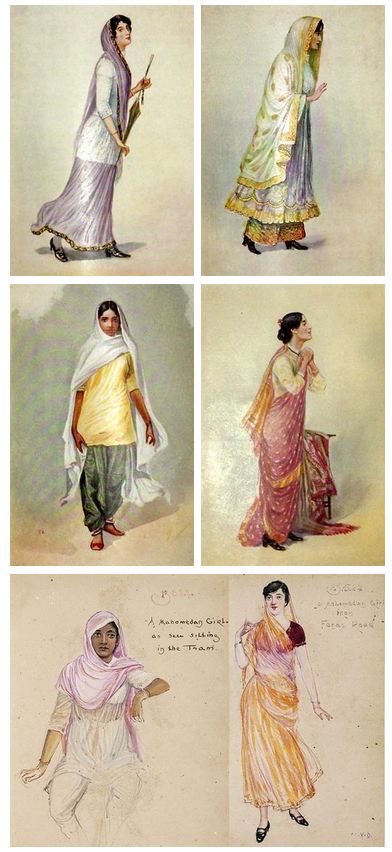
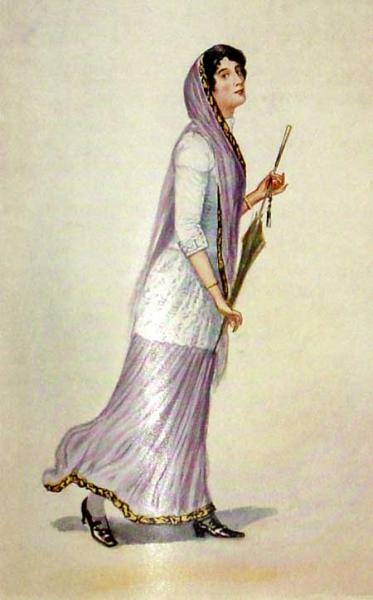
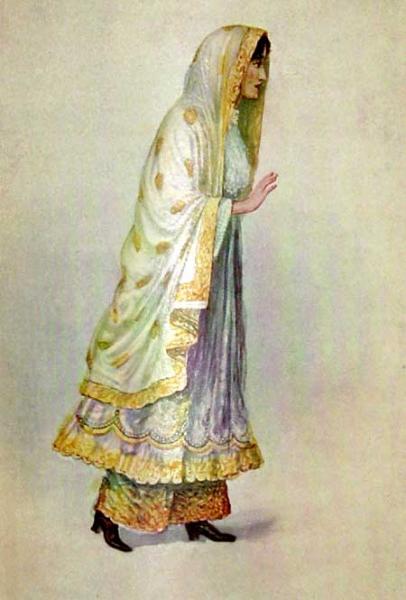
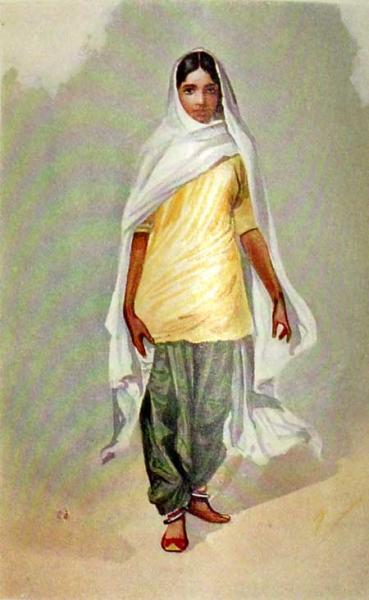
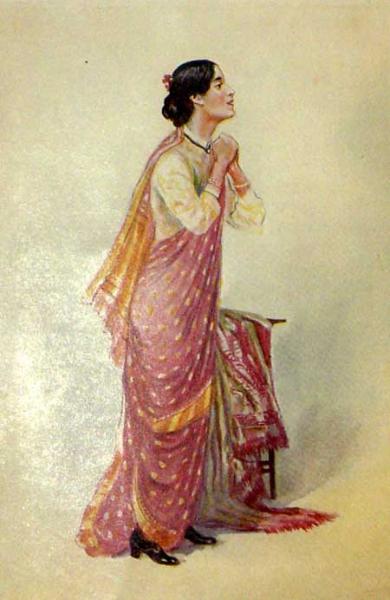
From MV Dhurandhar’s set of watercolours from the 1920s. It pretty much covers the diverse costumes of communities at the time and you can see a number of regional variations at play.

This set largely has attire worn in Bombay and Gujarat (ParsiKhoja (a little bit on them here), a dyer girl in Ahmedabad (hence the simplicity of her dress), and aPathare Prabhu lady (excuse the rambling wiki entry).  The other two are sketches that Dhurandhar made of “Mahomedan” girls in the then Bombay in the early 1920s.

The everyday kurta/tunic seems to be rather short in this decade (though the Khoja outfit is fairly voluminous and you can find longer lengths in the watercolours of northern dress). 1 and 6 are saris worn Parsi style (the long sudren of 1 is replaced by a tinyblouse in the watercolour entitled Mahomedan Girl on Foras Road), Pic 4 is the nine yard Maharashtrian sari. Pic 1 and 4 have long and sleeved blouses (perhaps the sleeveless blouse only became popular by the 30s?). And the closed kind of Western footwear appears so much in the early 20th century.

Posted in 1920s, Art, Colonial, Early 20th Century, Vintage, Vintage Blouse, Vintage Dress, Women | Tagged , , , , , , , | Leave a comment

International Women’s Day

fb1


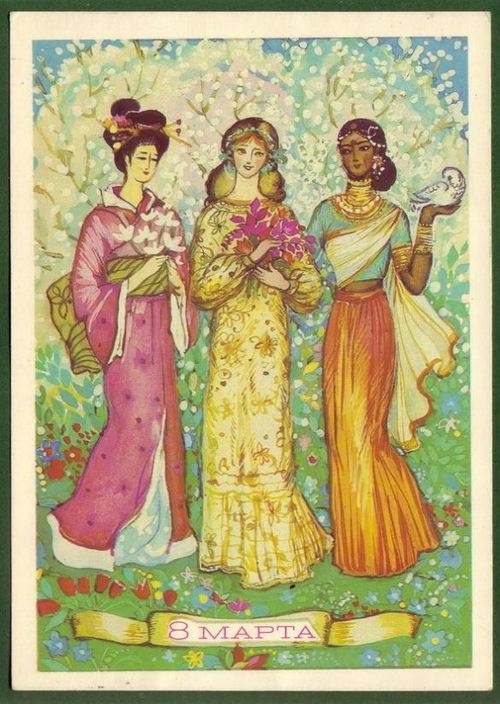
Russia appears to have an International Women’s Day that is also Mother’s Day.  On the other hand of late Mother’s day seems to fall in  November there.

This is a 1986 postcard commemorating the day (they seem to have had a number of these multination postcards).

Posted in 1980s, Postcards, Vintage, Vintage Dress, Women | Tagged , , , , , , , , | Leave a comment

Bits n Pieces

I have been fairly active of late on tumblr (mainly because I have a good degree of material). These are just short posts so I will post only the links:

Ellis Dungan and Meera

Temple Visit

Hemendranath Mazumdar’s 1930s painting

Sadhana channeling her inner Hepburn

Abdur Rahman Chughtai’s paintings

Blouse Cutting

Women novelists in the 1930s

Posted in Tumblr | Tagged , , , , , | Leave a comment

The Tribal Sari

z1

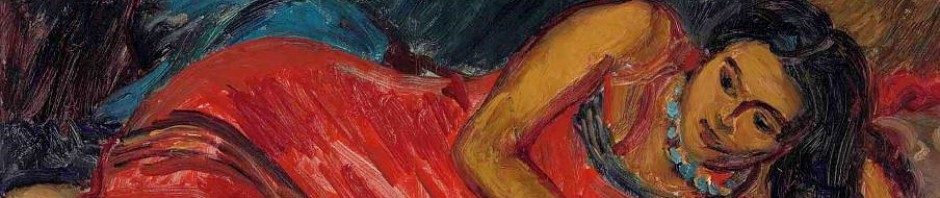
Post on the tribal sari. 

Doing this post was an exercise in paring. The tribes in India (I am going with the nomenclature of tribes here though that itself makes one curious) are extremely varied, their dress changes with region as does their socio-economic status. I didn’t want it to be a post that trades on “forest dweller fashion” but merely a document of clothes and adornment that is quite distinctive.  In the end I went with the Central Indian tribes like the Gonds, Muria and Santhals because the post focussed on the short sari and the evolution of the wearing of a blouse-and that is best seen here.

I think himalayanbuddhistart had mentioned the accessories that you can spot in posts and in this particular case there is a whole lot going on here.  Chunky silver jewellery worn by tribals is very popular and is often marketed as “tribal” or “ethnic” chic (Emma Tarlo’s book Clothing Matters discusses the rise of ethnic chic in the 1980s in India which adopted (some may say appropriated) a whole lot of tribal elements).

This post set off a lot of thoughts but the purpose of tumblr/wordpress is to focus on clothing and so I will stop here. You can stop by and appreciate  (expensive) modern tribal saris for the urban market here (Note: I am not affiliated with or endorsing the site, it’s linked merely to indicate the kind of sari).
Posted in Culture, Tribal, Vintage Blouse, Vintage Dress, Women | Tagged , , , , , , , , , | 2 Comments

The Marilyn Silverstone post

waheeda

Marilyn Silverstone‘s 1959 photograph of Waheeda Rehman.

More on her here.

Posted in 1950s, Actor, Old Bollywood, Photography, Sari, Sari Blouse, Women | Tagged , , , , , , , , | Leave a comment

The Music Post

Women and Stringed Instruments:

a) Temple Sculpture (anklets!) b) Kalighat Painting (the women always have anklets and pointy shoes) c) Mid 19th century portrait (the attire appears late Mughal) d) Raja Ravi Varma’s woman playing sitar (love the casually discarded footwear detail, the sari is the Maharashtrian 9-yard teamed with a fitted bodice)   e) Amrita Shergil in a sleeveless blouse (1930s) f) Lata Mangeshkar in the 1950s in trademark white sari.

UPDATE: The instruments: 1, 2 and 4-sitar, 3-lute, 5-veena, 6-tanpura.

PS: Post on retro-bridal here.

Posted in 1930s, 1950s, 19th century, Ancient India, fashion, Indian Dress, Sari, Sari Blouse, Vintage, Vintage Dress | Tagged , , , , , , , , , , | 4 Comments

Classical Drape

Post Alexander’s North Indian excursion, there were a number of Hellenic influences in that part of India.  It is hard to say how much the Greeks influenced the precursor of the sari (Greek garments at the time included the peplos and chiton) but thedepiction of draperies with fluted lines in sculpture was influenced by the Greeks.

In the 19th century, Victorian Hellenism influenced painters who often placed their subjects in Greek (and Roman) settings. In a number of these paintings, women wear fluid draperies in keeping with clothing of the classical age.  In turn European art movements of the time influenced Indian painters and classical Indian heroines in saris were a natural subject.

In the set today a) Raja Ravi Varma’s Padmini (Lotus Lady) b) Albert Joseph Moore’s Shells c) Frederick Leighton’s Invocation and d) Raja Ravi Varma’s Vasanthika (Spring)

A little bit on Raja Ravi Varma and his influences here.

Posted in 19th century, Colonial, Paintings, Sari, Victorian, Vintage, Vintage Dress | Tagged , , , , , , , , , , , | Leave a comment

The Tamil Cinema Poster Post

tam

I love that so many old Tamil film posters have just the actresses on them and you get to see different kinds of attire.

The first film is Madanamala, where the heroine is a dancer. The second,Devamanohari, features a princess. The other two women are a little more down to earth with the third picture being a poster for Velaikaari (translation: Servant Girl) and the fourth for Rohini, a Tamil adaptation of Bankim’s Bengali novel Krishnakanter Will (you can see that the actress is trying to create the Bengali look).

The movies are from the 1940s/1950s.

Posted in 1940s, 1950s, 20th century, Cinema, Courtesan, Dancer, Indian Cinema, Sari, Sari Blouse, Tamil Cinema, Women | Tagged , , , , , | 5 Comments