Dancers (Sudhir Khastgir)

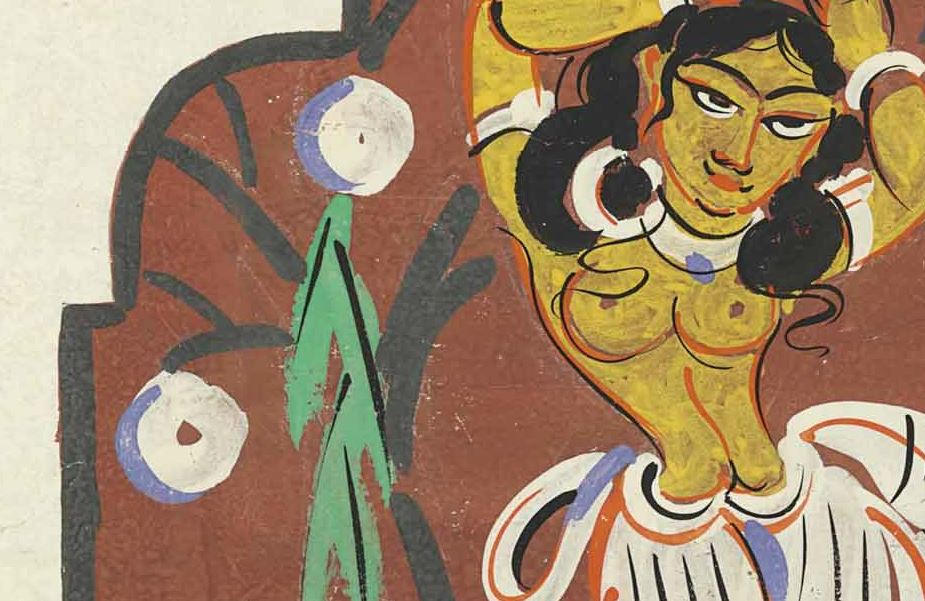
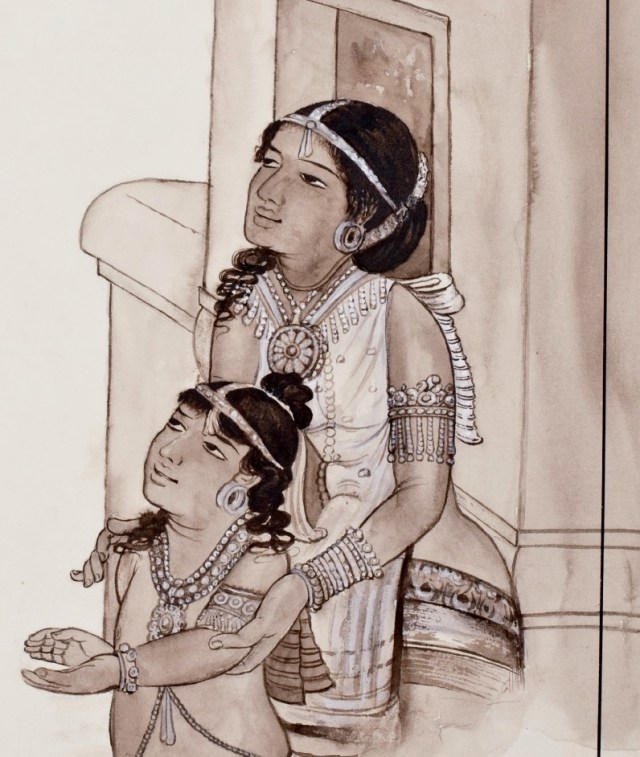
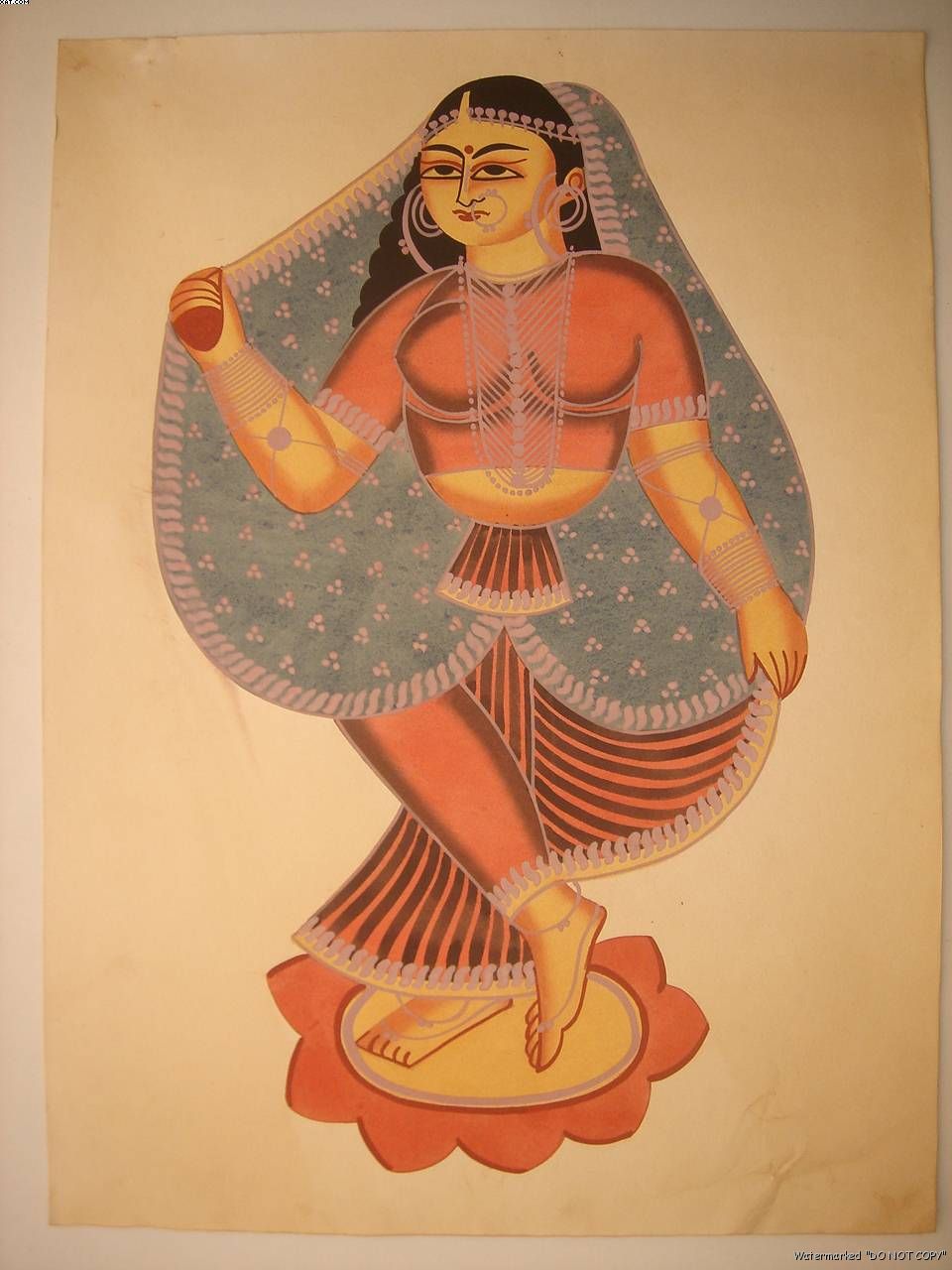
For awhile (in the 50s I think), Sudhir Khastgir painted a number of dancing figures. Here are two:

Sudhir Khastgir, Dancing Figure, 1962. The lower panels indicate the earrings and forehead ornament, a little bit of the knotted ponytail, bangles and the girdle.

khastgir1957Another painting by Khastagir (1957). Unfortunately I have lost the source and my notes on this.


Posted in 1950s, 1960s, Art, Bengal, Costume, Dance, Dancer, indian art, Indian Dress, Indian men, Indian Women, mid century, Paintings, Vintage, vintage art, vintage costume, Vintage Dress, women in art | Tagged , , , , , | Leave a comment

Costumes in NS Bendre’s Paintings

Part of a series on costumes as seen in Indian art.

n0

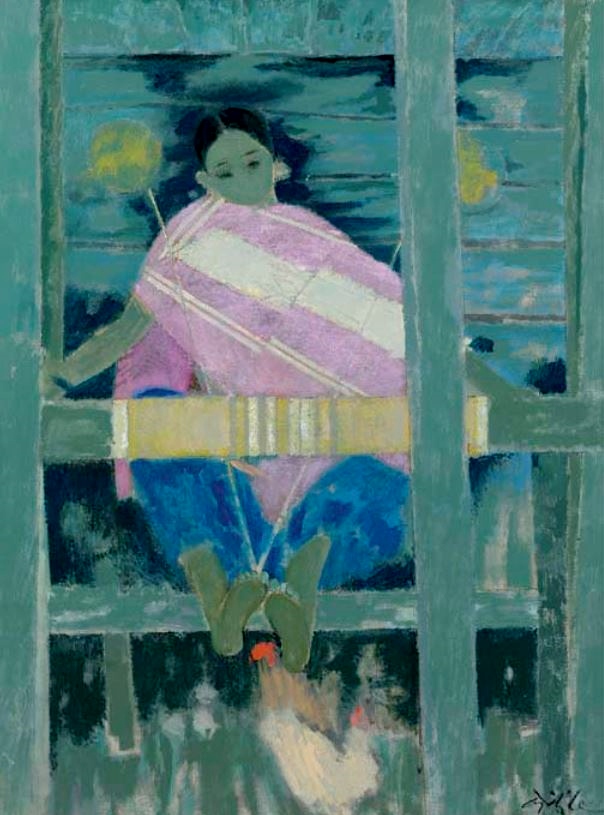
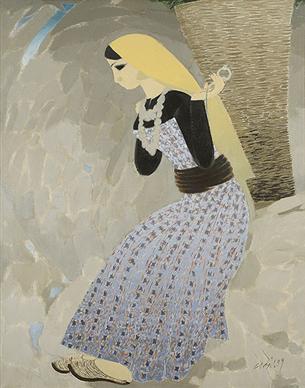
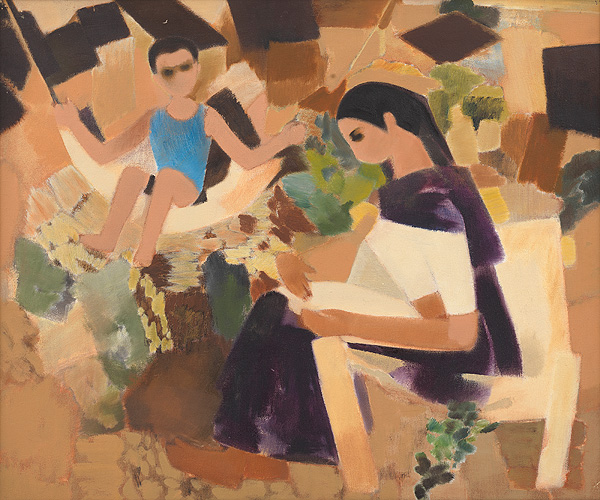
Weaving had a special significance for Bendre, who taught it together with painting and papier mache while in Baroda in the 1950’s. He painted several works over the years that depict women engaged in different methods of weaving; from sitting at a loom or behind a spinning wheel. This painting from 1987 shows a young girl sitting at a loom that is typical of the weavers in Arunachal Pradesh. [X].

Note: So is the costume, especially the shawl.

Indian costumes in N.S. Bendre’s paintings: 1 & 2) bordered saris of Bengal and Central/Northern India 3) Kullu costume (X) 4) Western India 5) Kerala 6) the salwar-kameez.

Posted in 1980s, 20th century, Art, Bengal, Costume, Culture, Early 20th Century, Folk, indian art, Indian Dress, Indian men, mid century, North East India, regional styles, Vintage, vintage art, vintage costume, Weaving, Women, women in art | Tagged , , , , , , , , , , , | Leave a comment

Costume Books

I have been reading a couple of books on Indian costumes and thought I would write a bit about two of them.

book1Queen Subada, Detail from Shahnamah, Sultanate School, 1450.

Costume Details:

Phiran: of transparent material, form-fitting and ankle length, has two embroidered vertical panels along the length and sleeves.
Odhni: of sheer material, fringed, draped over the head around the neck and shoulders.
Sulwar: tight fitting white pyjamas
Hairstyle: long, worn in a plait ending in a decorative tassel.
Hair ornaments: of pearls, have many strings and loops suspended from the head of the Queen.
Necklace: many stringed gold necklace edged with pearls, and a smaller necklace with a ruby pendant.
Bangles: of graded sizes of gold and pearls.
Baldric: gold and pearl baldric, like a chain, is worn over the right shoulder and under the left arm.
Anklets of gold and pearls.

Indian elements: odhni, bare feet, bare/visible torso, some of the ornaments.

From Roshen Alkazi’s Medieval Indian Costume (India and Central Asia). The tale referred to is the Shahnameh and the character is Sudabeh (I am assuming the name is modified in the Indian version). The illustrative style draws a bit on Jaina texts of the period.

This is a doorstopper of a book with great visuals and illustrations that covers an intermediate period of Indian history, starting with Mahmud of Ghazni and ending somewhere around the time of Babur. There aren’t too many costume resources for this period but Alkazi draws on Indian and foreign texts (largely Central Asia and Iran and both Islamic and Buddhist influences) to show the kinds of costumes that were prevalent and the intermingling of styles. It is a little more focussed on parts of India that came under Islamic rulers but covers a lot of ground.

Alkazi’s research was for theatre productions and it is really extensive. Some of the plays are listed at Natrang Pratishthan.

See also X, details of these costumes are also discussed in the book.

Posted in 1990s, 20th century, Accessories, Actor, Ancient India, antique, Art, Asia, Authors, Costume, Courtesan, Culture, Dancer, fashion, Hinduism, historical costume, historical dress, historical fashions, historical hairstyles, Illustration, indian art, Indian Dress, Indian History, Indian Illustrators, Indian Theatre, Indian Women, Jaina Literature, Jewellery, Medieval India, Sanskrit Drama, sari history, Theatre, Women | Tagged , , , , , , , , , , , , , , | Leave a comment

The Music Post

From a series of posts I did the week of 13 July 2015-17 July 2015.

This slideshow requires JavaScript.

Saraswati painted by Hishida Shunsō [X, X]

This slideshow requires JavaScript.

Flute Player (1) and Esraj Player (2), Nandalal Bose.  Both were painted in 1937 and were commissioned by MK Gandhi for Indian National Congress Party meeting 1938, Haripura.

kkPlaying the veena, January 1956.Both blouse and sari are typical of the decade.

This slideshow requires JavaScript.

Kesarbai Kerkar was born on 13 July in 1892. These beautiful screencaps from a piece on Kesarbai Kerkar featuring her great grand niece, Shalaka Kerkar.  Pic 1 includes a photograph of Kesarbai, probably taken in the 1910s (see also X). The song of pic 2 here.

Down South in the land of Tyagaraja, where the prevailing voices always had a chesty timbre, Lata clones sang shrieking into the night in every language. Even Bengali voices, which only a few years earlier reflected the honeyed textures of Kanan Bala, abandoned their inheritance and joined the Lata bandwagon.  Raghava Menon (1989) quoted in Cassette Culture: Popular Music and Technology in North India, Peter Manuel.

A particular kind of female voice, best embodied by the Mangeshkar sisters, held sway in India for much of the latter half of the 20th century in so far as film music  was concerned.  The voices in the 30s and 40s are much more varied (and of course actresses often sang their own songs). In the latter half of the 20th century there are a few scattered singers who have distinctive voices but whose output was limited at least by way of film songs.

Some of the early singers are documented at womenonrecord.

In the photoset 1) The Karnataki sisters, Amirbai and Gauharbai 2)  singer and flautist M. Saraswathi 3) Geeta Dutt (well known but not as prolific as the Mangeshkar sisters 4) Kamala Sista and Sharda 5) Chhaya Ganguli.

As always the clothes and styling embody the decade 1) 1930s 2) 1940s 3) 1950s 4) 1960s 5) late 1970s/early 1980s.

Posted in 1930s, 1940s, 1950s, 1960s, 1970s, 1980s, 20th century, Culture, Early 20th Century, Folk, Folk Dance, Goddess, Hinduism, India, Indian Music, Indian Singers, Indian Women, Japanese art, Music, Paintings, photodivision, Photography, regional styles, Sari, Sari Blouse, Sets, South India, Vintage Blouse, Vintage Music, vintage photography, vintage sari, Women | Tagged , , , , , , , , , , , , , , , , , , , , , , | 1 Comment

The Comics Post

For a lot of us in India at one time Comic = Amar Chitra Katha.

My nieces are Australian so their book cupboard is wash with princess stories, fairy stories, Peppa Pig, Horrid Henry and the like.  The Indian comics they are gifted tend to be mythological and they haven’t quite taken to them.  Given their princess obsession I decided to take a few comics on princesses but it went down like a lead balloon.

Two of the comics were Vasavadatta and Manonmani. We had a bit of a discussion on their costumes but they didn’t find it very interesting (they are 7 and 4), here the two heroines wear a knotted breast band known as the kancuka or kurpasaka.

ac1ac2Suddenly they have turned avid readers and the turning point was to The Magic Grove. I guess a girl with a magic garden that follows her around and does her bidding was irresistible. The red and gold costume of Aramashobha dislodged their love of the blue and white of Frozen and Cinderella for a few days.

The artists behind Amar Chitra Katha are little known but the artwork can be quite distinctive even as the costuming basics remain the same. This set is from a bound series on ancient classics and the artists for each comic are listed below. Interestingly the covers are by different artists.

Pic 1: Malati and Madhava. Illustrator: Pratap Mullick.
Pic 2: Malavika. Illustrator: PB Kavadi
pic 3: Kadambari. Illustrator: MR Fernandes
Pic 4: Nagananda. Illustrator: MN Nangare.

See also X.

Similarly the faces are strong and distinctive. And captivating. Seen above, pic 1 & 2- Parvati, Pic 3-Dharini from Malavika and 4. Sati.

ac0ac00 The regional details are often captured in the comics. Like North & South. The Instant Wedding, Ancient Indian Style. As illustrated by Amar Chitra Katha!

The comics: Shakuntala and Manonmani.  The latter is a historical verse novel written in 1892 by  P. Sundaram Pillai and set in the time of the Pandyas. I am impressed that they did this title given that I have barely been able to locate an English translation for the book.

sitaThere are also a lot of subtle details once you start looking at the drawings closely, like you would think Marimekko prints were around in Sita’s time.  More likely the comic dates from the 1970s when large flower print saris were around:)

India’s Immortal Comic Books: Gods, Kings and Other heroes by Karline McLain is a pretty interesting book and goes into some detail on the costuming choices for the Amar Chitra Katha comics.  Which are based on historical costumes but also simplify it and have a unifying aesthetic given the comic book genre.

Posted in 1970s, 1980s, Ancient India, Art, Comics, Costume, Culture, fashion, Girls, Hinduism, historical fashions, History, Illustration, indian art, Indian Dress, Indian fashion, Indian History, Indian Illustrators, Indian men, Indian Women, Jaina Literature, regional styles, Romance, Royalty, Sanskrit Drama, Sari, sari drape, sari history, Sets, tamil Literature | Tagged , , , , , , , , , , , , , , , , , , , , | 3 Comments

The Colour of Skin

s2s1s6s5s3 s4The red glow of her body, like an unfolding bud.

Her black rimmed eyes like flowers, her skin like gold.

Who can see your face in the moonlight, like milk in milk.

Her lustrous complexion like a blue sapphire.

Fair as champaka flowers.

Dusky young lady with sweet speech and lovely face, Broad hips, body painted with excellent sandal paste.

Her face is like the moon, (Just so).

In the poem ‘Madhuvan’, while describing the beauty of the face of a lady, the poet chooses the reddish objects like the pink morning, the reddish new leaf, the blush on the cheek, the pink lotus, the rose, the blood, the flame coloured Palash.

Colour, fragrance and softness all merge in her; a rose petal on her cheeks loses its identity.

Her hue is golden and the saffron paste mingles indistinguishably with her complexion, only its fragrance proves its existence.

Karpuraturistha – fair as camphor.

She is blue-complexioned and beautiful in every limb, having applied the sixteen elements of make-up.

Her nails bright as burnished copper.

The dark, divine maiden with great chastity.

The word used for ‘dark colour’ is shyama (deep green), and for indicating redness ‘lohita’.

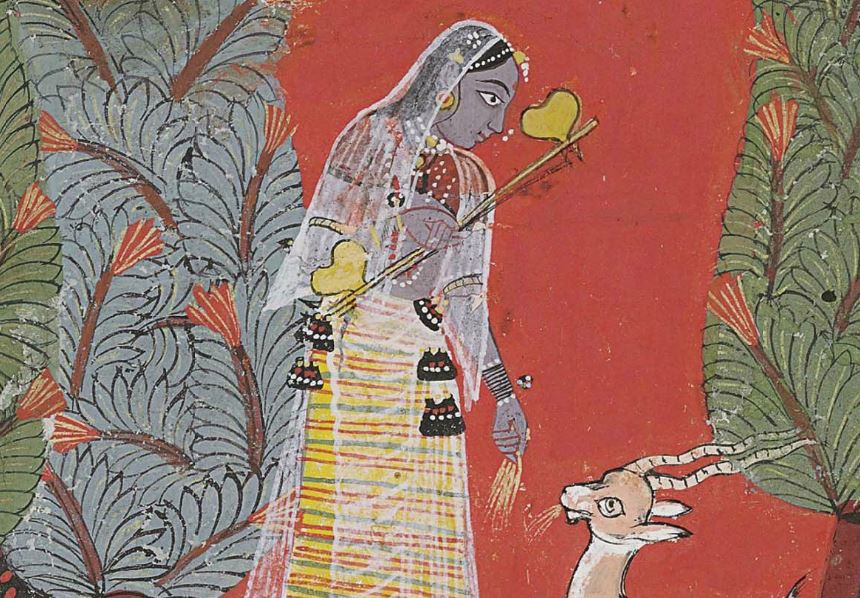
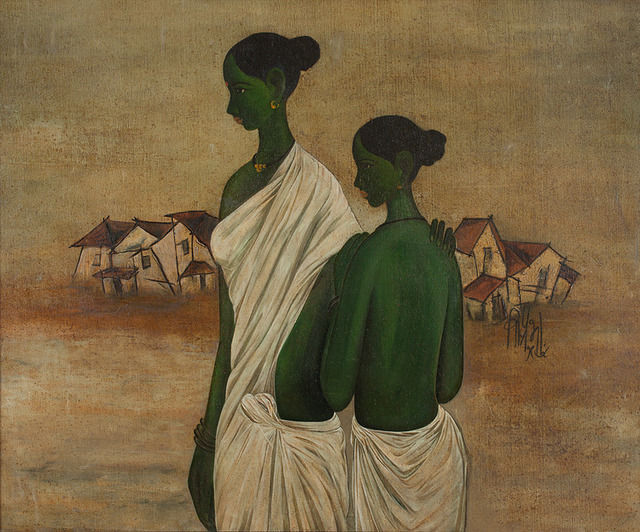
There are many ways to describe skin colour in India. Limitations of language in translation notwithstanding Indian poets, never shy of employing a simile, appear to draw on an imagery that includes saffron, sandalwood, camphor, sapphire, copper and more.  Similarly miniature painting employs a number of skin tints, especially when it comes to the raginis.  So it is a little sad that these days we are stuck with the polarities of gora/kala (fair/dark) with saavla/gehua/maanaram/”wheatish” to describe everything in between.

Pics: Todi Ragini (1), Jaipur courtesan (2), Indian women at a well (3), Standing figure under a kadamb tree (4), 18th century, Mandi (5), Untitled, B. Prabha (6).

Posted in 17th century, 18th century, 19th century, 20th century, Ancient India, Art, Colonial, Contemporary, Culture, Early 20th Century, fashion, Girls, historical art, historical fashions, in Colour, indian art, Indian fashion, Indian Women, miniature paintings, Paintings, Sets, Shringaar, vintage art, vintage fashion, vintage illustrations, vintage style | Tagged , , , , , , , , , , , , , , , , , , , , , , | Leave a comment

Vintage Illustration

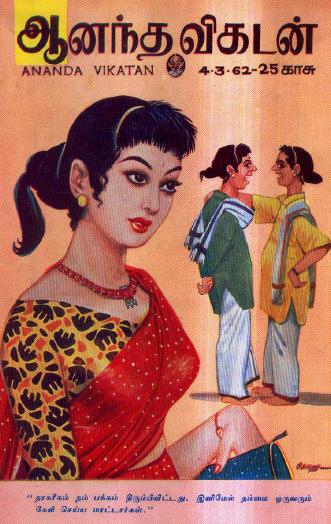
1Tamil caption loosely translated: The two men in the background sporting a kudumi  – “We are now fashionable (or fashion has taken inspiration from us). No one dare tease us anymore.”  from Ananda Vikatan, 1962.

I also found this illustration while doing the posts and it made me laugh a little since I *might* have this woman’s hairstyle at the moment.

The blouse with a wide V and three quarters sleeves is very late 50s/early 60s.

Posted in 1960s, ananda vikatan, fashion, Fashion Quote, Hair, Hairstyles, Illustration, Indian fashion, Indian men, Indian Women, Magazine, retro fashion, retro hair, Sari, Sari Blouse, Tamil, Vintage, Vintage Blouse, vintage hair, Vintage Illustration, vintage illustrations, Vintage Magazine | Tagged , , , , , , , , , , | 4 Comments

Illustration

When I was composing the hair posts, my brother, Shiv, decided to do an illustration of Jabakusum Hair Oil for the blog. Here is the illustration:

2

He joined tumblr to post it (hinotoridawn) but I don’t think he quite likes the site as yet:)

Posted in Art, Bengal, fashion, Hair, Illustration, Indian fashion, vintage hair | Tagged , , , , , , , | Leave a comment

All About Hair

I had a bit of a meandering look at the history of hairstyles in India on tumblr and as always this post collates it on wordpress.

curnakuntala (Sanskrit): locks or ringlets hair style.
alaka-avali (Sanskrit): hair arrangement in spiral locks
dhammilla (Sanskrit): hair bun

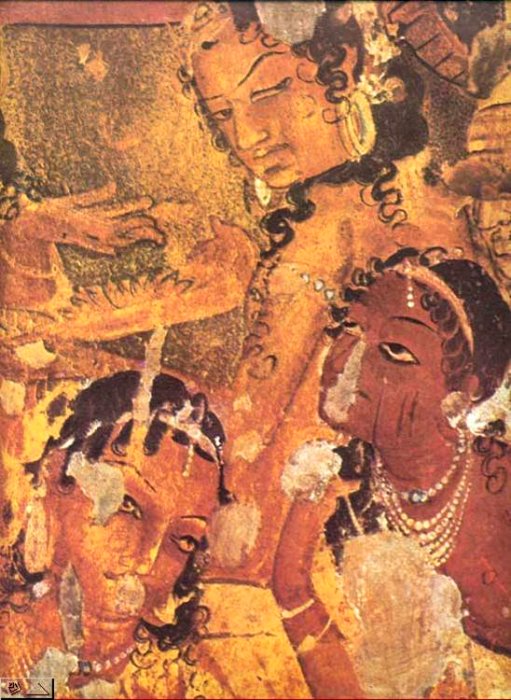
You could blame the Greeks but for a period of time everyone in the subcontinent was seemingly mad for curls. And ringlets and waves and completely improbable spherical somethings (though the last was probably confined to sculpture).  The beginnings seem to be in Gandharan art and representations of the Buddha but curls and elaborate coiffures appear in sculpture, literature and art for at least a few centuries later in different parts of the sub continent. The Gupta Age is probably the most classical style (see also X), the curls gradually disappearing from Indian art over later centuries.

Apart from the curls, the elaborate hair bun (I think the dhammiila is similar to the modern day khopa) was all the go. To this you could – if you wished – pin dupattas, flowers or jewels to give a style that recurs throughout Ancient Indian art.

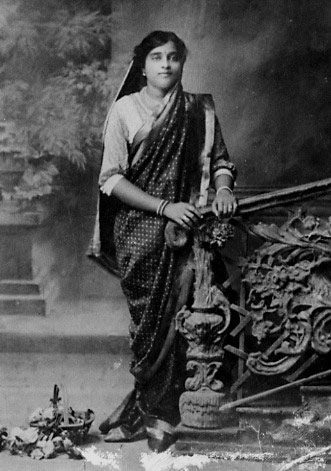
In the pics: 1- Head of Parvati from Ahichhatra, U.P. 5th century,  2 – detail from 12th century sandstone from Madhya Pradesh, 3 – Ajanta fresco.

1O your hair, he said,
It is like rainclouds
moving between branches of lightning.
It parts five ways
between gold ornaments
braided with a length of flowers
and the fragrant screwpine. From the Kalithokai, translated by AK Ramanujam.

I have probably seen this photograph all over the internet but it also probably best fits the poem (bar the screwpine).

The five different hair styles usually mentioned in Sanskrit and Tamil texts include hair in a knot, hair gathered in a bun, hair curled, hair parted and hair plaited. The last, the veni, as everyone is aware has a long history and is often embellished with flowers and jewels.

The beauty and eroticism of wet hair – loose, yet to be braided, perhaps perfumed a little after a bath – recurs throughout Indian art and literature. Almost always the setting is outdoors, whether natural or landscaped.

Sanskrit literature is much given to conceits – with wet hair it plays on the beauty of water drops wrung from hair. Women drying their hair after their bath are usually depicted with a hamsa – the bird mistakes the water drops for pearls. Not entirely clear but depicted in the 8th-11th century sculpture from Morena, UP  in pic 1 and here.

Wet hair and beauty rituals of the bath are also seen in a number of miniature paintings like in pic 2 (18th century, Bikaner or Deccan).

Then again in colonial paintings as in pic 3 (Bengali woman wringing out her hair after bathing).

The early 20th century boasts a number of paintings titled After the Bath. One amongst several similarly titled works of  Hemen Mazumdar (pic 4).

Pic 5: Contemporary photograph via Getty Images.

12the sight of me combing my long hair
brings you back to your country
where you tell me
girls sit in the open air
combing each other’s hair.  Poem for an Indian Scholar, Crazy Melon and Chinese Apple, The Poems of Frances Chung.

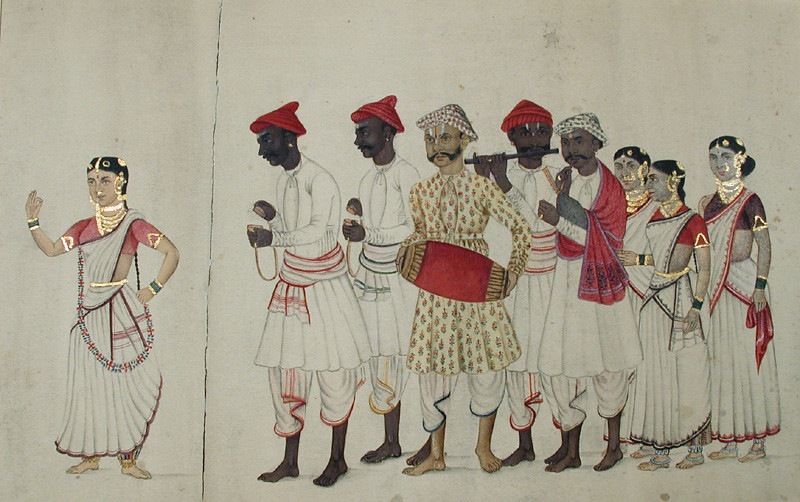
Perhaps it is the nature of miniature painting but for most of the 16th-19th century hairstyles are flat and either depicted loose or plaited (also in company paintings/Kalighat paintings.). As always with Indian hair jewels and flowers are present minimally or in abundance.  In miniature paintings additionally hair is often partially covered with an odhni.

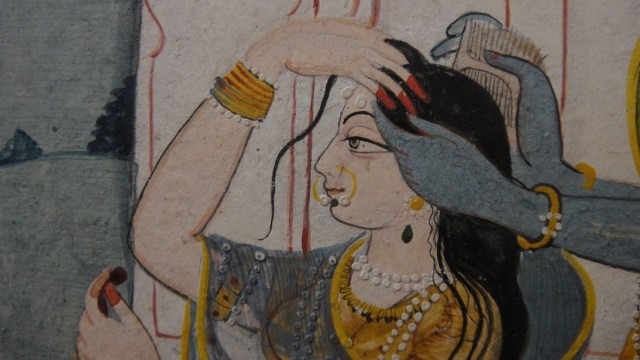
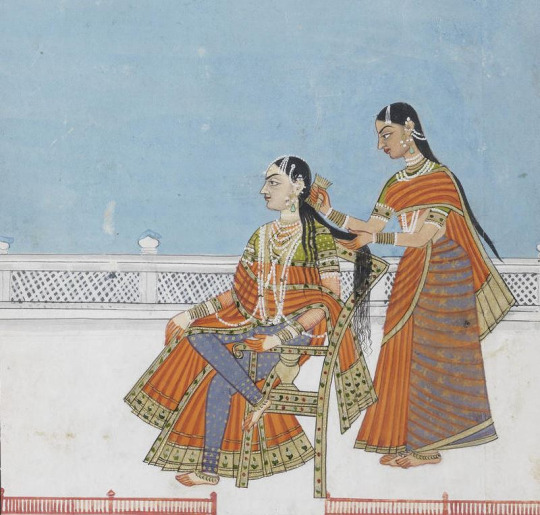
The second painting depicts a nayika whose lover/husband is devoted to her (swadhinabhartruka).  Often paintings depict these nayikas having their foot decorated or having their hair dressed. This can also be seen in sculpture (e.g. Shringhar, Kushan period) but in miniature paintings the nayika and her lover are usually Radha and Krishna.

Pic 1 (Hyderabad, 1840)Pic 2: Kangra, 18th century.

This slideshow requires JavaScript.

simanta (sanskrit): sima + anta – boundary line/hair parting.

The hair parting itself may be a decorative aspect of the Indian hairstyle.  Additionally flowers or jewellery can be arranged along the parting (e.g. mang tikka as in pic 3 where a pendant is added and also substitutes for the bindi).  Apart from the decorative aspect, there are ritual aspects to the hair parting. E.g. the sindoor as a mark of marriage (on Konkona) in some parts of India or the simantonnayana (arranging the parting of the hair) ceremony.  See also X.

In the pics: Sulochana, Konkona Sen Sharma, Sitara Devi.

Their hair shimmered with an intense shine
and gave off a beautiful scent. Virsinghdev Charit, Keshavdas.

The hero was handsome
with oiled, curly hair, on which
fragrant pastes and perfumes
had been rubbed. The Handsome Hero, Kurinjipattu

You didn’t step out without a slather of hair oil, preferably scented, up until the middle of the 20th century in India.  Advertisements of the 40s and 50s promised black, glossy and groomed hair, many products were also strongly scented. Sometimes they made use of new ingredients like the glycerine of pic 3, sometimes they played on Indian tradition.

Pic 2 is for Himani.

1 2A look at hairstyles in a brief window of time: 1930s-1960s.

1930s: MS Subbulakshmi’s naturally wavy hair, a bit of finger wave for Miss Gohar.
1940s: The double choti on Baby Sulochana, perhaps a bit of a perm/roll for Brijmala.
1950s: Plaits and ribbons for Vyjayanthimala, a bit of wave and hairband for Roopmala.
1960s: Asha Parekh in a bun encircled with flowers, Unknown lady in a piled high hairdo.

1And even now, instead of working, I visualise her, a pale silhouette in a sari of blue silk, all interwoven with gold thread. And her hair! The Persians were right, in their poetry, to compare women’s hair to snakes. What will happen? I do not know. Maitreyi, Mircea Eliade.

Though there is many an Indian song dedicated to it, in my view the beauty of unbound tresses is most seen in Bengal (normally seen on younger women, older women tend to tie the hair in a bun or plait). Not the heavily styled and waved kind, just the natural fall and flow of tresses.  Usually it is worn unadorned but Mrinalini and Lotika, the daughters of Manmohan Ghose, have styled it with ribbons as was common in the late 19th/early 20th century. This is probably late 1910s or early 1920s.

Pic Source. See also X, X, X.

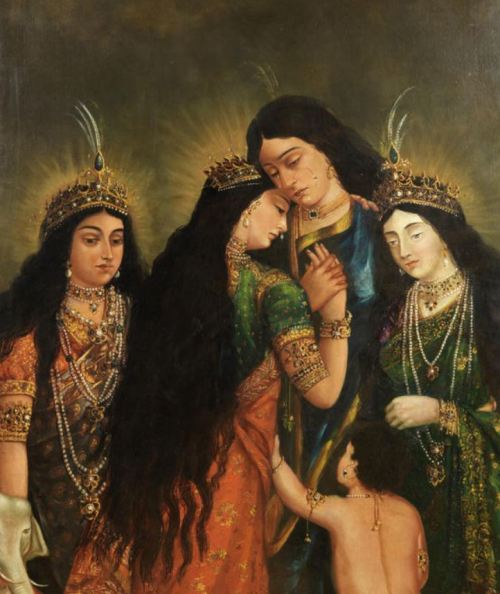
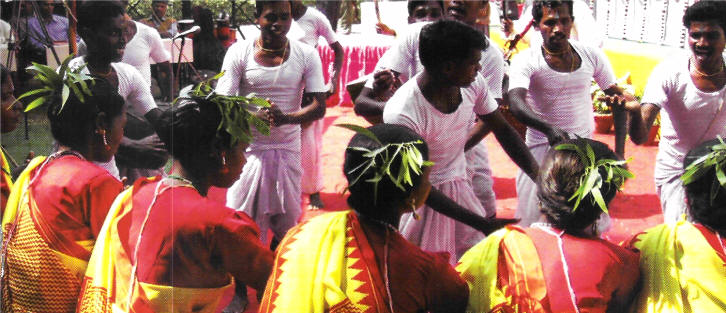
1Some forms of hair decoration (e..g the gajra) predominate in India. Like leaves are sometimes worn as a hair ornament in tribal communities in India (X, X). Flowers with elongated petals that resemble leaves are also worn. The arrangement of flowers of this sort, e.g. palash which is worn in the hair or lotus as in this painting is similar to the sun ray like hair ornaments often seen in vintage photos.

The painting: Charm of the East, AR Chughtai.

For previous posts on hair styles and decoration, see:

The 70s updosIn the 60s; The 60s bun; 1950s Ribbons; The evolution of ribbons; The 1950s hair style guide; The Jabakusum ad; The gajra post; Flowers in the hair; The plait; Nair hairstyles; Medieval Karnataka.
Posted in 1600s, 16th Century, 1700s, 17th century, 1800s, 18th century, 1930s, 1940s, 1950s, 1960s, 19th century, 20th century, Accessories, Ancient India, Art, Asia, Bengal, Bollywood, Colonial, Contemporary Style, Culture, Dance, Dancer, fashion, Flowers, Hair, historical fashions, historical hairstyles, History, indian art, Indian fashion, Indian History, Indian men, Indian Women, Jewellery, Medieval India, miniature paintings, Old Bollywood, Paintings, regional styles, retro, retro hair, Sanskrit Literature, Sculpture, Sets, Tamil, Tumblr, Vintage, vintage hair, vintage jewellery | Tagged , , , , , , , , , , , , , , , , , , , , , , | 5 Comments

The Buddhism Post

I had done this set of posts starting on Buddha Purnima on tumblr but it’s taken me till now to collate it on WP.  In some ways posts are more coherent on WP so despite the delay here it is.  As always it is not definitive but looks at parts of the Buddha’s life via various genres of painting. As for the costumes expect a heavy reliance on Ajanta art.
1The flowers of the flame trees, Which resemble parrots’ beaks, Make the ground resplendent, Like a congregation of monks Prostrate in worship at the feet Of the Buddha. [X]

For 4 May (Buddha Purnima).   Pic: Monks in Singapore. 2Painting at Bellanwila Rajamaha Vihara in Sri Lanka by Somabandu Vidyapathy (the murals were painted between 1990 and 1998). Buddhist temples usually have murals depicting the stages of the life of Buddha – I think this represents the marriage of Siddhartha and Yashodhara. A number of modern murals depicting Buddhist life draw on the costumes seen in Ajanta. 3The Great Departure of Buddha, Tempera on Paper, 1942 ( Manindra-Bhushan Gupta). This painting is evocative of miniature paintings with its detailed landscape and the pavilion with the sleeping Yashodhara and Rahul. The costumes are similar to depictions of Mauryan costumes. 4Yokoyama Taikan works depicting I think Sujata and the temptations of Mara. Again the costumes of the women have a lot of Ajanta/Ajanta as interpreted in the early 20th century influences.  I love the delicacy of this – Taikan visited India at one point and his influence is seen in early Bengal watercolours with a “wash technique”.
See also Roma Mukerji’s Amrapali. 5Yashodhara and Rahul meet the Buddha, circa 1880.  This is probably from a set made by students at the Bombay School of Art who made a number of copies of the Ajanta cave paintings between 1872 and 1885 when J. Griffiths was the Principal. The costumes therefore directly reference Ajanta art.

6[Mara:] That place the sages gain is hard to reach A mere woman can’t get there.

[Soma:] What harm is it to be a woman when the mind is concentrated and the insight is clear. [X]

Thai painting of Dhammadinna Bhikkhuni [X].  For more on women Buddhists see BhikkunisWomen in Buddhist texts. Rengetsu. For a discussion of Himalayan Buddhist Art go here.
Posted in 1880s, 1900s, 1940s, 1990s, Ancient India, Art, art recreation, Asia, Buddhism, Colonial, Costume, Culture, Early 20th Century, East Asia, historical art, historical costume, historical dress, History, Illustration, India, indian art, Indian Dress, Indian History, Indian men, Indian Women, Japan, Late 19th century, Paintings, Philosophy, Religion, Sanskrit Literature, Sari, Sri Lanka, Women | Tagged , , , , , , , , , , , , , , , , , , , , , , , , , | Leave a comment